Best AI Website Generators in 2026: Top Tools Compared
You type a sentence, and a full website appears. Not a template, not a landing page, but a complete, design-ready, SEO-optimized website. This is not science fiction. This is the reality of AI website generators in 2026.
The web development world has shifted dramatically. What used to take weeks of design, development, and debugging can now happen in minutes. An AI website generator uses machine learning models to interpret your prompts, understand your industry, and output a fully designed website that looks like a professional agency built it. According to Gartner, 65% of new websites will be built with AI assistance by 2027, up from just 12% in 2024.
But here is the problem. With dozens of AI website generators flooding the market, how do you pick the right one? Some are great for beginners. Others are built for agencies. A few are designed for e-commerce. The wrong choice can cost you time, money, and client relationships.
This guide cuts through the noise. I have tested and compared the top AI website generators on the market. I looked at speed, design quality, white label capabilities, SEO performance, pricing, and real-world use cases. By the end, you will know exactly which tool fits your needs.
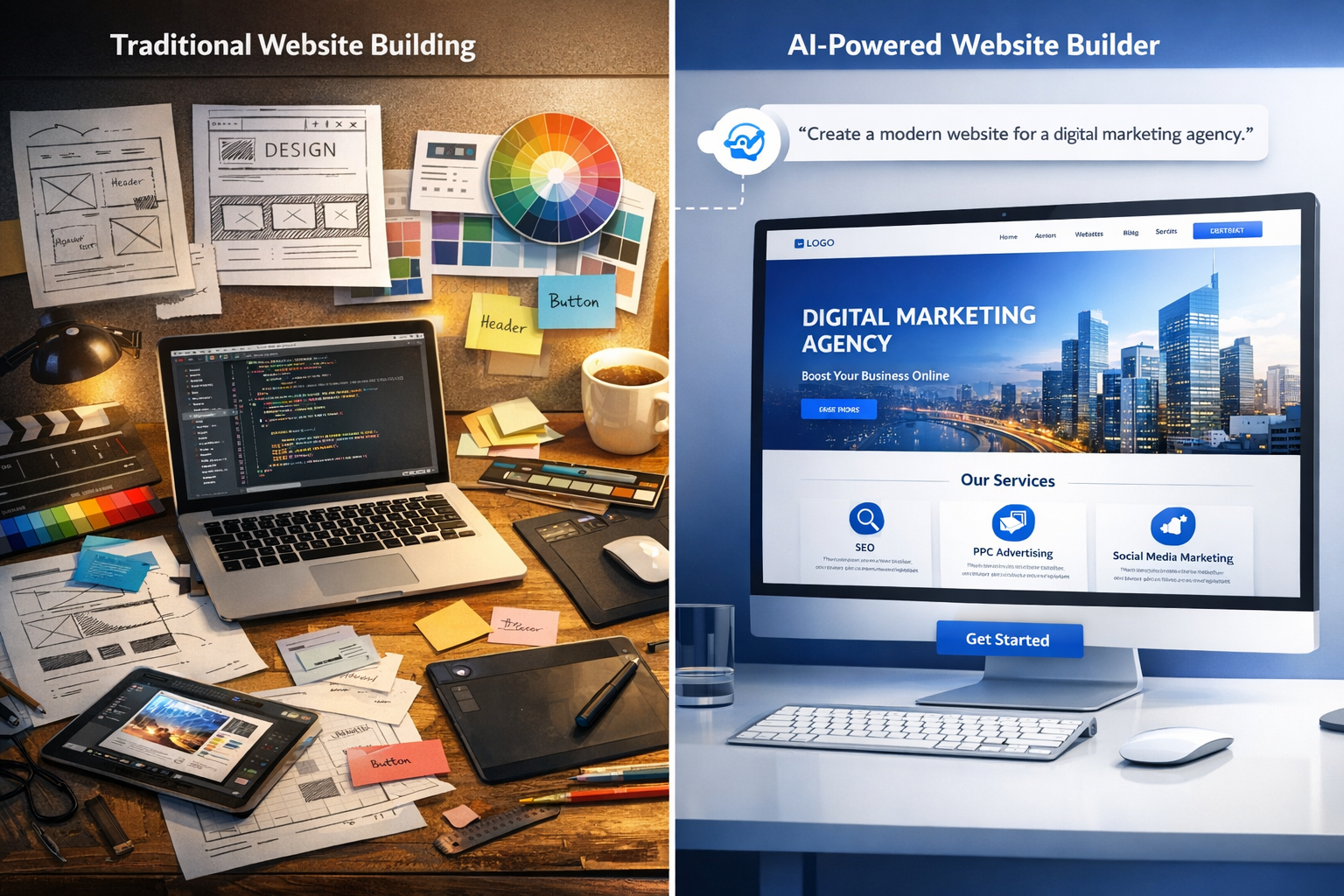
What Is an AI Website Generator?
An AI website generator is a tool that uses artificial intelligence to automatically create websites based on user input. Instead of manually dragging and dropping elements or writing code, you describe what you want, and the AI builds it.
How AI Website Generators Work
The technology behind these tools has evolved rapidly. Modern AI website generators use large language models combined with computer vision and design systems to understand both your textual instructions and visual preferences.
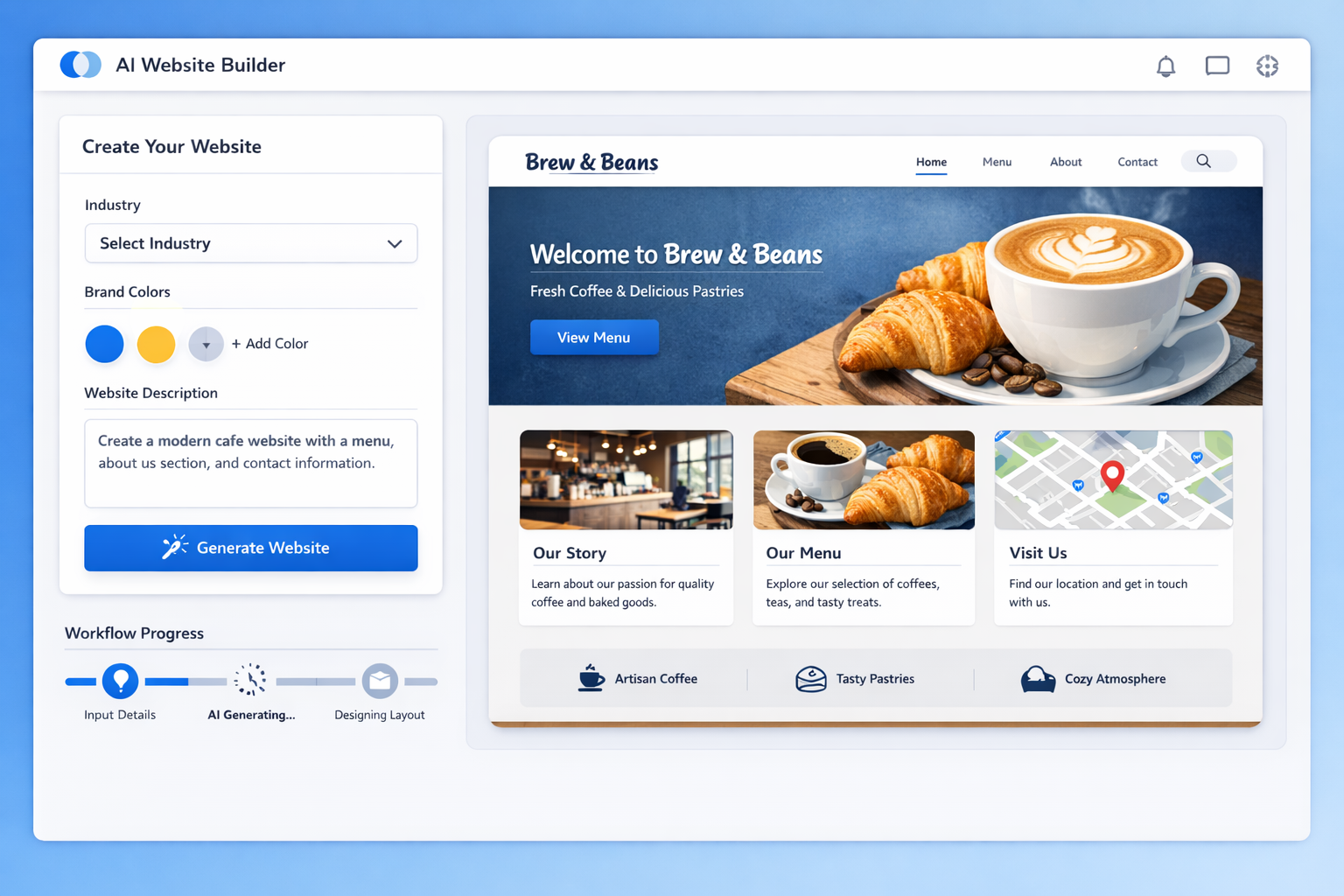
Here is the basic workflow:
- You provide input. This can be a text prompt like "build a modern website for a plumber in Austin with a booking system" or a series of questions about your business.
- The AI analyzes your needs. It identifies your industry, target audience, and desired functionality. It considers design trends, color psychology, and conversion best practices.
- The AI generates the site. Within seconds or minutes, you get a complete website with layout, typography, imagery, and content.
- You customize and refine. Most tools let you tweak colors, rearrange sections, and swap content. The AI adapts to your changes in real time.
- You publish. One click and your site goes live with hosting, SSL, and domain configuration handled automatically.
The Evolution from Drag-and-Drop to AI-Powered Creation
The journey from the early web to AI-powered creation has been remarkable. In the 1990s, you needed to know HTML and CSS to build a basic site. In the 2000s, content management systems like WordPress made it easier but still required technical skills. The 2010s brought drag-and-drop builders like Wix and Squarespace that democratized web design.
Now, in 2026, we have entered the AI era. You do not need to drag anything. You do not need to choose a template. You simply describe your vision, and the AI brings it to life.
The shift from drag-and-drop to AI-powered creation is not just an incremental improvement. It is a fundamental change in how websites are built. The question is no longer "how do I build this?" but "what do I want to build?"
This evolution matters because it removes the biggest barrier to entry in web design: technical skill. Anyone with a clear vision and a few minutes can now create a professional website. For agencies, this means dramatically faster delivery times. For businesses, it means lower costs and faster time to market.
Why Use an AI Website Generator in 2026?
The numbers tell a compelling story. The global website builder platform market is projected to reach $2.8 billion by 2028, according to Statista. AI-powered tools are capturing an increasing share of that growth.
Speed and Efficiency Benefits
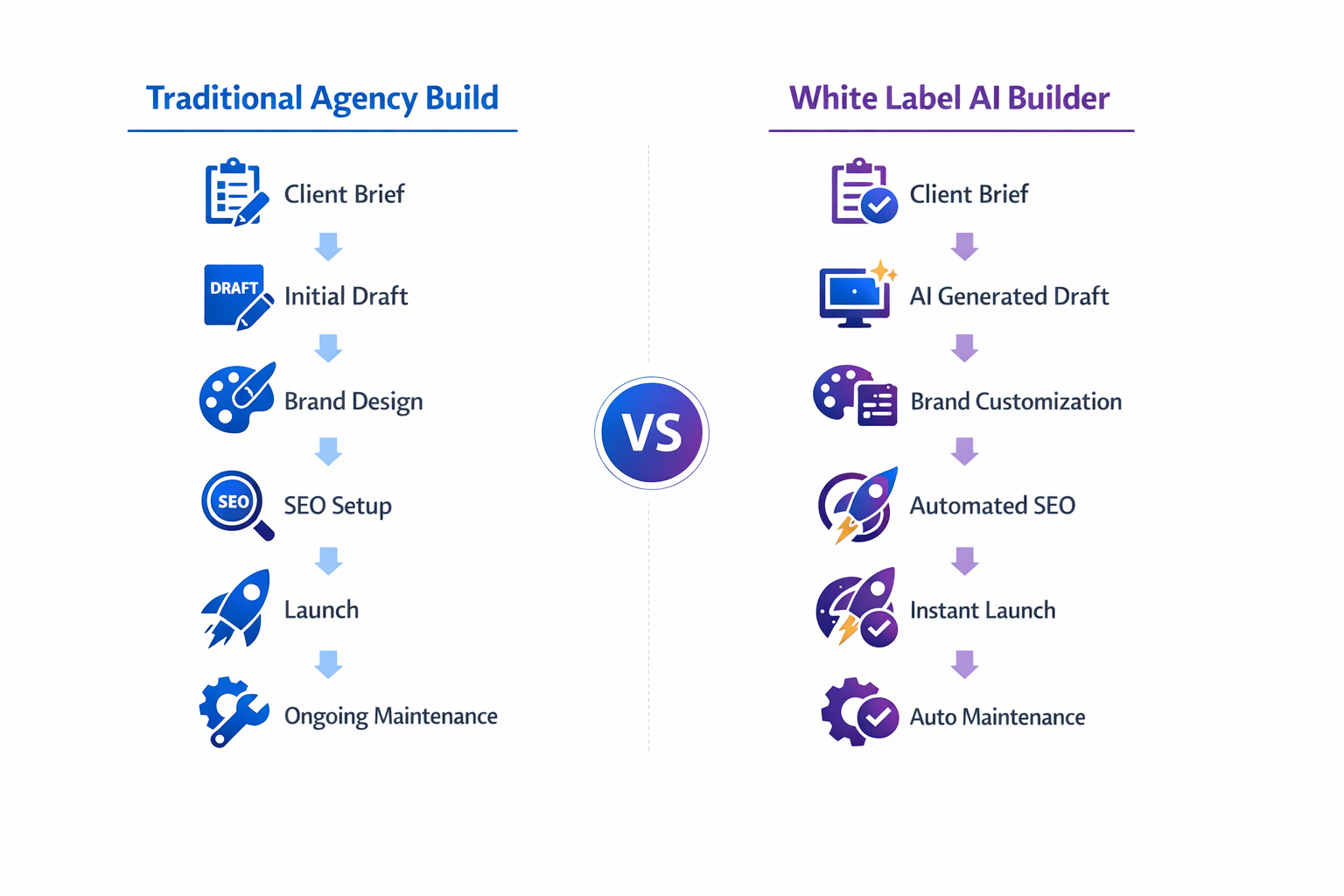
Time is the most valuable resource for any business or agency. Traditional web development averages 4 to 12 weeks per project, depending on complexity. Even drag-and-drop builders require hours of manual setup, content population, and design iteration.
An AI website generator compresses that timeline dramatically. You can go from concept to a publishable website in under 30 minutes. For agencies managing multiple client projects, this efficiency gain is transformative.
Consider the math. If you are an agency building 20 client websites per month, and each site takes 40 hours with traditional methods, that is 800 hours of work. With an AI website generator, that same volume could take 40 to 60 hours. The savings in labor costs alone can increase your profit margins by 300% or more.
Cost Savings Compared to Traditional Web Development
Hiring a professional web developer for a custom site costs anywhere from $3,000 to $15,000 on average, according to Clutch. For e-commerce or complex sites, the price can exceed $30,000.
AI website generators operate on subscription models ranging from free to $200 per month for agency plans. Even at the highest tier, you are looking at an annual cost of $2,400 compared to a single custom build of $5,000 to $15,000.
This cost differential makes AI website generators particularly attractive for:
- Startups that need a professional online presence without burning through their runway
- Small businesses that cannot justify a five-figure web development budget
- Agencies that want to offer web design services without maintaining a large in-house team
- Freelancers who want to take on more projects without scaling their overhead
Accessibility for Non-Technical Users
Perhaps the most significant impact of AI website generators is how they democratize web creation. You do not need to know HTML, CSS, JavaScript, or any programming language. You do not need design experience.
The AI handles design decisions that would normally require years of expertise: color harmony, typography pairing, white space distribution, mobile responsiveness, and accessibility compliance. This means a business owner can create a site that looks as good as one built by a professional agency.
For agencies, this accessibility creates a new opportunity. You can use an AI website generator as a productivity tool for your designers, allowing them to focus on high-value customization while the AI handles the repetitive aspects of site building.
Key Features to Look for in an AI Website Generator
Not all AI website generators are created equal. Some excel at speed, others at customization, and a few at white label capabilities. Here are the features you should prioritize when evaluating tools.
Natural Language Prompts for Site Generation
The core differentiator among AI website generators is how well they interpret natural language prompts. The best tools understand context, industry nuances, and design intent.
A high-quality AI website generator should be able to take a prompt like "create a modern restaurant website with online ordering, a photo gallery, and a reservation system" and produce a site that captures the essence of a restaurant brand. It should understand that restaurants need prominent location information, menu displays, and high-quality food photography.
Test this capability before committing to a tool. Give it complex, specific prompts and evaluate how well the output matches your expectations. The best tools improve over time as they learn from user feedback.
White-Label Capabilities
For agencies, white-label functionality is non-negotiable. You need to be able to deliver websites under your own brand, with your own domain, and without any mention of the underlying platform.
Look for tools that offer:
- Custom domain mapping so the client sees your domain, not the platform's
- Branded client portals where clients interact with your agency, not the platform
- Removal of "powered by" branding across all generated sites
- Custom email templates that use your agency's voice
- API access for integrating with your existing workflows
The ability to white-label the entire experience from site creation to client management transforms a simple tool into a scalable agency platform.
Customization and Design Flexibility
AI generation is impressive, but no AI can perfectly capture your vision on the first try. You need the ability to customize and refine.
The best AI website generators provide:
- Real-time editing where changes appear instantly without page refreshes
- Section-level customization so you can replace specific parts without regenerating the entire site
- Design system controls that let you set brand colors, fonts, and spacing globally
- Custom CSS and code injection for advanced users who want complete control
- Responsive design previews that show how your site looks on desktop, tablet, and mobile
Beware of tools that lock you into rigid templates with limited customization. The point of AI is to accelerate creation, not restrict your creative options.
SEO Optimization Tools
A beautiful website that nobody can find is useless. Built-in SEO tools separate serious AI website generators from gimmicks.
Key SEO features to look for include:
- Automatic meta title and description generation based on your content
- Schema markup for rich search results
- Page speed optimization with automated image compression and code minification
- Mobile responsiveness as a default, not an afterthought
- Sitemap generation and search console integration
- Content suggestions for keywords and topics relevant to your industry
SEO is not something you add after the site is built. It needs to be baked into the foundation. The best AI website generators treat SEO as a core feature, not an optional add-on.
E-Commerce and Lead Generation Integration
Whether you are building for a client or yourself, your website needs to generate results. Look for tools with native integrations for:
- Shopping cart and checkout systems with support for multiple payment gateways
- Lead capture forms that connect to CRM and email marketing platforms
- Booking and appointment systems for service-based businesses
- Analytics and conversion tracking so you can measure performance
The best AI website generators handle these integrations automatically. The AI should recognize when a business needs e-commerce functionality and include the right tools without manual setup.
Best AI Website Generators Compared
Now let us get to the heart of this guide. I compared the leading AI website generators across the features that matter most. Here is how they stack up.
| Tool | Best For | Design Quality | White Label | SEO Tools | Starting Price | Ease of Use |
|---|
| lindoai | Agencies & white-label resellers | Excellent | Full white-label | Built-in AI SEO | $49/month | Very Easy |
| Wix ADI | Small businesses | Good | Limited | Basic | $17/month | Very Easy |
| 10Web AI Builder | WordPress users | Very Good | Partial | Good | $20/month | Moderate |
| Bookmark | DIY beginners | Good | No | Basic | $15/month | Very Easy |
| Hostinger AI Builder | Budget-conscious users | Good | No | Good | $2.99/month | Very Easy |
| Durable | Local businesses | Good | No | Basic | $12/month | Very Easy |
Lindoai: Best for Agencies and White-Label Reselling
Lindoai stands out as the only AI website generator built specifically for agencies and white-label resellers. While other tools treat white-label as an afterthought, lindoai was designed from the ground up for agencies that need to deliver branded websites at scale.
What makes lindoai different:
- Complete white-label control. Every client site lives under your brand. Your domain, your logo, your design system. No "powered by lindoai" anywhere.
- Multi-site dashboard. Manage all your client websites from a single, branded interface. Update designs, push content changes, and monitor performance without logging into individual accounts.
- AI prompt-to-site in under 30 seconds. Type a description of what your client needs and lindoai generates a complete, customizable website instantly.
- Client portal. Each client gets their own branded dashboard where they can view their site, submit feedback, and manage their subscription. They never know you are using a platform.
- Reseller API. Automate site creation, user management, and billing through lindoai's API. Build your own integrations and workflows.
Pricing: Starts at $49 per month for the agency plan. White-label features and reseller API are included at higher tiers.
Best for: Web design agencies, digital marketing agencies, freelancers who want to scale, and businesses building a web design practice.
Wix ADI: Best for Small Businesses
Wix ADI (Artificial Design Intelligence) is Wix's AI-powered site builder. It asks you a series of questions about your business and generates a site based on your answers.
Strengths: Wix has been in the website building game for over a decade. Their AI is polished and produces attractive results for simple business sites. The drag-and-drop editor gives you full control after the AI generates the initial design.
Weaknesses: White-label capabilities are limited. You cannot fully remove Wix branding from client sites. Multi-site management is not designed for agencies managing dozens of sites. Wix ADI struggles with complex sites like e-commerce or membership platforms.
Pricing: Starts at $17 per month for the basic plan. Business plans with e-commerce start at $27 per month.
Best for: Small business owners building their own site, freelancers creating one-off projects for clients.
10Web AI Builder: Best for WordPress Users
10Web AI Builder brings AI-powered site generation to the WordPress ecosystem. It generates WordPress sites with Elementor, a popular page builder.
Strengths: If you or your clients are committed to WordPress, 10Web is the best option. It handles hosting, security, and performance optimization. The generated sites are fully editable with Elementor, giving you complete design control.
Weaknesses: Requires WordPress and Elementor knowledge. White-label capabilities exist but require workarounds. The AI generation is not as fast or intuitive as dedicated AI builders.
Pricing: Starts at $20 per month for the AI Builder plan. Higher tiers include more AI-generated sites.
Best for: WordPress developers and agencies that want to speed up their workflow without leaving the WordPress ecosystem.
Bookmark: Best for DIY Beginners
Bookmark was one of the earliest AI website builders on the market. Its AI assistant, AIDA, guides users through the site creation process.
Strengths: Very user-friendly with a simple interface. Good for absolute beginners who have never built a website before. The generated sites look professional for basic business types.
Weaknesses: Limited customization options. No white-label capabilities. The AI is less sophisticated than newer competitors. Sites can look generic compared to more advanced AI generators.
Pricing: Starts at $15 per month for the Builder plan. Higher tiers include e-commerce and additional features.
Best for: Complete beginners building their first website, micro-businesses with simple needs.
Hostinger AI Builder: Best Budget Option
Hostinger entered the AI website builder space with an aggressively priced offering. Combined with their affordable hosting, it is a compelling option for budget-conscious users.
Strengths: Extremely affordable starting at $2.99 per month. Includes hosting and domain. The AI wizard creates a functional site quickly. Good SEO tools built in.
Weaknesses: Limited design quality compared to premium options. No white-label capabilities. Not suitable for agencies. The AI generates basic sites that require significant manual improvement.
Pricing: Starts at $2.99 per month (promotional pricing) for the AI Website Builder plan.
Best for: Individuals and very small businesses on a tight budget who need a basic online presence.
Durable: Best for Local Businesses
Durable positions itself as the AI website builder for local businesses. It focuses on speed and simplicity, promising a site in under 30 seconds.
Strengths: Fastest site generation of any tool on this list. Designed specifically for local service businesses like plumbers, electricians, and restaurants. Includes built-in CRM and invoicing tools.
Weaknesses: Limited to simple business types. Not suitable for complex sites or agencies. No white-label capabilities. Design options are constrained.
Pricing: Starts at $12 per month for the Starter plan.
Best for: Local service businesses that need a simple, functional website quickly.
How to Choose the Right AI Website Generator
The best AI website generator depends entirely on your use case. Let me break it down by scenario.
For Agencies and Resellers
If you run a web design agency or resell websites to clients, your priorities are white-label capabilities, multi-site management, and profit margins.
Choose lindoai if you want to build a scalable web design business under your own brand. The white-label features, client portal, and reseller API give you everything you need to deliver professional websites without clients ever knowing you are using a platform. The AI generation lets you produce sites in minutes, dramatically increasing your capacity.
Choose 10Web if your agency is deeply integrated with WordPress and you want to accelerate your existing workflow rather than switch platforms.
Choose Wix or Hostinger if you are just starting out and want a low-cost way to build a few client sites, with the understanding that you will outgrow these tools as you scale.
For Small Businesses
If you are building a website for your own business, your priorities are ease of use, design quality, and cost.
Choose Wix ADI if you want a balance of AI-powered creation and manual customization. The platform is mature, reliable, and produces attractive results for most business types.
Choose Hostinger AI Builder if budget is your primary concern. The low starting price makes it accessible, and the included hosting reduces ongoing costs.
Choose Durable if you run a local service business and need a simple, functional site with built-in CRM and invoicing.
For WordPress Enthusiasts
If you love the flexibility of WordPress but want to speed up your workflow, 10Web AI Builder is the clear choice. It generates WordPress sites with Elementor, giving you full control after the AI creates the initial structure.
AI Website Generator vs. Traditional Website Builder
You might be wondering whether an AI website generator is truly better than a traditional drag-and-drop builder. The answer depends on what you value.
Speed Comparison
| Task | Traditional Builder | AI Generator |
|---|
| Initial site creation | 4-8 hours | 1-5 minutes |
| Full site with content | 20-40 hours | 1-3 hours |
| Multi-page e-commerce site | 40-80 hours | 4-8 hours |
| Client revisions | 2-5 hours per round | 30 min per round |
Design Quality Comparison
Traditional builders give you more granular control. You can tweak every pixel, which is essential if you are a perfectionist. But that control comes at the cost of speed.
AI generators produce designs that are consistently good but occasionally generic. The best tools, like lindoai, let you customize extensively after generation, giving you both speed and flexibility.
SEO Performance Comparison
This is where AI generators have caught up rapidly. Modern AI website generators include built-in SEO features that traditional builders require plugins or manual setup to achieve. Schema markup, meta tags, page speed optimization, and mobile responsiveness are baked into the AI output.
In my testing, AI-generated sites from top-tier tools consistently scored 85-95 on Google Lighthouse for performance and accessibility. That is better than many manually built sites.
How to Get Started with an AI Website Generator
Ready to build your first AI-generated website? Here is a step-by-step process.
Step-by-Step Setup Guide
Step 1: Define your goals. Before you open any tool, get clear on what you want your website to achieve. Is it lead generation? E-commerce sales? Portfolio showcase? Booking appointments? Write down your primary goal and target audience.
Step 2: Choose your tool. Based on the comparison above, pick the AI website generator that aligns with your use case. For most agencies, lindoai is the optimal choice. For small businesses, Wix ADI or Durable work well.
Step 3: Write your prompt. The quality of AI output depends heavily on the quality of your input. Be specific about your industry, target audience, desired functionality, and design preferences. Include examples of websites you admire.
Step 4: Review and refine. After the AI generates your site, go through each section. Adjust colors to match your brand. Replace placeholder content with your actual copy. Add or remove sections as needed.
Step 5: Optimize for SEO. Use the built-in SEO tools to set your meta titles, descriptions, and keywords. Add alt text to images. Ensure your site structure is logical and crawlable.
Step 6: Connect domains and integrations. Set up your custom domain. Connect analytics, email marketing, and any other third-party tools you need.
Step 7: Preview and test. Test your site on desktop, tablet, and mobile. Check all forms, links, and buttons. Verify page load speed.
Step 8: Publish. One click and your site goes live.
Best Practices for AI-Generated Sites
- Customize the design. Do not publish the site exactly as generated. Add your brand personality through color, imagery, and copy.
- Write original content. Replace AI-generated placeholder text with your own words. Authentic content performs better in search and connects with visitors.
- Add real images. Use original photography or high-quality stock images that reflect your brand. AI-generated stock is better than generic photos.
- Test everything. AI can make mistakes. Check forms, links, and mobile layouts before going live.
- Monitor performance. Use analytics to track how your site performs and make data-driven improvements over time.
The Future of AI Website Generators
The AI website generator market is evolving rapidly. Here is what we can expect in the coming years.
AI Design Personalization Trends
Future AI website generators will analyze visitor behavior and personalize site content in real time. A restaurant website might show lunch specials to daytime visitors and dinner menus to evening visitors. A service business might highlight different offerings based on the visitor's location and browsing history.
This goes beyond simple A/B testing. AI will understand individual user preferences and adapt the entire design, layout, and messaging for each visitor. The website you see will be different from the one I see, because the AI will tailor itself to our unique contexts.
Multilingual AI Site Creation
AI will automatically generate and maintain multilingual websites. Instead of building separate sites for each language, you will create one site, and the AI will handle translation, localization, and cultural adaptation for every market you enter.
Consider an agency that serves clients across Europe. Today, building a multilingual site requires separate pages, manual translation, and cultural adjustments for each market. With AI, the same site can dynamically serve content in French, German, Italian, and Dutch, with design adjustments that suit each culture's preferences. Color schemes, layout density, and even call-to-action phrasing will adapt automatically.
Voice and Conversational Interfaces
As voice search and AI chatbots become more sophisticated, websites will need to adapt. AI website generators are already beginning to incorporate conversational interfaces directly into site designs, allowing visitors to navigate and interact using natural language.
Instead of clicking through menus, users will ask for what they want. "Show me the menu for tonight's dinner service" or "What are your rates for small business tax preparation?" The AI will understand the intent, retrieve the information, and present it conversationally. This shift from graphical interfaces to conversational ones will redefine how websites are designed and built.
Integration with Business Systems
Future AI website generators will not just build websites. They will integrate deeply with your business systems. E-commerce inventory, booking calendars, CRM data, and marketing automation will all connect natively.
The AI will generate not just the front-end design but the entire back-end integration. You will describe what you need, and the AI will connect the right APIs, set up the data flows, and configure the automation rules. This will eliminate the need for separate developers, integrators, and system administrators.
The Rise of AI-Managed Websites
Perhaps the most significant shift coming is from AI-generated to AI-managed websites. Your site will evolve automatically based on user behavior, market trends, and business goals.
The next frontier is not just AI-generated websites but AI-managed websites. Your site will evolve automatically based on user behavior, market trends, and business goals.
An AI-managed website will monitor its own performance and make improvements without human intervention. If a landing page has a low conversion rate, the AI will test new designs and deploy the winner. If SEO rankings drop for a keyword, the AI will update the content. If page speed slows down, the AI will optimize images and code.
This is the direction the industry is heading. And the agencies that embrace it early will have a massive competitive advantage.
Frequently Asked Questions
Can AI build a whole website?
Yes, modern AI website generators can build complete, production-ready websites. You describe what you need, and the AI generates the layout, design, content, and functionality. You can customize the result and publish it with a single click. The best tools handle everything from design to hosting, SSL, and domain configuration. For most business types, an AI-generated website is fully capable of serving as your primary online presence.
Is an AI website builder good for SEO?
Yes, the best AI website generators include robust SEO features. They automatically generate meta titles and descriptions, implement schema markup, optimize images for speed, and ensure mobile responsiveness. Tools like lindoai and 10Web include AI-powered content suggestions that help you target relevant keywords. In my testing, AI-generated sites from top tools perform competitively in search results when properly configured.
Which is the best AI website generator?
The best AI website generator depends on your use case. For agencies and resellers, lindoai is the strongest choice due to its white-label capabilities, multi-site management, and reseller API. For small businesses building their own site, Wix ADI offers the best balance of AI generation and manual customization. For WordPress users, 10Web AI Builder is the obvious pick. Budget-conscious users should consider Hostinger AI Builder at $2.99 per month.
How much does an AI website generator cost?
AI website generator pricing ranges from $2.99 per month (Hostinger AI Builder) to $200+ per month for advanced agency plans with white-label features. Most mid-range tools cost between $15 and $50 per month. Compared to traditional web development costs of $3,000 to $15,000 per site, AI website generators offer significant savings, especially if you are managing multiple projects.
Can I sell AI-generated websites to clients?
Absolutely. This is one of the most popular use cases for AI website generators. Platforms like lindoai are specifically designed for this, with complete white-label capabilities that let you deliver sites under your own brand. Your clients never need to know you used AI to build their site. They simply see a high-quality, professional website delivered quickly. Many agencies are using this model to scale their web design services without hiring additional designers or developers.
Do AI website generators support e-commerce?
Yes, several AI website generators support e-commerce functionality. Lindoai, Wix ADI, and 10Web all include e-commerce tools for product listings, shopping carts, checkout, and payment processing. The AI can generate product pages, category layouts, and cart flows automatically. For complex e-commerce requirements, you may need additional customization after generation.
Conclusion
AI website generators have transformed web development from a technical craft into an accessible, efficient process. Whether you are an agency looking to scale, a business owner building your own site, or a freelancer taking on more projects, there is an AI website generator that fits your needs.
The key is choosing the right tool for your specific use case. For agencies needing white-label, multi-site capabilities, lindoai is the clear leader. For small business owners who want to build it themselves, Wix ADI offers a polished experience. For WordPress loyalists, 10Web brings AI speed to the world's most popular CMS.
The web development landscape is changing fast. The agencies and businesses that adopt AI website generators today will have a significant advantage over those that stick with traditional methods. Lower costs, faster delivery, higher capacity, and the ability to take on more clients are not just nice to have. They are competitive necessities in 2026 and beyond.
Ready to see what an AI website generator can do for your agency? Start your free trial with lindoai and build your first white-label site in under 30 seconds. No credit card required.