White Label Website Builder: How to Start Your Reseller Agency in 2026
There's a quiet revolution happening in web design. Agencies are no longer building every website from scratch, hiring armies of designers and developers, or sweating over every line of code. Instead, a growing number of smart operators are using a white label website builder to deliver professional sites under their own brand, without building anything from zero.
The model is simple: you find clients, you sell them websites, and a white label platform does the heavy lifting behind the scenes. Your clients see your brand, your dashboard, and your service. They never know the platform exists.
If that sounds like a business you could run, you're right, and this guide shows you exactly how. We'll cover what white label actually means, why the economics work, how to choose a platform, and the step-by-step process for launching and scaling your own reseller agency.
What Is a White Label Website Builder?
Let's start with the fundamentals, because the term gets thrown around loosely.
Definition and How White Labeling Works
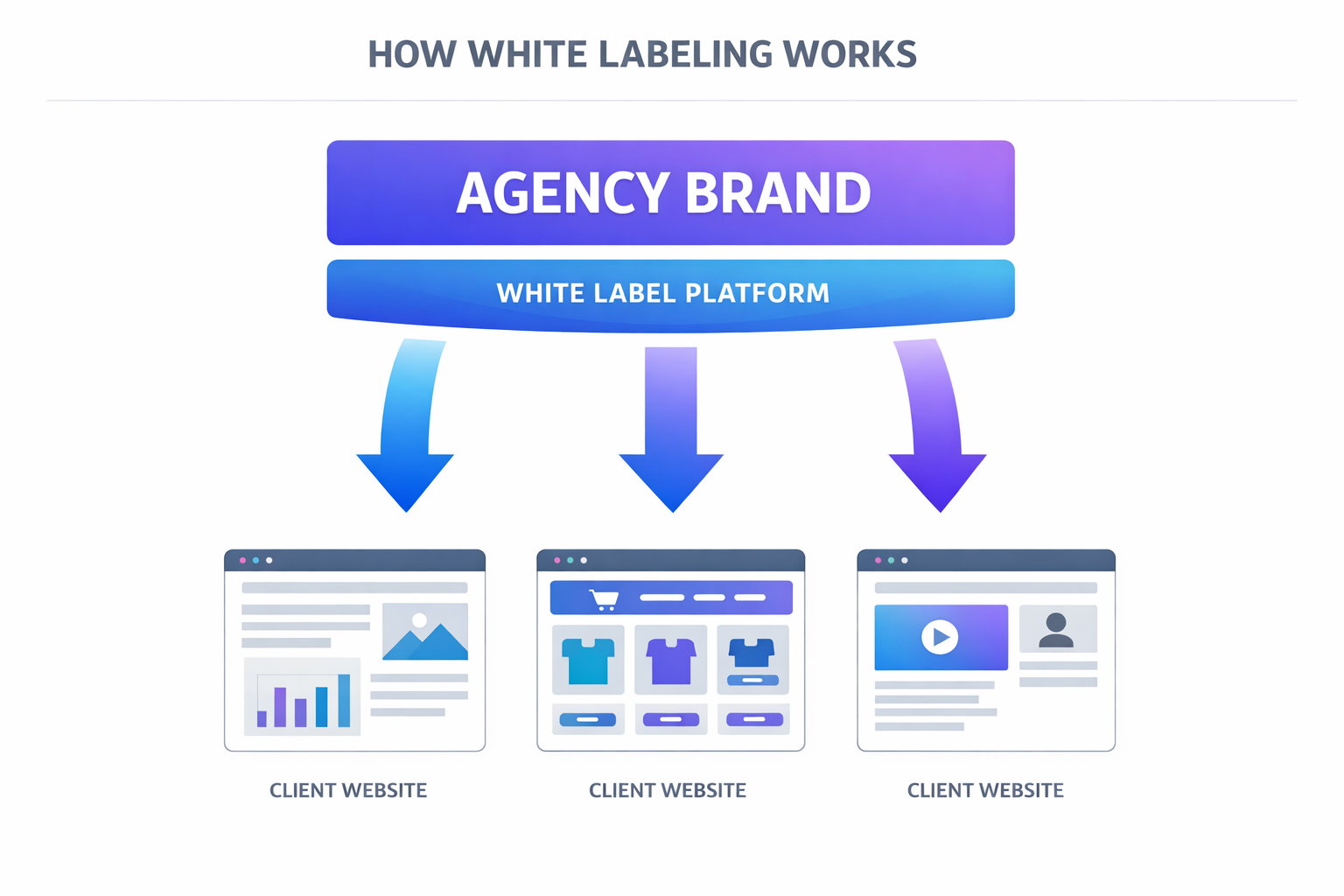
A white label website builder is a platform that lets you create and manage websites for clients under your own brand. You subscribe to the platform, and in exchange you get the tools to build sites, plus the right to present the entire experience as your own product.
The mechanics are straightforward. You sign up, upload your logo and brand colors, and the platform's dashboard, client emails, and delivered sites all carry your branding. When a client visits their project workspace, they see your agency's name, not the platform's.
The white label model comes from manufacturing. A factory produces a product, and a retailer sells it under its own label. The retailer doesn't need to own a factory; they need to own the customer relationship. White label website builders bring that same logic to web design.
How White Label Differs from Traditional Web Design
Traditional web design means building a site from scratch for each client. You design, you code (or direct a developer), you test, you launch, and you maintain. Every project is a new production run.
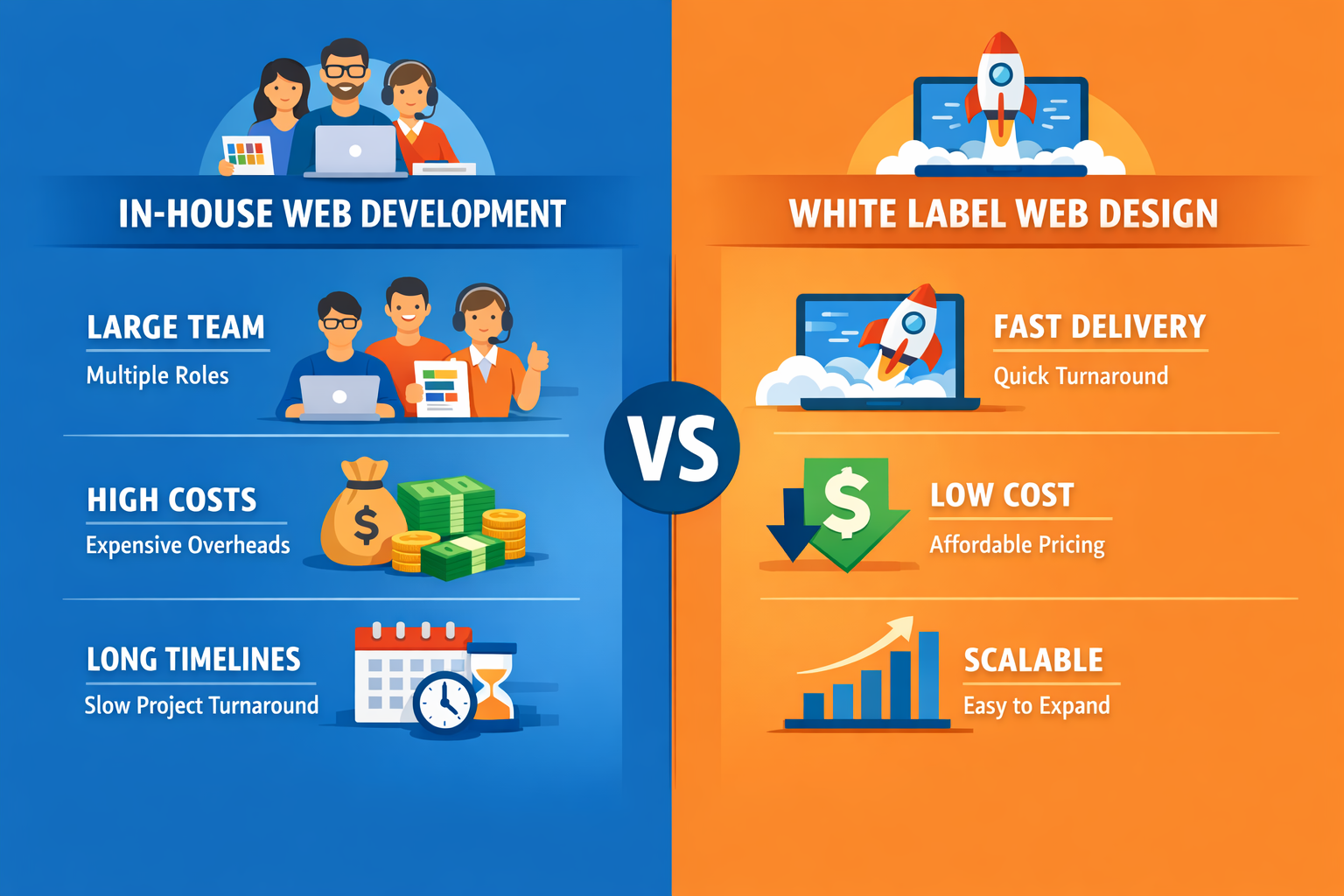
White label flips the economics. The platform provides the production capability, and you provide the client relationship, the strategy, and the service layer. Instead of spending weeks producing each site, you spend hours customizing a strong base.
The difference isn't just speed; it's the shape of your business. A traditional agency's capacity is capped by its team's hours. A white label reseller's capacity is capped by how many clients it can sell to, because production scales almost for free.
The Economics: Why Agencies Use White Label Solutions
The numbers explain the appeal. Building a small business website traditionally involves 20 to 40 hours of design and development work. At agency rates, that's thousands of dollars in labor per site.
A white label approach cuts production time dramatically, especially with AI-assisted builders. A site that took a week can be ready in a day, and the cost per site drops to a platform subscription that's a fraction of what you charge clients.
The margin math is the real story. Charge a client $3,000 for a website, and traditional production might eat $1,500 to $2,000 of that in labor. With white label, your production cost might be $100 to $300 in platform costs and a few hours of your time. The same project that left a traditional agency with a thin margin leaves a white label reseller with a thick one.
The white label model doesn't just save you time; it changes your margin structure. When production costs drop and your prices stay the same, the difference falls straight to your bottom line.
That's why agencies adopt white label. It's not about cutting corners on quality. It's about removing the production bottleneck that limits every traditional agency.
Who Is White Label For?
It helps to be honest about who thrives in this model. White label reselling suits people who are strong at sales, client communication, and project management, and who want to run a business without becoming production staff.
It suits freelancers who want to stop trading hours for dollars. It suits marketers who keep being asked "can you also do websites?" and want to say yes profitably. It suits business-minded people who see the demand for websites in their local market and want a piece of it.
It's less suited to people who love the craft of design and want to spend their days building. If you're a designer at heart, white label will feel like outsourcing your favorite part of the job. For everyone else, it's an opportunity.
Why Start a Web Design Agency with White Label?
If you've ever wanted to run your own agency but felt blocked by the skills, team, or capital required, white label removes most of those barriers.
Low Startup Costs
A traditional agency needs designers, developers, project managers, and often an office. That's a heavy upfront investment, easily $10,000 to $50,000 just to get started properly.
A white label reseller starts with a platform subscription, often $50 to $300 per month, plus the cost of your domain, email, and basic marketing. You can launch a legitimate, professional web design business for a few hundred dollars.
That low barrier changes who can play. Freelancers, marketers, virtual assistants, and business-minded people with zero design skills can all run a web design agency.
Scale Faster Without Hiring
Growth in a traditional agency means hiring. More clients, more projects, more designers, more overhead. Hiring is slow, expensive, and risky.
With white label, you scale by selling more. The platform handles the production, so your team size doesn't need to grow with your client count. You can go from 5 clients to 50 clients without adding a single designer.
Recurring Revenue Potential
The best agencies don't just build websites; they own them. A monthly maintenance retainer, typically $50 to $500 per site per month, turns one-time projects into recurring revenue.
White label platforms support this model naturally. You keep managing client sites through your branded dashboard, charging a monthly fee for hosting, updates, and support. Over time, that recurring revenue becomes the most valuable part of your business.
Focus on Sales and Client Management
Here's the liberating part: your job becomes sales and relationships, not production. If you're someone who's good with people, good at selling, and good at managing expectations, you're already qualified.
The platform handles the technical side. You handle the side that actually drives revenue: finding clients, closing deals, and keeping them happy.
This shift also changes your day-to-day. Instead of staring at code or design tools, you're having conversations, writing proposals, and building relationships. For many people, that's not a compromise; it's the reason they wanted to run a business in the first place. And because production is fast, you can turn a sales conversation into a delivered project in days, which is deeply satisfying for both you and the client.
How a White Label Website Builder Works
Understanding the day-to-day operation helps you decide if the model fits you. Here's how the pieces come together.
The Dashboard: Managing Multiple Client Sites
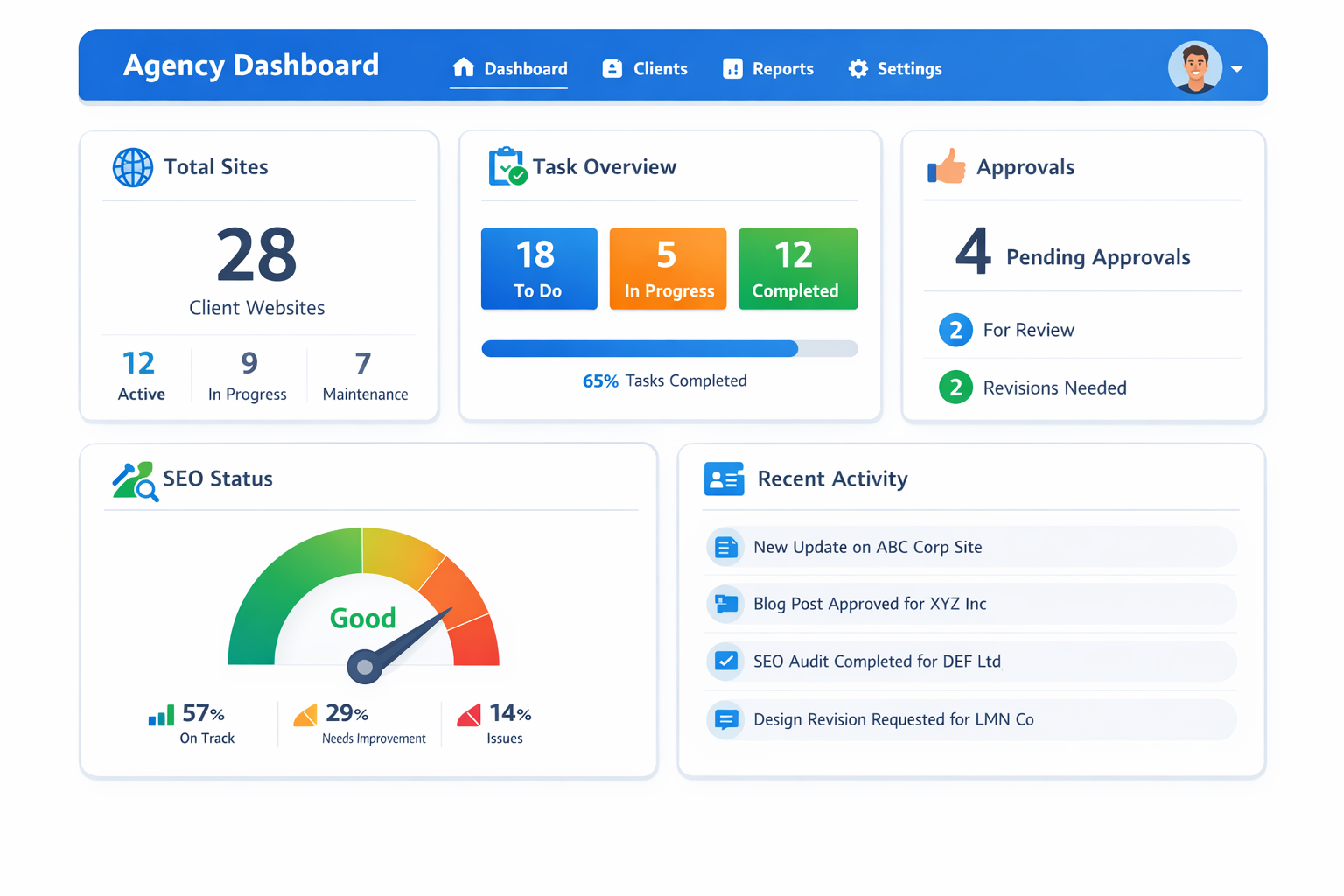
Your white label platform gives you a central dashboard for every client site. You can see all projects at a glance, track their status, and jump into any site to make changes.
This is where the multi-client capability shows its value. A consumer builder is built for one site; a white label platform is built for many. You get workspaces per client, permission controls, and a clean overview that keeps a busy agency organized.
Custom Branding: Your Logo, Your Domain
The branding layer is what makes the model work. You upload your logo, choose your colors, and the entire client-facing experience reflects your agency.
That includes the client's website preview, the handoff interface, and even the domain the site lives on. Everything a client sees carries your brand, which builds trust and makes your service feel like a proprietary product.
Client Handoff Process
When a project is done, handoff should be clean. The client gets access to their site under your brand, with your support contact and your billing relationship. If they need changes, they come back to you.
That ownership of the client relationship is the whole point. The platform is invisible, and you're the face of the service. Clients who are happy with their site stay with you, which feeds your recurring revenue.
A clean handoff also includes a short orientation: show the client how to request changes, explain what's covered by their maintenance plan, and set expectations for response times. Clients who understand the process make better clients. They request changes through the right channel, they don't panic over minor updates, and they renew their plans without friction.
Why Clients Prefer the White Label Experience
It's worth noting that white label isn't just good for you; it's good for clients too. Most small business owners don't care which platform their site runs on. They care that their agency is responsive, that the site looks professional, and that someone picks up the phone when something breaks.
A single, consistent brand experience feels more reliable than a jumble of third-party tools. When your client sees one logo, one dashboard, and one support contact, they feel like they're dealing with a serious company. That perception is worth real money, because it's what justifies premium pricing and long retainers.
Choosing the Best White Label Website Builder
Not every platform delivers the same white label experience. Here's what to evaluate before you commit.
Must-Have Features for Resellers
- Deep white labeling: logo, colors, dashboard, emails, and domains all branded as yours
- Multi-site management: a dashboard for all client projects, with per-client workspaces
- Client permissions: invite clients to review and comment without giving them the keys
- Recurring billing support: tools that match how you charge monthly retainers
- Reliable infrastructure: hosting, security, and updates handled by the platform
Reliability and Support
When you're selling websites under your own name, reliability is non-negotiable. Your platform is your infrastructure: if it goes down, your clients blame you. Look for platforms with strong uptime records, managed hosting, and automatic backups.
Also consider the support you'll receive as a reseller. When you have a problem at 6 PM before a client demo, you need answers fast. Platforms with responsive support for agency accounts are worth a premium over cheaper options with slow ticket queues.
AI Assistance
Modern platforms generate site drafts from briefs, cutting your production time further. The AI handles the initial structure, copy, and design, and you handle the customization. For a reseller, this is the difference between delivering in a week and delivering in a day.
The AI quality varies by platform, so test it before committing. Generate a site for a typical client and judge the copy quality and design variety. A platform whose AI produces generic results will make your client sites feel generic, which is exactly what you don't want under your own brand.
Pricing Models: Per-Site, Subscriptions, Commissions
Platforms price white label access differently. Some charge a flat subscription for unlimited sites. Others charge per site, which scales with your volume. A few take a commission on what you bill.
The right model depends on your volume. Low-volume resellers prefer flat subscriptions. High-volume agencies often prefer per-site pricing that keeps unit costs low. Run the math on your projected client count before choosing.
lindoai White Label vs. Competitors
The main alternatives are Duda, Wix Studio, and Dorik, all of which offer white label features. They're mature platforms with solid client management.
Where lindoai differentiates is the AI-first approach. Sites are generated from a client brief in minutes, which cuts production time further than traditional white label builders. That speed advantage is exactly what a reseller wants, because your cost per site depends on how fast you deliver.
| Feature | lindoai | Duda | Wix Studio | Dorik |
|---|
| AI site generation | Yes, full | Basic | Basic | Basic |
| Deep white label | Yes | Yes | Yes | Yes |
| Client dashboard branding | Yes | Yes | Partial | Yes |
| Per-site pricing | Yes | Yes | Yes | Yes |
| Reseller focus | Core model | Strong | Good | Good |
Step 1: Set Up Your White Label Account
Enough theory; let's build your agency. The first step is getting your platform configured.
Registration and Onboarding
Sign up for your chosen platform and complete the onboarding. Most platforms walk you through the initial setup, including connecting your domain and configuring your workspace.
Take this step seriously. Your account setup determines what clients experience, so configure it as if you were launching a real product, because you are.
Uploading Your Branding
Upload your logo, set your brand colors, and configure your fonts. If you don't have a logo yet, a simple, professional one from a tool like Canva is fine to start.
Also set your agency name, support email, and any legal details. Every piece of branding you configure now is one less thing clients see from the platform later.
Setting Pricing for Your Clients
Before you sell anything, decide what you'll charge. Research local market rates for the type of sites you'll deliver, then set your packages. We'll cover pricing in depth in Step 3, but decide your headline numbers now so you're ready to quote.
Step 2: Build Your First Client Website
With your account ready, it's time to produce your first site. This is where AI-assisted building changes everything.
Using AI to Generate a Client Site
Enter the client's business details into the platform's AI generator: their industry, services, goals, and any brand preferences. The AI produces a complete site draft, including structure, copy, and design.
This draft is your starting point. For a typical small business site, it gets you 80% of the way in minutes. Your job now is the final 20% that makes it feel custom.
The more detailed your input, the better the output. Include the client's actual services, their differentiators, their location, and the tone they want. If the client has examples of sites they like, describe what you admire about them. This context turns a generic AI draft into a page that genuinely reflects the client's business.
Customizing for Client Branding
Apply the client's logo, colors, and imagery. Rewrite the copy in their voice, add their real contact details, and adjust sections to match their services.
This is where your value lives. The AI provides the skeleton, and you provide the judgment: what to keep, what to change, and what the client actually needs.
Pay particular attention to the details that signal quality: real photos instead of stock placeholders, accurate service descriptions, a working contact form, and a fast mobile experience. Clients notice these details even when they can't articulate them, and they're what separate a professional deliverable from a template dump.
Demo Walkthrough
Once the site is built, walk through it as a client would. Click every link, test the forms, check mobile, and verify the copy. Then present it to the client for feedback.
A smooth demo builds trust fast. When a client sees a polished, branded site within days of the kickoff call, they're impressed, and impressed clients pay and refer.
Step 3: Pricing Your White Label Services
Pricing is where resellers either build a real business or undercut themselves into burnout. Here's how to get it right.
How to Price Web Design Packages
Price by value, not by hours. A client cares about the outcome, a website that brings them customers, not about how long it took. Package your services so the price reflects the result.
The Clutch research on web design pricing shows small business sites commonly range from $2,500 to $10,000, depending on scope and market. Even at the lower end, your margins are strong when production costs are a platform subscription.
One-Time Build Fees vs. Recurring Maintenance
Two revenue streams should be in your model. The one-time build fee covers the initial site. The recurring maintenance fee covers hosting, updates, support, and content changes.
The maintenance retainer is the more valuable stream over time. A client paying $100 per month for maintenance generates $1,200 per year of recurring revenue. Ten such clients, and you've built a stable monthly income that doesn't depend on new sales.
Example Pricing Tiers
- Starter Site: $1,500 one-time + $50/month for a 5-page brochure site for a small local business
- Business Site: $3,000 one-time + $100/month for 8-10 pages, blog, SEO basics, and contact forms
- Premium Site: $5,000+ one-time + $200/month for e-commerce or advanced features with priority support
These numbers are a starting point; adjust for your market. The key is that every tier includes a recurring component, so your business compounds.
Step 4: Finding and Closing Clients
A great production setup means nothing without clients. This is the step most resellers underestimate.
Identifying Your Target Market
Don't try to sell to everyone. Pick a niche: local restaurants, dental clinics, real estate agents, fitness studios, tradespeople. A focused niche makes your marketing sharper and your pitch more relevant.
Your local market is a natural starting point. Businesses near you are easy to reach, easy to meet, and often underserved by web design options.
Once you pick a niche, learn its language. A dental clinic cares about patient bookings and trust. A restaurant cares about menus, reservations, and appetizing photos. When your pitch speaks the client's language, you stop sounding like a generic web designer and start sounding like an expert in their industry.
The Outreach Playbook
The most reliable way to find your first clients is direct outreach. Build a list of 50 businesses in your niche, then contact them with a specific, helpful message.
A good outreach message mentions something real about their business, points out a specific improvement opportunity, and offers a concrete next step, like a free site audit or a sample mockup. Avoid the generic "we build websites, are you interested?" email that gets deleted in seconds.
Follow up consistently. Most sales happen after multiple touches, so plan to follow up several times over a few weeks. It feels awkward at first, and it's exactly what separates resellers with clients from resellers with good intentions.
Building a Portfolio with Sample Sites
You need proof of work before your first paying client. Build sample sites for fictional businesses in your niche: a mock bakery, a mock law firm, a mock gym. This portfolio shows prospects exactly what they'll get.
These samples also let you practice your production workflow, so by the time a real client arrives, you can deliver fast and confidently.
Sales Scripts and Proposals
Prepare a simple pitch: identify the problem (your site is costing you customers), present the solution (a professional site, fast), and handle the objection (price, time, trust). HubSpot's sales resources are a great free library for sharpening your approach.
Keep proposals simple: what they get, when they get it, what it costs, and what happens next. A clear proposal closes more deals than a fancy one.
Scaling Your White Label Agency
Once you have paying clients and a working process, it's time to think bigger.
Hiring Salespeople and Support
When you're doing everything yourself, your growth is capped by your hours. The first hire for most resellers is a salesperson on commission: they bring in clients, and you deliver.
Support is the second hire. Once you have enough maintenance clients, answering their requests becomes a job. A part-time assistant who handles routine updates frees you for sales and strategy.
Automating Client Onboarding
Every new client should go through the same smooth process: kickoff questionnaire, proposal, contract, deposit, build, review, launch. Automate the repetitive parts with templates, forms, and checklists.
Good onboarding sets expectations and prevents the scope creep that kills agency margins. Clients who know exactly what happens next are happier clients.
Build your template kit once and reuse it forever: a kickoff questionnaire that captures everything the AI needs, a proposal template you can adapt in minutes, a simple contract, and a launch checklist. The time you invest in templates pays back on every single client after the first.
Expanding Services: SEO, Hosting, Maintenance
Your client sites are a platform for more services. SEO packages, content writing, ads management, and hosting are natural upsells.
Forbes coverage of small business trends regularly highlights how service businesses grow by expanding their offering. Your white label agency can do the same: the website is the entry point, and the ongoing services are where the real revenue builds.
A practical expansion path: start with websites and maintenance, add SEO once you have a few clients, add content writing when demand appears, and consider ads management as clients ask for it. Each new service increases your revenue per client without requiring new infrastructure, because the platform and your workflow already exist.
The smartest white label resellers treat the website as the front door. The long-term money is in the recurring services that come after launch.
Case Study: A Successful White Label Agency Example
Let's make this concrete with a realistic example of how the model plays out.
Real-World Numbers
Sarah starts a white label web design agency part-time. Her setup costs: $150/month for her platform subscription, $50/month for domains and email, and a few hundred dollars for a logo and basic marketing.
In month one, she sells two Starter packages at $1,500 each, earning $3,000 against costs of a few hundred dollars. In month two, she adds a Business package at $3,000. By month six, she has 12 maintenance clients at an average $100/month, adding $1,200 in recurring revenue on top of new builds.
By month twelve, her numbers look like this: 18 sites delivered, $40,000+ in build revenue, and $1,500+ per month in recurring maintenance. She's replaced a full-time salary working part-time hours, with no designers on payroll.
Lessons Learned
- Start narrow: her early focus on one niche made selling much easier
- Package recurring revenue from day one: the maintenance stream is what made it a business
- Protect your time: sample sites and templates kept production to a few hours per client
- Deliver fast: her 5-day turnaround beat every local competitor
FAQ About White Label Website Building for Resellers
What is a white label website builder?
A white label website builder is a platform that lets you create and manage client websites under your own brand. You subscribe to the platform, and everything the client sees, the dashboard, the emails, the delivered sites, carries your branding instead of the platform's.
How much does a white label website builder cost?
Most white label platforms cost between $50 and $300 per month, depending on the number of sites and features. Some charge per site rather than a flat subscription. lindoai's pricing page shows the current plans for resellers and agencies.
Can I make money reselling white label websites?
Yes. Resellers typically charge $1,500 to $10,000 per site while paying a fraction of that in platform costs, plus recurring maintenance fees of $50 to $500 per month per client. The model is proven, and the low startup cost means the risk is small.
Do I need design skills to use a white label builder?
No. The platform handles design and production, and AI-assisted builders generate complete site drafts from a client brief. Your job is sales, client management, and customization. Design judgment helps, but you don't need to be a designer.
What features should I look for in a white label website builder?
Prioritize deep white labeling (dashboard, emails, domains), multi-site management, client permissions, recurring billing support, and reliable hosting. If you want speed, look for AI-assisted site generation, which cuts production time dramatically. Explore lindoai's features to see how these come together.
Start Your White Label Agency Today
The web design market is huge, and most businesses still need websites or better ones. The white label model lets you serve that market without the traditional barriers: no design team required, no heavy startup capital, and no production bottleneck limiting your growth.
The path is clear: choose a platform, set up your branding, build sample sites, price your services with recurring revenue built in, and start selling. Every step is within reach, and the first client is closer than you think.
If you're ready to get started, explore lindoai's white label solution and see how fast you can launch your own branded web design agency.