
Let’s be honest, most agencies do not need more leads. They need more delivery capacity.
If you are getting inquiries, closing work, or you have a strong niche, the bottleneck is usually the same: design and build bandwidth. That is exactly why the web design reseller model is having a moment in 2026.
A web design reseller program lets you sell websites under your brand, without building everything yourself. Done right, it is a clean way to protect your time, expand your offer, and add recurring revenue through ongoing website management.
In this guide, I will walk you through what a website design reseller actually is, how agencies make money with it, what the delivery workflow should look like, and how to choose a partner without getting trapped in vendor lock-in.
What is a web design reseller program?
A web design reseller program is an arrangement where you sell websites to your clients and fulfill the work through a partner, platform, or provider. The client relationship stays with you. The invoice comes from you. The brand experience is yours.
Sometimes the partner is a classic white-label production team. Sometimes it is a software platform that makes delivery faster. Sometimes it is a hybrid where you get both.
The key idea is simple: you are reselling a website deliverable, not “introducing a vendor.”
Reselling vs subcontracting vs referrals
These models get mixed up all the time. Here is the clean way to think about it.
- Reselling (reseller web design): You own the client relationship and the offer. You package, price, and manage delivery. A partner helps you fulfill under your brand.
- Subcontracting: You hire freelancers or a studio to execute parts of the work. The client can still feel “you” as the provider, but your subcontractors are not usually a formal program.
- Referrals (marketing reseller program style): You send a lead to a vendor and get a commission. The vendor takes over sales, delivery, and billing.
If you want predictable margins and a consistent client experience, reselling beats referrals almost every time. Referrals are passive income. Reselling is a real service line.
What “white label web design” really means
White label web design means the end client sees your brand, not your vendor’s.
In practice, a true white-label setup includes:
- Your brand on the client portal and emails
- Your domain or a branded subdomain for login
- Your proposal, your contract, your invoice
- Your support channel, even if your vendor is behind the scenes
Some programs claim “white label” but still expose the underlying provider through dashboards, billing receipts, watermarking, or support interactions.
If your goal is to build a long-term agency asset, treat white labeling as non-negotiable, not a nice-to-have.
Who should become a web design reseller (and who shouldn’t)?
The reseller model is powerful, but it is not magic. It works best for agencies that are strong at sales, positioning, and client management, and that want to add delivery capacity without building a huge internal team.
Ideal agency profiles
A web design reseller program is a strong fit if you are any of the following:
- A small web design studio that wants to ship faster without sacrificing quality
- An SEO agency that keeps losing deals because “we also need a website” becomes a blocker
- A PPC/ads agency where landing pages turn into full sites, and you want to keep the client in-house
- A branding agency that wants to add execution after strategy and visual identity
- A consultant or fractional CMO who wants a reliable fulfillment layer
There is also a niche sweet spot. If you serve one vertical (dentists, home services, fitness studios), you can template the workflow, standardize packages, and increase margins.
Who shouldn’t do it
You probably should not resell web design if:
- You hate project management and client communication.
- You do not have a clear scope discipline.
- You are uncomfortable with QA and approvals.
- You want to offer completely bespoke, experimental builds every time.
Reselling is a business model. Business models thrive on repeatability.
Common failure modes (scope creep, QA gaps)
When reseller programs go wrong, it is almost never because “the partner was bad.” It is because the agency did not install the right operating system.
The most common failure modes:
- Scope creep that kills margin — you sell “a website,” the client buys “a digital transformation.”
- Weak QA and inconsistent standards — the vendor delivers, you ship without a checklist, and the client finds bugs.
- Too many revision loops — the project becomes a design committee.
- Unclear ownership and portability — the client asks for exports or migration, and you cannot provide them.
Your reseller offer should be designed like a product. Scope, process, and acceptance criteria are your margin protection.
Web design reseller models (and how you make money)
The big question is not “can I resell websites?” The question is “can I resell websites profitably, predictably, and without chaos?”
You make money in a reseller model through margin and recurring services.
Fixed project margin vs monthly retainers
Most agencies start with fixed projects because it is familiar.
- Project margin: You buy fulfillment at a wholesale cost, then sell at retail.
- Monthly retainers: You earn recurring revenue for management, updates, SEO, hosting, and support.
A healthy target for many agencies:
- 40% to 60% gross margin on projects
- 60% to 80% gross margin on ongoing management
If your margins are lower, it usually means your scope is not tight enough, or your delivery stack is too labor-heavy.
For benchmarks and common agency pricing patterns, you can cross-check guidance from sources like HubSpot’s agency resources and market research platforms like Clutch.
Per-site pricing vs per-seat vs revenue share
Reseller programs typically price in one of three ways:
- Per-site wholesale pricing — you pay a fixed cost per delivered site (or per package). Best for predictability.
- Per-seat or per-user pricing — you pay for internal users, client seats, or both. Best when software and management features drive value.
- Revenue share — your partner takes a percentage of what you bill. This can work early, but it can become painful once you scale.
If you want to build a strong agency asset, prioritize models where you control pricing and keep your client data portable.
Packaging offers (starter, business, ecom)
Before you lock packages in, do one quick exercise: define what you are actually selling.
For most buyers, a website is not the product. The product is one of these:
- More qualified leads
- More booked calls
- A cleaner sales process
- A brand that looks legitimate
When you package around outcomes (and you keep delivery constraints clear), you stop competing on “pages and pixels” and start competing on clarity.
Use this mini framework to decide whether a reseller deal is worth taking.
- Retail price (what the client pays): $_____
- Wholesale delivery cost (what you pay to fulfill): $_____
- Internal delivery time (your PM + QA time): _____ hours
- Your internal cost per hour: $_____
Now calculate:
- Gross profit (before your time): retail minus wholesale
- True gross profit (including your time): retail minus wholesale minus (hours × cost/hour)
- True margin: true gross profit divided by retail
If your true margin is not at least 35%, you are buying stress.
The biggest hidden cost in reseller web design is not the vendor invoice, it is your internal project management time.
Your packaging is where your profit is created.
Here is a practical package set many agencies use, whether you fulfill via a team or through an AI builder.
- Starter Site — 5 pages, template-based design, basic SEO, contact form. Best for local services.
- Business Site — 8 to 12 pages, stronger design system, blog setup, conversion modules. Best for professional services.
- E-commerce — Shopify or native commerce, products, collections, shipping and payments. Best for brands with inventory.
If you want this to scale, each package needs:
- A page limit
- A revision limit
- A clear “content provided by client” rule
- A defined timeline
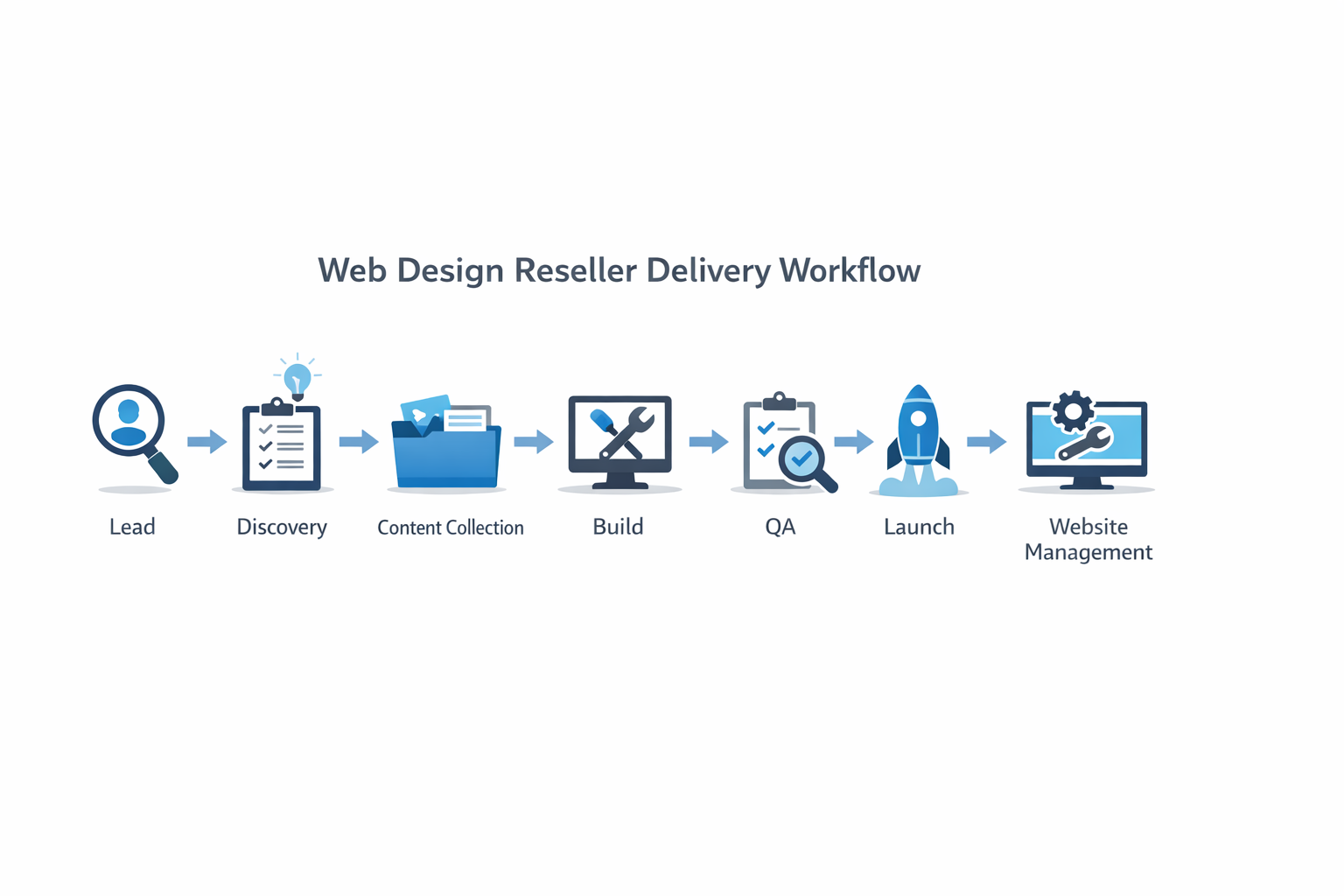
The white-label delivery workflow (from lead to launch)
The fastest way to lose money is to treat each reseller project as a custom snowflake.
Your delivery workflow should feel like a checklist. The client can still feel special, but your team should not reinvent the process.
Discovery and content collection
Discovery is not a long workshop. It is a structured intake.
A strong discovery packet includes:
- Business name, address, service area
- Primary goal: leads, bookings, sales
- Top 3 competitors and “what you like about them”
- Brand assets: logo, colors, fonts
- Content: services list, FAQs, testimonials, photos
If you want to keep timelines tight, do not start design until content is at least 80% complete.
The cleanest reseller workflow uses “content gates.” No content, no build. It sounds strict, but it is the difference between a 2-week delivery and a 2-month mess.
Design, build, revisions
A practical reseller build cycle looks like this:
- Homepage draft (structure, sections, tone)
- Design system (buttons, typography, spacing)
- Core pages build (services, about, contact)
- Functional modules (forms, booking, maps)
- Revision window (tight, timeboxed)
Set expectations upfront:
- Two revision rounds included
- Revisions are “edits,” not redesigns
- Requests are collected in one document, not in scattered emails
Launch checklist and post-launch support
One extra step I recommend is a “48-hour stabilization window.”
For 48 hours after launch, you:
- Monitor forms and lead routing
- Watch for broken links and missing images
- Check analytics firing (GA4, pixels)
- Fix anything that would create immediate client doubt
This small ritual reduces churn, increases referrals, and turns the launch into a moment where you look extremely on top of things.
If your agency is selling websites without a basic SEO pass, you are leaving value on the table.
Here is a simple checklist for a single service page:
- URL slug: short and descriptive (example: /roof-repair)
- Title tag: primary keyword first, then brand (example: “Roof Repair in Austin | Brand Name”)
- Meta description: include the offer and location, aim for clarity
- H1: matches the service and intent (example: “Roof Repair in Austin, TX”)
- H2 sections: process, pricing factors, FAQs, service area, trust signals
- Internal links: point to contact page and related services
- Schema (optional): LocalBusiness + FAQ when relevant
For ongoing SEO work, use Google’s documentation as your baseline, starting with Google Search Central.
Launching is not “publish and pray.” It is a controlled handoff.
A strong launch checklist includes:
- Mobile and tablet QA
- Form test and email routing check
- 404 check and redirects
- Core Web Vitals and performance sweep
- Basic on-page SEO: titles, descriptions, H1s
For SEO launch basics, Google’s own documentation is the best reference, start at Google Search Central.
After launch, you should sell website management. A website without updates gets stale fast.
A standard management plan covers:
- Security and platform updates
- Small content edits
- Landing pages
- Monthly reporting
If you want to productize this, build a clear “what’s included” list and a response-time SLA.
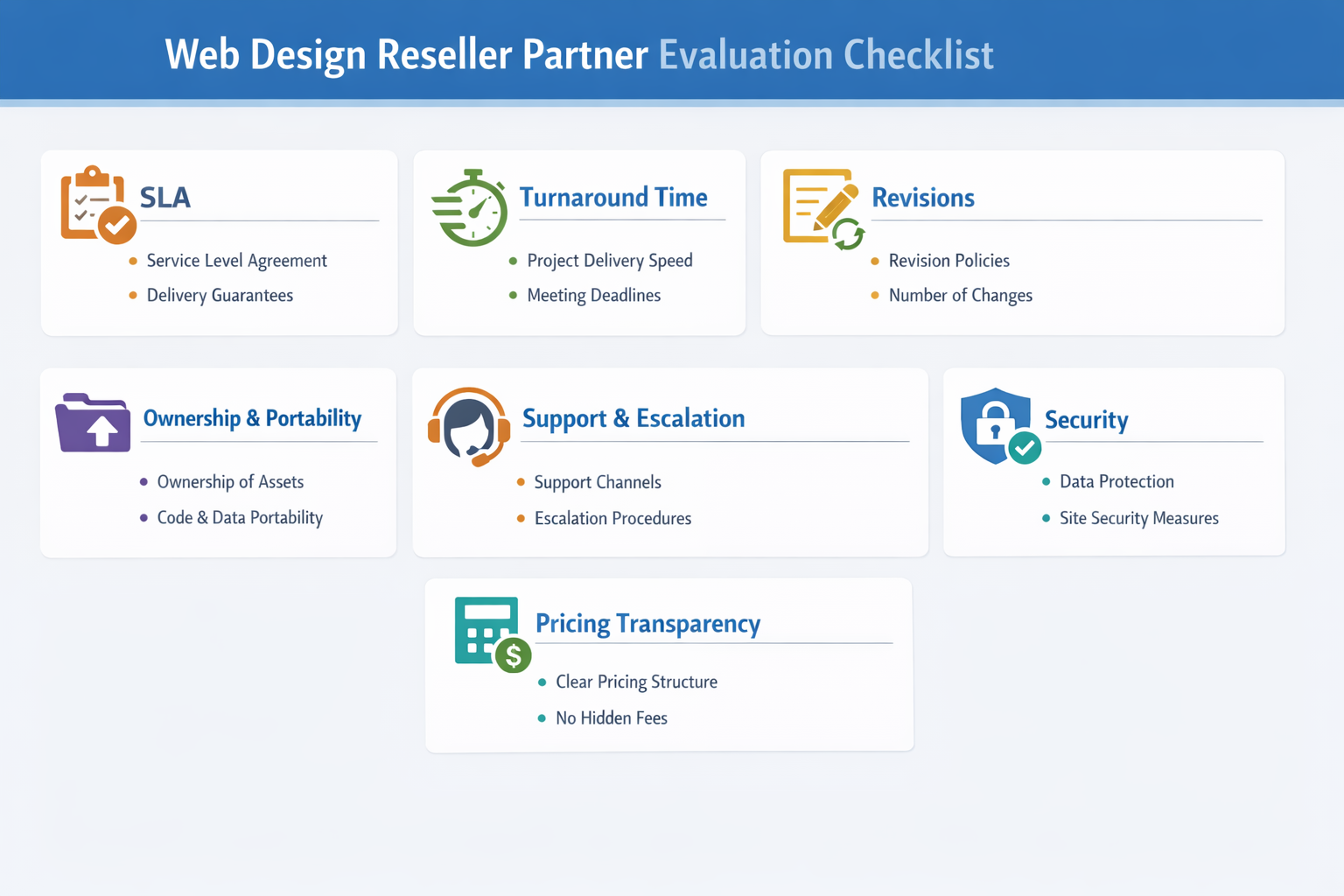
What to look for in a reseller partner (checklist + SLAs)
Your reseller partner is part of your reputation. You are effectively outsourcing trust.
So you need to evaluate them like you would evaluate a key hire.
Turnaround time, revision policy, QA standards
Ask for specifics, not promises.
A good partner should define:
- Typical delivery timelines by package (example: 10 business days for a 5-page site)
- Revision policy (example: two rounds, 5 business days each)
- QA checklist and acceptance criteria
- Escalation path when something breaks
If they cannot answer clearly, you are buying chaos.
Ownership, portability, and vendor lock-in
Here is a blunt way to test lock-in: ask your partner to describe the exit process.
A good answer includes:
- How domains are transferred
- How content is exported
- What happens to emails, forms, and integrations
- What fees (if any) exist for migration
A weak answer sounds like: “Don’t worry about it.”
Use this simple scoring matrix when comparing partners. Score each item:
- 0: not offered or unclear
- 1: offered, but with limitations
- 2: offered clearly, with documentation
| Category | What to verify | Score (0-2) |
|---|---|---|
| White label | Portal, emails, domain branding | |
| Delivery SLA | Standard timelines by package | |
| Revisions | Clear limits, turnaround, what counts | |
| QA | Documented checklist, testing standards | |
| Ownership | Content ownership, export options | |
| Portability | Domain transfer, redirects, backups | |
| Support | Response times, escalation path | |
| Security | Roles, permissions, audit logs | |
| Pricing | Transparent wholesale costs, no surprises | |
| Management | Ongoing updates, reporting, change requests |
If a partner cannot score at least 16/20, keep looking.
This is where many reseller programs hide the sharp edges.
You need to know:
- Who owns the website assets and content?
- Can you export the site?
- Can you move domains easily?
- What happens if you stop paying?
If your partner owns everything, you are not building an agency, you are building a dependent channel.
Support, uptime, and escalation paths
For any platform-based delivery model, uptime and support response time matter.
You do not need enterprise SLAs, but you do need clarity.
A practical baseline:
- Business-hours support for standard issues
- Clear escalation for outages
- Transparent incident communication
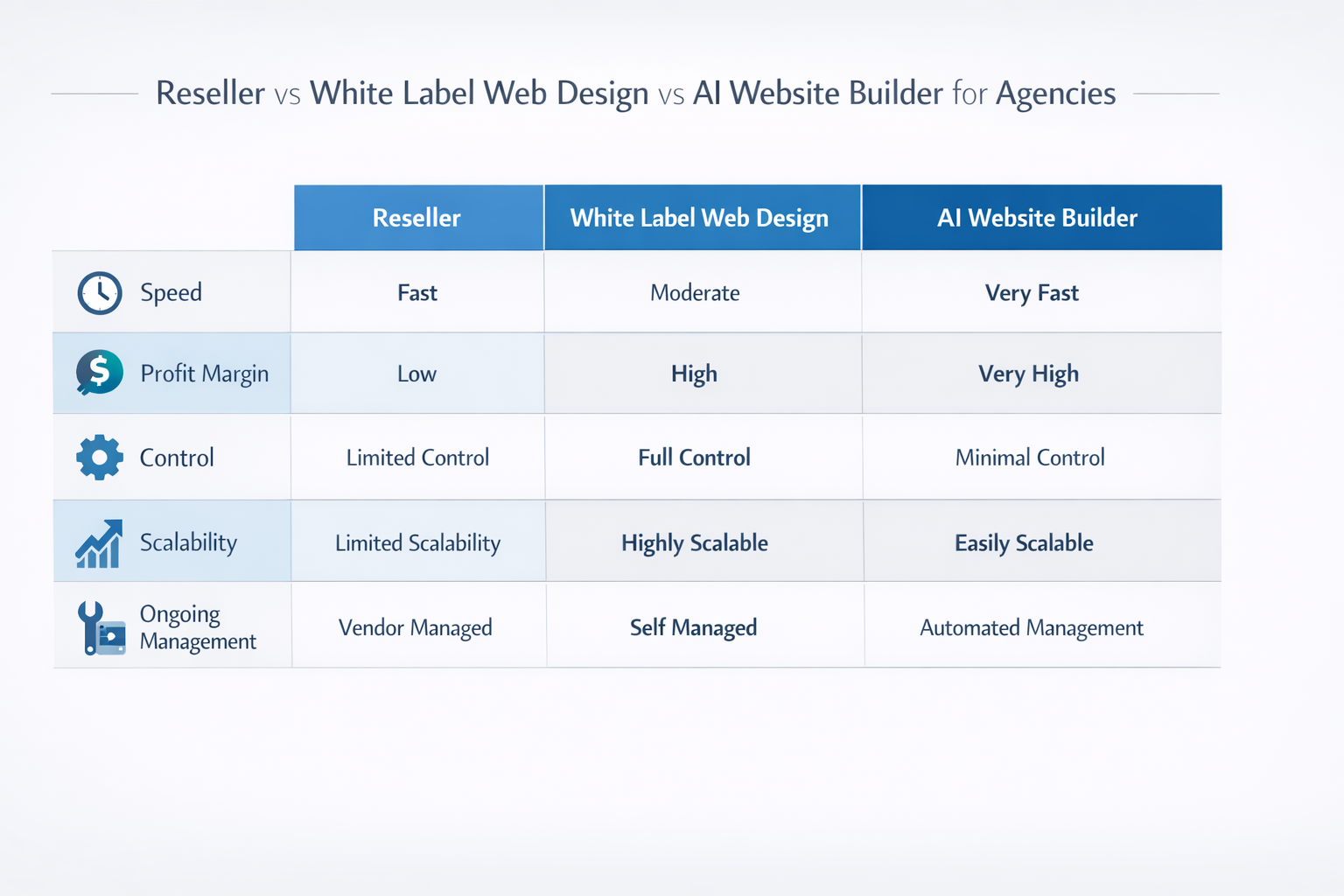
White label web design vs an AI website builder for agencies
The big shift in 2026 is that agencies can fulfill more of the build with software, not labor.
So the real decision is not just “reseller vs white label.” It is:
- Do you want a people-based fulfillment model?
- Or a platform-based model that compresses timelines?
Speed and margins
Traditional white label production can work, but it often depends on human capacity.
AI-assisted delivery changes the math:
- Faster first drafts
- Faster content generation and page structure
- Easier scaling across niches
The more your workflow becomes “review and polish” instead of “build from scratch,” the more margin you keep.
Quality control and brand consistency
Quality is not just design. It is consistency.
The best reseller setups have:
- A component library and templates
- A brand system you can apply quickly
- A repeatable QA checklist
Platform-based builders can help because they standardize components. But you still need human review.
When AI helps (wireframes, copy drafts, site generation)
If you want to use AI without damaging quality, give it constraints.
A simple agency-friendly approach is:
- AI produces a first draft (structure + basic copy)
- Your team applies your brand voice guidelines
- You add proof: testimonials, numbers, case examples
- You run QA: mobile, forms, SEO basics
This keeps the speed while protecting your reputation.
Imagine you run an SEO agency for home services. A prospect wants a new site because their current one is slow and hard to update.
A productized reseller workflow could look like:
- Day 1: intake, content collection, competitor review
- Day 2: AI-generated first draft site structure + copy draft
- Day 3: brand styling + homepage approval
- Days 4-6: build pages + forms + local trust sections
- Days 7-8: QA + revisions
- Day 9: launch + tracking + redirects
- Day 10: handoff + management plan upsell
The measurable outcomes you can aim for are realistic ranges, not guarantees:
- Faster load time and better mobile experience
- Higher conversion rate from clearer CTAs
- Lower lead response time due to cleaner form routing
To ground expectations, use industry benchmarks and report sources like Clutch when discussing typical project budgets and timelines, and validate SEO best practices through Google Search Central.
AI is most useful in the early 70% of the project:
- Wireframe suggestions
- Copy drafts based on the client’s niche
- Initial page generation
- Basic SEO structure
It is less useful for:
- Final brand nuance
- High-stakes conversion copy
- Complex integrations
AI is a speed layer, not a taste layer. Your agency still needs taste.
Legal, contracts, and operational essentials
This is also where you decide whether you are running a “services business” or a “subscription business.”
A reseller program becomes more stable when you shift client expectations from one-off delivery to ongoing stewardship.
The operational playbook: roles you need (even if you are tiny)
You do not need a big team, but you do need clear roles.
- Account owner: relationship, renewals, upsells
- Project manager: timeline, scope, approvals
- Production lead: build quality, design consistency
- QA owner: checklist, bug triage, launch sign-off
In a small agency, one person can wear multiple hats. The point is that the hats must exist.
Change requests: how to keep them from wrecking your margins
Set a standard rule: changes flow through one place.
A simple system:
- Clients submit changes in a form or ticket
- You categorize: bug, edit, new feature
- You respond with: “included,” “needs approval,” or “out of scope”
The client feels taken care of, and you protect your profitability.
If you resell websites, you are responsible for the relationship. That means your paperwork needs to match your delivery model.
MSA/SOW basics, IP and licensing
At minimum, make sure you have:
- A master services agreement (MSA)
- A scope of work (SOW) per project
- A clear revision policy
- IP language for content, design assets, and licenses
Also clarify:
- Stock assets policy (your vendor must not sneak in non-licensed images)
- Fonts licensing
- Third-party plugins and subscriptions
Data privacy, client access, roles and permissions
If you manage websites, you will handle:
- Admin logins
- Customer inquiry data
- Analytics access
Keep it clean:
- Use role-based access
- Document who has access
- Avoid sharing one admin account across clients
If you are marketing in the EU, privacy expectations are higher, so treat this seriously.
How lindoai fits: resell AI-powered websites under your brand
If your goal is to resell websites with strong margins, the best path is to reduce labor and increase repeatability.
That is where lindoai is built to fit.
White-labeling and client management features
With lindoai, agencies can build and manage websites under their own brand using a white-label experience.
Key pages to review:
Website management and ongoing updates
The reseller model only becomes a real business line when you sell management.
Website management is where you:
- Create recurring revenue
- Reduce churn
- Stay close to the client’s growth
Learn more about website management and how to package updates as a monthly plan.
Suggested reseller offer templates
Here are three offer templates you can copy.
Offer 1: “Website Launch Sprint”
- Fixed price
- 10 business days
- 5 pages
- 2 revision rounds
- Launch checklist included
Offer 2: “Website + Growth Foundation”
- Website build
- Local SEO setup
- 2 landing pages
- 90-day roadmap
Offer 3: “Managed Website Subscription”
- Website included
- Hosting and updates
- Monthly content edits
- Quarterly redesign refresh
If you want a lower-commitment acquisition channel, you can also consider an affiliate model, depending on your business.
Pricing examples you can adapt (with real numbers)
Pricing is where most new resellers get stuck because they fear overcharging. Here is the reality: clients are not paying for “a site.” They are paying for speed, confidence, and an outcome.
Below are example ranges you can adapt. They are not promises, but they are practical anchors for sales conversations.
Example 1: Local service business (lead gen)
- Retail price: $2,500 to $6,000
- Typical scope: 5 to 8 pages, lead form, reviews, service area
- Timeline: 10 to 15 business days
- Add-on: local SEO setup (GBP, citations plan) for $500 to $1,500
Margin tip: keep this package template-based, and make your “custom design” an upgrade.
Example 2: Professional services (trust + authority)
- Retail price: $5,000 to $12,000
- Typical scope: 8 to 15 pages, case studies, lead magnets, blog structure
- Timeline: 15 to 25 business days
- Add-on: conversion copy polish for $800 to $2,500
Margin tip: define the number of “decision-maker review cycles.” Too many stakeholders is where profit disappears.
Example 3: E-commerce starter
- Retail price: $8,000 to $25,000+
- Typical scope: theme setup, collections, products, payments, shipping, policies
- Timeline: 3 to 6 weeks
- Add-on: email automation starter flows for $500 to $3,000
Margin tip: require product data in a spreadsheet before you start. No spreadsheet, no build.
The strongest reseller agencies use a rule of thumb: if the site is complex enough to need a developer, it is complex enough to need a written acceptance checklist.
Outsource web design services vs reseller vs building in-house
Agencies often ask: should I outsource web design services, join a reseller program, or hire a team?
Here is a practical comparison.
| Option | Best for | Pros | Cons |
|---|---|---|---|
| Outsource web design services (ad hoc) | Irregular demand | Flexible, easy to start | Inconsistent quality, hard to scale standards |
| Web design reseller program | Repeatable offers | Predictable delivery, easier packaging | Needs process discipline, partner dependency risk |
| Build in-house team | High volume | Maximum control and IP | Highest fixed costs, hiring and retention risk |
A good strategy for many agencies is phased:
- Start with reseller delivery to validate demand and packages
- Standardize templates, QA, and pricing
- Hire in-house only when utilization is predictable
A simple SLA template you can include in proposals
You do not need legal language here. You need clarity.
Delivery SLA (example)
- Draft homepage delivered within 5 business days of receiving content
- Full site delivered within 10 to 15 business days depending on package
- Revision turnaround: 2 business days per round
- Included revisions: 2 rounds
Support SLA (example)
- Critical site down issues: response within 4 hours during business days
- Minor edits: completed within 2 to 5 business days depending on plan
This kind of SLA protects you and reassures the client.
Risk management: how to protect your brand as a reseller
If you resell websites, your name is on the line. Here are practical protections that reduce headaches.
Run every project through the same QA checklist
It sounds basic, but it is rare. Your checklist should include:
- Mobile responsiveness
- Form routing tested end-to-end
- Analytics firing
- Basic accessibility pass (contrast, labels)
- Page speed check
Define what counts as a “revision”
Clients will try to sneak in new pages and new features as “small edits.” Put it in writing:
- Text edits and minor layout changes are revisions
- New sections, new pages, and new features are change requests
Keep a vendor contingency plan
Even if you love your partner, have a backup plan.
- Keep templates and brand assets organized
- Document your workflow in one SOP
- Avoid putting client logins in a vendor-owned password manager
These small habits keep you in control.
FAQ
How much can you earn as a web design reseller?
It depends on your pricing and your fulfillment cost. Many agencies aim for 40% to 60% gross margin on builds, then add monthly management at high margin. If you sell a $5,000 business site and fulfill it for $2,500, that is $2,500 gross profit before your sales and ops costs. The real upside comes when you attach a $149 to $499 per month management plan.
Is white label web design profitable in 2026?
Yes, but the profitable version is the productized version. Agencies that treat delivery like a repeatable system, with clear packages and a strict revision policy, win. Agencies that “custom everything” tend to bleed margin. AI tooling has made timelines shorter, which increases potential margin if you keep scope tight.
What’s the difference between white label and reseller?
Reseller describes the business model, you sell a service you fulfill through someone else. White label describes the branding experience, the client sees your brand, not the provider’s. You can be a reseller without white label (not ideal), and you can white label parts of your workflow without being a formal reseller program.
Do I need developers to resell websites?
Not necessarily. Many agencies resell websites using template-based systems and modern builders, then reserve developers for complex features. The key is having a workflow for discovery, content collection, QA, and launch. If your partner or platform covers most build needs, you focus on strategy, design direction, and client outcomes.
How do I price monthly website management?
Start with tiers. A simple structure is: Basic (updates and small edits, 24 to 72 hour response), Growth (content changes plus landing pages and reporting), and Performance (SEO collaboration, CRO tests, quarterly redesign work). Price should reflect response time, volume of changes, and how much you are accountable for business outcomes.
Ready to add a reseller offer without adding a dev team? lindoai helps you deliver and manage websites under your brand, faster and at higher margins. Start with the white label website builder and build your packages from there.