White Label
Best Website Builder for Agencies in 2026 (Buyer's Guide)
• • 4 min read
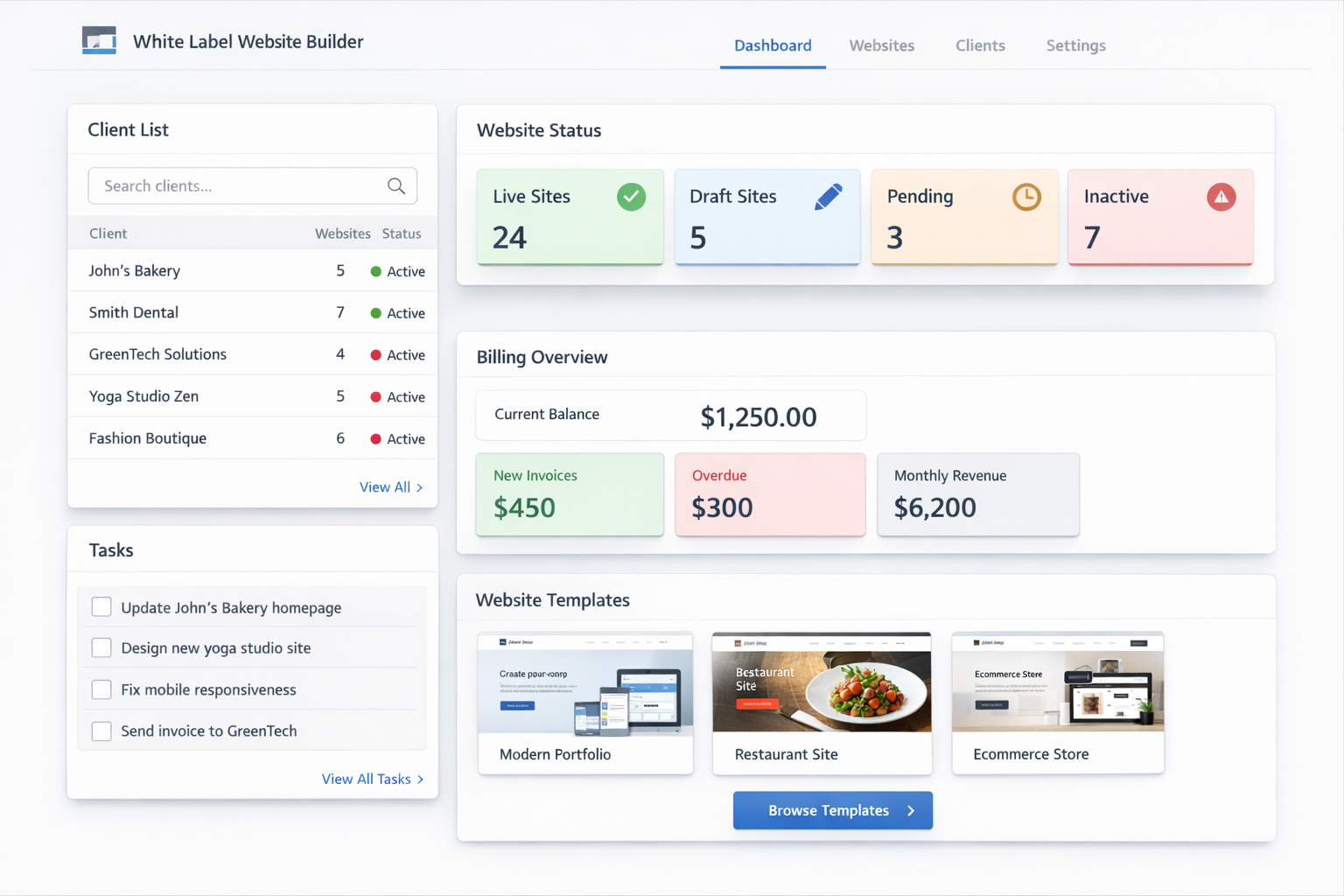
A practical buyer's guide to choosing a website builder for agencies: white label options, AI features, pricing models, and how to scale client delivery.

Running a web design agency is a juggling act. You're managing client expectations, scoping projects, hiring talent, meeting deadlines, and trying to keep margins healthy while doing it. The tool you build websites with sits at the center of all of it. Pick the wrong one, and every project becomes a grind. Pick the right one, and delivery gets faster, cheaper, and more profitable.
That's why the choice of a website builder for agencies matters more than almost any other decision you'll make. It's not just a tool; it's your production line.
The market has changed dramatically in the last two years. AI-powered builders can now generate client-ready sites in minutes, and white label platforms let agencies resell that capability under their own brand. If you're still building every site from scratch in a traditional tool, you're leaving money on the table.
This guide walks through what agencies actually need from a website platform, compares the top options on the market, and gives you a clear framework for choosing the right one for your agency's size, client type, and business model.
Here's a question worth asking: can't you just use the same website builder a small business uses? Technically yes. Practically, it's a mistake, and here's why.
A small business builds one website, maybe two, ever. An agency builds websites continuously, often several at once, for clients who expect professional results and fast turnaround. Those are fundamentally different workloads.
Think about what an agency deals with that a solo business owner never sees: multiple client accounts, dozens of sites in different stages of completion, client feedback loops, handovers, billing, and the constant need to deliver consistent quality across projects. Consumer website builders weren't designed for any of that. They're designed for one person building one site.
A dedicated agency platform handles these realities natively. It gives you a dashboard for all your client sites, permission controls so clients only see their own project, and billing structures that match how agencies actually charge.
The cost of ignoring this is quiet inefficiency. You spend hours exporting sites, managing logins, duplicating work, and patching together tools that don't talk to each other. Multiply that by every project, and it's a serious tax on your margins.
Here's a hard truth about the web design market: clients care more about speed than most designers want to admit. When a business owner decides they need a website, they usually need it now, and they'll pick whoever can deliver it fastest.
The global web development market keeps growing, and Statista's data on the web development services market shows the opportunity is huge. But that opportunity is captured by whoever can deliver quality at speed. An agency that launches a client site in days instead of weeks wins the proposal, wins the referral, and wins the next project.
Speed also changes the conversation you have with clients. When delivery takes weeks, clients second-guess decisions, request endless revisions, and the project scope creeps. When delivery takes days, the momentum carries the project forward and the client stays happy. Slow delivery doesn't just cost you time; it costs you control of the project.
Speed isn't a luxury in agency work; it's the competitive edge. The agency that delivers in days wins clients the agency that delivers in weeks never gets to pitch.
A dedicated builder with AI assistance collapses the production timeline. What used to take a designer a full week takes a day. That doesn't just win you more clients; it lets you take on more projects with the same team, which is how agencies actually grow.
The difference between an agency platform and a consumer builder isn't subtle. It comes down to three things: how you manage clients, whether you can brand the platform as your own, and whether the pricing supports your business model.
A consumer builder gives you one account, one site. An agency platform gives you a multi-site workspace with granular control.
The practical difference: you can create a workspace for each client, invite the client with limited permissions, let them review and comment without breaking anything, and keep your internal work hidden. When the project ends, you hand over the keys cleanly or keep managing the site under a maintenance agreement.
Without these features, agencies end up doing the worst kind of work: sharing logins, exporting sites to other platforms, and managing access through spreadsheets. It's fragile, unprofessional, and it creates a mess every time a client leaves.
White label is the feature that separates "a tool I use" from "a platform my agency is built on." A white label website builder lets you replace the platform's branding with your own: your logo on the dashboard, your domain in the client's URL, your brand on the delivered site.
This changes your positioning completely. When clients see your branded dashboard and your branded deliverables, you look like a technology company, not a freelancer with a template. You can charge more, retain clients longer, and create a moat around your service.
White label isn't vanity branding. It's the difference between renting a tool and owning a product. Every client touchpoint that carries your brand builds equity you keep.
The most profitable agencies don't just build websites; they rent them. A client pays a monthly fee that covers hosting, maintenance, updates, and support, and the agency keeps a healthy margin on top.
Agency platforms are built for this. They support per-site subscriptions, reseller pricing, and billing structures that let you charge clients monthly while paying the platform a fraction of that amount. The gap between what you charge and what the platform costs is your recurring revenue.
Consumer builders can't do this cleanly. You'd have to manage the billing yourself, host the sites on your own, and handle every support request manually. An agency platform automates the whole loop.
Not every "agency" platform is equal. When you evaluate options, these are the features that actually matter in day-to-day use.
Check how deep the white labeling goes. Some platforms let you change a logo; others let you rebrand the entire experience, including the client dashboard, emails, and the site editor itself.
The deeper the branding, the more the platform feels like your own product. That matters for perception, but it also matters for retention: if clients would have to learn a new system to leave you, they're far less likely to churn.
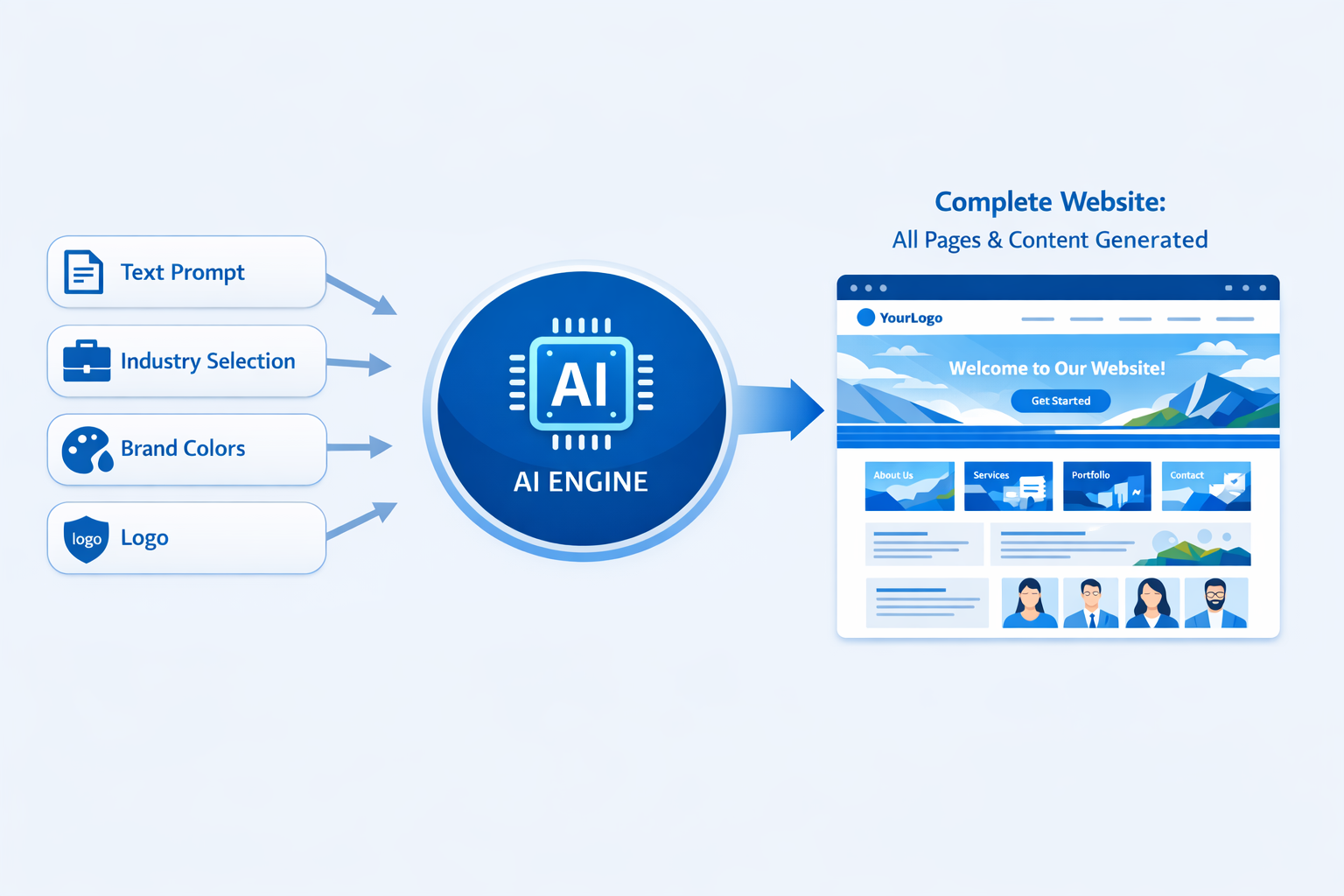
This is the feature that didn't exist a few years ago and now separates modern platforms from legacy ones. AI-assisted creation means the platform can generate a site draft from a client brief, complete with structure, copy, and design.
For agencies, AI is a force multiplier. A designer who used to produce one site per week can now produce several, with the AI handling the initial draft and the designer focusing on customization and polish. It doesn't replace designers; it removes their most tedious work.
The quality varies by platform. Test the AI output before you commit, especially the copy quality and the design variety. A platform whose AI produces generic results will make all your client sites feel generic.
Pricing models vary wildly, and the right one depends on your volume. Some platforms charge per agency seat, which gets expensive as your team grows. Others charge per site, which scales naturally with your client count.
Look for a model that keeps your unit cost per client site low. If you're paying a premium for features you don't use, or if pricing jumps sharply as you add sites, the platform will eat into your margins exactly when you start growing.
Let's get into the options. These are the platforms agencies actually use in 2026, with honest pros and cons for each.
lindoai is built specifically for agencies that want to combine AI speed with white label delivery. You generate client sites with AI, customize them, and deliver everything under your own brand.
It's the strongest fit for agencies that want to adopt an AI-first production model: generate a site from a brief in minutes, refine it, and deliver it through your own branded dashboard. The reseller economics are designed for agencies, with pricing that keeps your per-client cost low.
Webflow is the favorite of designers who want granular visual control. Its designer tool is genuinely powerful, and the ability to export clean code gives you flexibility no template-based builder can match.
The trade-offs are real: there's a steep learning curve, client management is less of a focus, and the AI angle is limited compared to dedicated AI builders. It's a design tool first and an agency platform second.
WordPress remains the workhorse of the agency world. Its flexibility is unmatched, the plugin ecosystem is enormous, and clients know the name. Many agencies build on WordPress and sell monthly maintenance plans on top.
The catch is the workload. WordPress requires ongoing maintenance, security updates, and plugin management, which is exactly why maintenance plans exist as a revenue stream. It's profitable, but it's also constant work.
Wix Studio and Duda both court agencies with white label options, multi-site management, and agency-focused pricing. They're solid, mature platforms with good client management features.
Their weakness is the AI gap. Their AI tools exist, but they're additive features bolted onto a traditional builder rather than a fundamentally AI-first experience. If AI generation is a core part of your strategy, you'll be fighting the platform's assumptions.
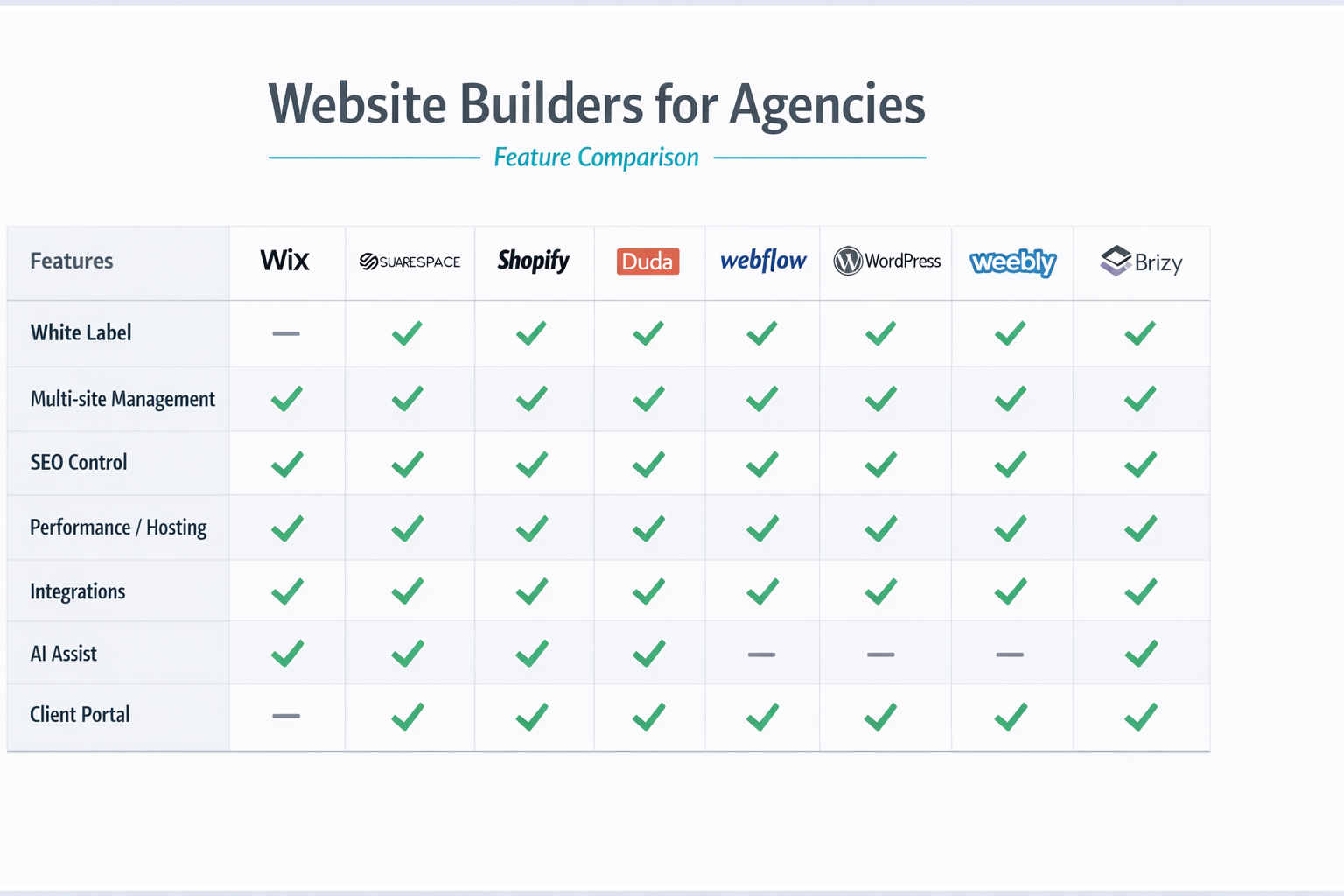
| Platform | AI Build | White Label | Client Mgmt | Best For |
|---|---|---|---|---|
| lindoai | Yes, full | Deep | Yes | AI-first agencies, resellers |
| Webflow | Minimal | Limited | Basic | Design-led custom builds |
| WordPress | Via plugins | N/A | Manual | Classic stacks, maintenance plans |
| Wix Studio | Basic | Yes | Yes | Traditional agency workflows |
| Duda | Basic | Yes | Yes | Traditional agency workflows |
Most agencies choose their platform once and live with it for years, so it pays to avoid the classic mistakes. Here are the ones I see most often.
The cheapest platform is rarely the cheapest overall. A tool that saves you $50 a month but costs you five hours per project is the most expensive option in the room. Price matters, but only after you've calculated total cost per delivered site, including your team's time.
Agencies evaluate platforms on their own experience and forget that clients will touch the platform too. If the client dashboard is confusing, if feedback tools are clunky, or if handover is a mess, your clients feel it. The platform should make you look good in front of your clients, not the reverse.
It's easy to overbuy: enterprise features, unlimited everything, the plan your agency will need when it's three times bigger. That's wasted money today, and the market changes fast enough that today's premium platform may not be the right one later. Buy for your current scale with room to grow, not for a fantasy version of your agency.
Many agencies put off the white label decision, assuming they can rebrand later. Rebranding later means moving clients, rebuilding dashboards, and redoing work. If you plan to build a brand or sell recurring services, white label should be a first-class requirement from day one, not an upgrade path.
The right platform depends on your agency's specifics. Here's a decision framework that works regardless of which option you're leaning toward.
Who are your clients? An agency serving small local businesses needs a platform that delivers professional sites fast at low cost, which points to AI-powered builders with templates and automation. An agency serving enterprise clients needs scalability, security, and deep customization, which points to more flexible platforms like Webflow or custom WordPress builds.
The mismatch happens when agencies pick a platform based on what other agencies use instead of what their clients need. A solo designer doing brochure sites for dentists doesn't need Webflow's code export. They need speed and simplicity.
Be honest about whether white label matters to you. If you're a freelancer who doesn't mind clients seeing the platform's brand, you can use a consumer tool and save money. If you're building a brand, planning to scale, or selling recurring website services, white label is a strategic investment, not a nice-to-have.
The test: when your client logs in to review their site, whose name do you want them to see? Your answer determines how much white label capability you need.
Don't compare monthly subscription prices in a vacuum. Calculate the true cost per client site, including your labor. A platform that costs more per month but saves you 10 hours per project is dramatically cheaper than a free tool that eats your time.
The formula: platform cost plus your hourly rate multiplied by hours per project, divided across the sites you deliver. Run this calculation for each option, and the winner is usually not the cheapest subscription.
A worked example makes this concrete. Platform A costs $30 per month but adds 8 hours of work per site. Platform B costs $150 per month but cuts build time by 10 hours per site. At a $75 hourly rate, Platform A effectively costs $630 per site in labor plus subscription, while Platform B costs $750 saved against the same baseline. The "expensive" platform is the profitable one.
Finally, don't choose on a features list alone. Run a 30-day trial with a real project: take one of your typical client briefs and build it end to end. Evaluate the experience honestly: how fast was the first draft, how much customization did you need, how did the client review feel, and what would it cost per site at your real volume?
A trial with a real project tells you more than any comparison article, including this one. The platform that survives your trial is the platform you should adopt.
The biggest opportunity in agency tooling right now is AI, and it's not close. Here's how AI-powered building changes the economics of your agency.
An AI website builder for agencies turns a client brief into a working site draft in minutes. The designer's job shifts from building to directing: choosing the right structure, refining the copy, and applying brand polish.
The workflow looks like this: collect the client brief, generate the site, customize, get client feedback, refine, launch. That's a two-day cycle for what used to be a two-week project.
The numbers matter. If AI cuts your build time by 70%, you can either take on three times the projects with the same team, or keep the same volume and pour the saved time into higher-margin work like strategy and optimization.
AI doesn't shrink the value of your work; it shrinks the time between "client says yes" and "site goes live." That gap is where agencies lose money. Close it, and your margins improve on every single project.
Be clear-eyed about what AI does well and what it doesn't. AI excels at structure, first-draft copy, layout generation, and the repetitive parts of site building: creating consistent sections, writing service descriptions, and assembling standard pages.
AI still struggles with genuine brand nuance, complex custom functionality, and the judgment calls that come from experience. A designer's eye, a strategist's positioning, and a developer's architecture are still very much in demand.
The winning agencies treat AI as a junior teammate: fast, tireless, and needing direction. The human sets the standard, and the AI does the heavy lifting. That division of labor is the new competitive advantage in agency delivery.
If you're adopting an AI builder, the workflow looks something like this:
Each step is faster with the right platform, and steps 4 through 6 are exactly where white label capability turns a project into a relationship.
Let's put numbers on it. A typical small business site built traditionally might take 30 hours of an agency's time. At a blended rate of $60 per hour, that's $1,800 in labor, before any platform costs.
With AI generation and customization, the same site might take 8 hours: $480 in labor. If you charge the client $3,000 for the site, your margin jumps from $1,200 to $2,520 on the same deliverable. Deliver four of those a month and the annual difference is over $60,000 in profit.
That's the real reason agencies are adopting AI builders. Not because AI is trendy, but because it converts hours into margin at a scale that compounds across every project.
Choosing a website builder is one decision, but the best agencies think in terms of a stack: the builder, the communication tools, and the billing systems all working together. Here's how to think about the full picture.
Your website builder should be the hub of your delivery process, not an island. The best agency platforms include client communication, feedback collection, and handover tools so the whole project lives in one place.
That consolidation matters more than it sounds. Every time you switch between a builder, an email thread, and a billing tool, you lose context and introduce errors. A platform that keeps the project in one workspace reduces friction at every step.
Even with AI, you'll hit projects that need more than a builder can give. Plan for the escalation path: standard sites generated and customized in the platform, premium sites that bring in a senior designer, and complex builds that involve a developer.
The platform handles the base volume, and your specialists handle the exceptions. That's how agencies scale without hiring a dozen new people every time client demand grows.
Finally, measure what the platform actually does for you. Track time-to-launch per project, hours spent per site, client satisfaction, and margin per project. Before and after adopting a new platform, these numbers tell you whether the change is working.
Most agencies don't track this, and it shows. The ones that do can make decisions based on data instead of vibes, which is exactly the advantage you want when choosing your next tool.
Set a simple review cadence: monthly, look at delivery time and margin per project. Quarterly, review whether the platform still fits your client mix. Annually, check the market for new options. Platforms improve fast, and an annual review keeps you from being stranded on a tool that's fallen behind.

The best choice depends on your model. For AI-first agencies that want white label delivery and fast client site generation, lindoai is built specifically for that. For design-led agencies doing complex custom work, Webflow is a strong fit. For classic WordPress shops, the WordPress plus maintenance plan model still works well.
A white label website builder lets an agency rebrand the platform as its own. The agency's logo appears on the client dashboard, the client URL uses the agency's domain, and the delivered product carries no third-party branding. This lets agencies present themselves as technology providers and build recurring revenue around their own brand.
Agency platforms typically range from $50 to $300+ per month, depending on the number of sites, white label capabilities, and AI features. Some charge per site, which scales with your client count. Compare total cost per client site, including your labor, rather than monthly subscription price alone.
Here is a quick way to think about it: if your agency plan costs $150 a month and you deliver 8 client sites, the platform cost per site is under $20. Traditional delivery stacks that size (hosting, page builder license, premium plugins, maintenance tools) can easily run $40 to $80 per site per month once you add everything up. The gap only widens when you factor in the hours AI saves on each build.
No, and it shouldn't. AI replaces the repetitive parts of site building: structure, first-draft copy, and standard layouts. Designers still handle brand nuance, custom design, strategy, and quality judgment. The best agencies use AI to multiply their designers' output, not replace them.
If your clients need complex custom functionality and you have the capacity to manage maintenance, WordPress remains powerful. If your clients need professional sites delivered fast, and you want to scale volume without scaling headcount, an AI-powered builder with white label support is the stronger economics. Many agencies run both: AI builders for standard projects, WordPress or custom builds for complex ones.
Your website builder is the engine of your agency. The right platform speeds up delivery, improves your margins, and lets you scale without scaling headcount. The wrong one taxes every project with inefficiency.
The 2026 market gives you real choices: AI-powered white label platforms for speed and branding, design tools for custom work, and classic stacks for established workflows. The key is matching the platform to your client type, your branding ambitions, and your actual cost per delivered site.
If you're ready to see what an AI-powered, white label approach can do for your agency, explore lindoai and see how fast client sites can go from brief to launch. Whatever you pick, the right website builder for agencies is the one that compounds speed, margins, and brand control. You can also dig into our white label website builder to understand the reseller model in depth.