White Label Web Design: The Complete Guide for Agencies in 2026
Imagine a client comes to you asking for a complete website redesign. They love your agency's reputation and trust your expertise. But your design team is fully booked for the next six weeks. What do you do?
You say yes anyway. Then you use white label web design to deliver the project on time, under budget, and entirely under your brand.
This is the reality for hundreds of agencies around the world. White label web design has grown from a niche outsourcing strategy into a mainstream business model. In 2026, it is one of the fastest ways for agencies to scale their services without the overhead of hiring, training, and managing an in-house design team.
The numbers back this up. The global white label services market is projected to grow at a compound annual growth rate of 16.4% between 2024 and 2030, according to Forbes. Agencies that adopt white label web design are positioned to capture a growing share of this expanding market.
This guide covers everything you need to know. What white label web design is, how it benefits agencies, what to look for in a partner, and exactly how to start offering white label web design services today.
What Is White Label Web Design?
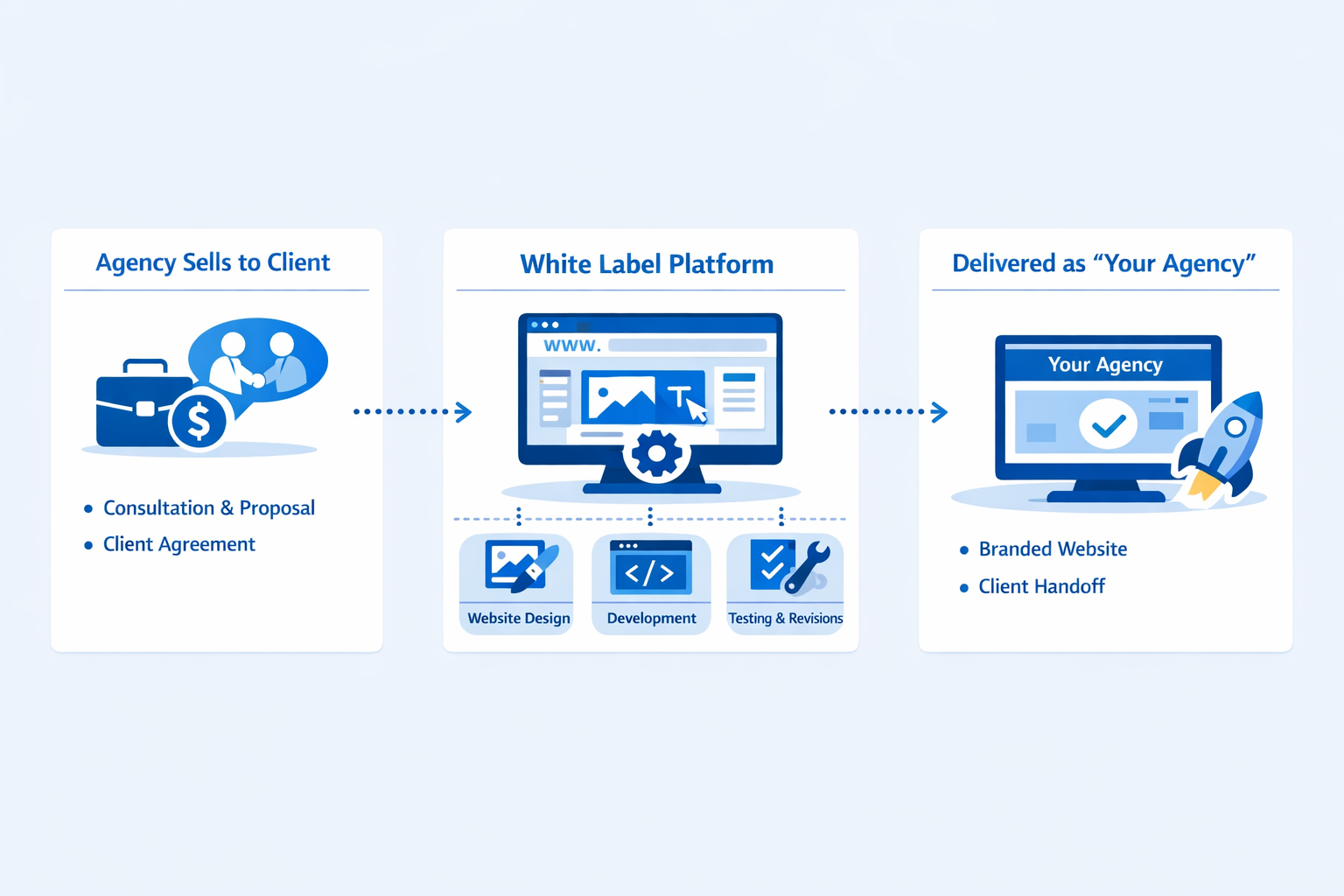
White label web design is a business arrangement where one company builds websites for another company, which then sells them under their own brand. The end client never knows a third party was involved. As far as they are concerned, the agency they hired built the website themselves.
Definition and How It Works
The process is straightforward. A white label web design provider, like lindoai, builds and hosts websites on a platform that agencies can rebrand as their own. The agency handles the client relationship, sales, and strategy. The provider handles the technical production.
Here is how a typical white label web design workflow looks:
- Step 1: The agency lands a client and agrees on scope, timeline, and pricing.
- Step 2: The agency creates the website using the white label platform's AI tools or builder.
- Step 3: The platform hosts the site under the agency's brand, with no third-party logos or links.
- Step 4: The agency delivers the finished site to the client, who never sees the underlying platform.
The beauty of this model is that the agency maintains full control over the client relationship while outsourcing the technical heavy lifting.
The Difference Between White Label and Reseller
These two terms are often used interchangeably, but they represent different business models.
In a reseller model, you purchase services from a provider at a wholesale price and resell them to your clients at a markup. The client may or may not know a third party is involved, depending on the arrangement. Reseller programs are common in hosting, domains, and basic website builders.
In a white label model, the provider stays completely invisible. Your agency's brand is the only brand the client sees, from the proposal to the dashboard to the finished website. The provider is your silent partner, not a visible intermediary.
For agencies that want to build a strong, independent brand, white label web design is the superior choice. Your clients develop loyalty to your agency, not to the underlying technology provider.
White label means your brand is the only brand your clients ever see. Reseller means you are a middleman. If you want to build an agency with lasting equity, white label is the only way to go.
Why White Label Web Design Is Booming in 2026
Several market forces are converging to make white label web design more popular than ever.
First, the demand for websites continues to grow. According to Clutch, the number of businesses seeking professional web design services increases by roughly 12% year over year. Small and medium businesses especially are investing in their online presence at unprecedented rates.
Second, finding skilled web designers and developers is harder than ever. The talent shortage in tech means agencies either pay premium salaries to attract talent or struggle with understaffed teams. White label web design eliminates this bottleneck entirely.
Third, AI has made white label web design significantly more accessible. Modern white label platforms use AI to automate much of the design and development work. This means agencies can deliver high-quality websites in hours, not weeks, with minimal technical effort.
How White Label Web Design Benefits Agencies
The advantages of white label web design go far beyond simply outsourcing work. For agencies that adopt this model strategically, the benefits touch every part of the business.
Expand Service Offerings Without Hiring
Every agency faces the same scaling challenge. To take on more clients or offer new services, you need more people. Hiring is slow, expensive, and risky. The wrong hire can set your team back months.
White label web design removes this constraint. You can offer professional website design services to any client, regardless of your current team capacity. The white label platform scales with you. When you get a new client, the platform handles the production. When that client is done, there is no unused staff to manage.
This flexibility means you can say yes to more projects, explore new verticals, and test new service offerings without committing to permanent headcount.
Think about it this way. Expanding your service catalog traditionally requires 3 to 6 months of hiring, onboarding, and training. With white label web design, you can add a new service line in a matter of days.
Reduce Time-to-Delivery From Weeks to Hours
Time is money in the agency world. Every day a project drags on, your profit margin shrinks. White label web design platforms, especially those powered by AI, dramatically compress delivery timelines.
A typical website project built in-house might follow this schedule:
- Discovery and planning: 1 week
- Design: 2 weeks
- Development: 2 to 3 weeks
- Testing and revisions: 1 week
- Total: 6 to 7 weeks
With a white label AI website builder, that same project can follow a much tighter schedule:
- AI-powered creation: 1 day
- Client review and refinement: 3 to 5 days
- Launch: 1 day
- Total: 5 to 7 days
That is a 70% to 80% reduction in delivery time. For clients, faster delivery is a compelling selling point. For your agency, it means you can take on more projects and improve cash flow.
Maintain Brand Consistency Across Client Sites
When you build websites in-house, maintaining consistent brand quality across multiple projects is difficult. Different designers have different styles. Client preferences pull the work in different directions. Before you know it, your portfolio looks like a collection of unrelated experiments.
White label web design platforms that offer templates and AI-assisted design help you maintain a consistent baseline quality. Every site benefits from the same design intelligence, the same code quality standards, and the same performance optimization.
Your clients get professional, polished results. Your portfolio stays cohesive. Your brand reputation grows stronger with every project.
Lower Operational Costs and Overhead
The cost savings from white label web design go beyond payroll. Consider all the hidden expenses of in-house web production:
- Software licenses: Design tools, prototyping tools, project management tools.
- Hosting and infrastructure: Servers, CDN, SSL certificates, domain management.
- Training and development: Ongoing education to keep skills current.
- Hardware: Computers, monitors, peripherals for each team member.
A white label platform bundles most or all of these costs into a single, predictable monthly fee. For a growing agency, this can mean savings of 40% to 60% on operational costs compared to maintaining an in-house production team.
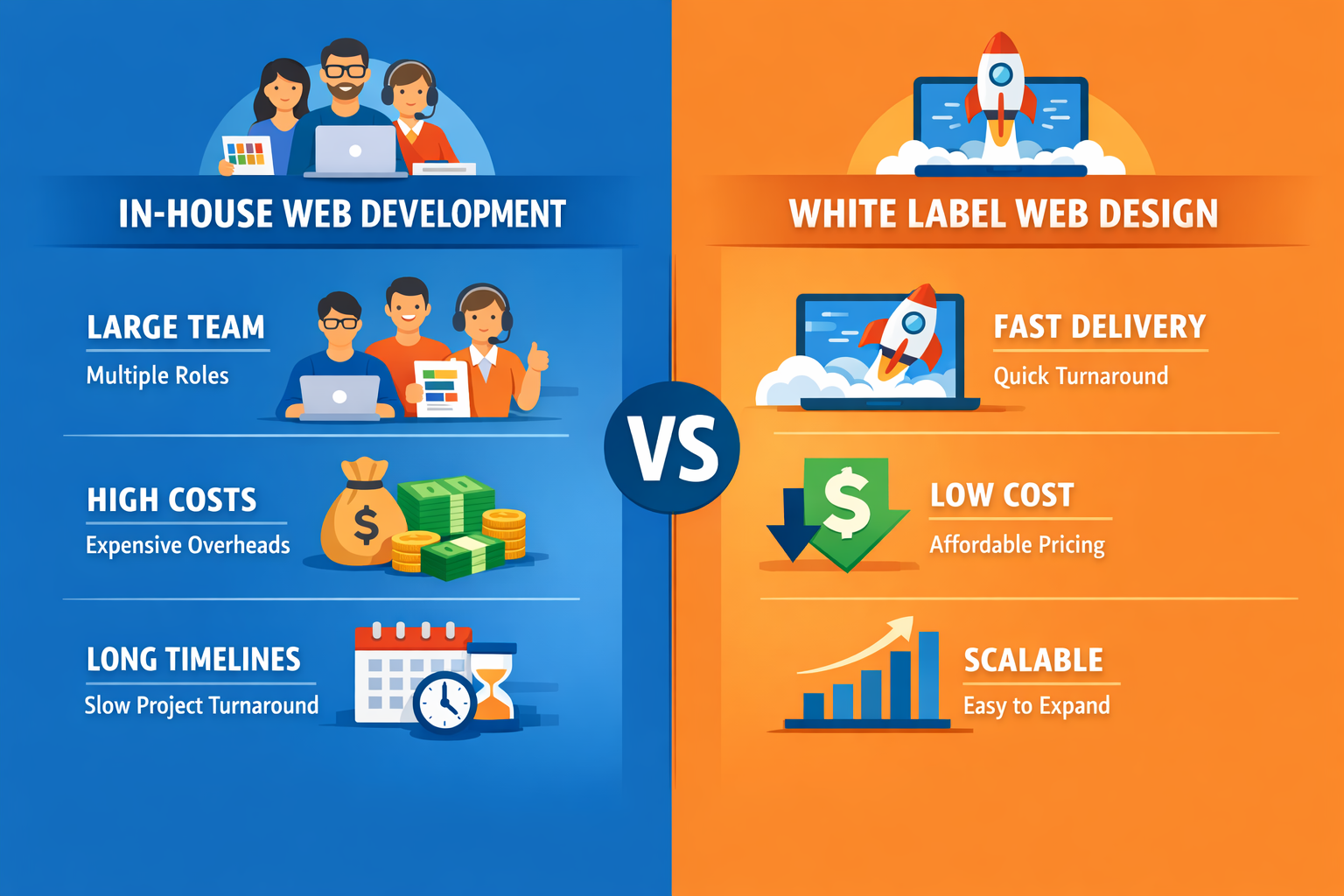
White Label Web Design vs In-House Development
Choosing between white label and in-house development is one of the most strategic decisions an agency makes. Both approaches have their place, and the right choice depends on your goals, resources, and growth stage.
Cost Comparison
The financial difference between white label and in-house development is stark.
Building an in-house web design team requires significant upfront investment. A single senior web designer in the United States commands an average salary of $75,000 to $110,000 per year, according to industry salary data. Add benefits, taxes, and equipment, and the total cost easily exceeds $100,000 per team member.
For a team of three designers and developers, you are looking at $300,000+ per year before you build a single client site.
White label web design flips this equation. Instead of paying fixed costs for a team, you pay variable costs tied to actual production. A white label platform like lindoai charges a flat monthly fee that is a fraction of a single employee's salary. For agencies producing 10 to 20 sites per month, the cost per site drops to $30 to $100, compared to thousands of dollars per site with an in-house team.
| Cost Factor | In-House Team | White Label Platform |
|---|
| Annual salaries | $100,000+ per designer | $0 |
| Software licenses | $2,000 to $5,000 per year | Included |
| Hosting | $500 to $2,000 per year per site | Included |
| Training | $3,000 to $10,000 per year per person | Included |
| Total for 5 sites/month | $15,000 to $25,000 per month | $200 to $500 per month |
The math is not subtle. For most agencies, white label web design is significantly more cost-effective than maintaining an in-house production team, especially in the early growth stages.
Quality and Control
A common concern about white label web design is quality. Will the output match what an experienced in-house designer would produce?
The answer depends on the platform. Old-school white label providers offered limited templates with minimal customization. The results were generic and uninspired.
Modern white label platforms are different. AI-powered tools allow deep customization. You can control typography, spacing, colors, layout, and functionality. The AI generates a strong starting point, and you refine it to match your standards.
For agencies that need pixel-perfect control over every element, the best white label platforms offer full CSS and JavaScript access. You can inject custom code, integrate third-party services, and build truly bespoke experiences.
In practice, the quality gap between white label and in-house development has narrowed to the point where most clients cannot tell the difference. And for many projects, the white label result is actually superior because it benefits from the platform's continuous improvements and security updates.
Scalability for Growth
Scalability is where white label web design truly shines.
An in-house team has a hard ceiling on output. You can only produce as many sites as your team has hours to build them. Scaling means hiring, which means months of recruitment and training before you see increased capacity.
White label web design has no such ceiling. The platform's capacity is essentially unlimited. You can scale from 1 site per month to 50 sites per month without adding a single employee to your production team.
The most successful agencies in 2026 will not be the ones with the largest design teams. They will be the ones that leverage white label technology to deliver more sites, faster, without the overhead of a massive payroll.
This scalability is especially valuable for agencies that experience seasonal spikes in demand. Instead of scrambling to hire contractors or turning away work, you simply lean harder on your white label platform.
What to Look for in a White Label Web Design Partner
Not all white label platforms are created equal. Choosing the right partner is a critical decision that affects your agency's quality, margins, and client satisfaction.
AI Powered Design Tools for Faster Delivery
The most important feature to look for is AI-powered design tools. AI transforms white label web design from a manual, template-driven process into an automated, intelligent workflow.
The best AI tools in a white label platform should offer:
- AI content generation: Write headlines, copy, and CTAs from simple prompts.
- AI layout generation: Create industry-specific page structures automatically.
- AI image selection: Suggest relevant images from integrated libraries.
- AI SEO optimization: Generate meta tags, alt text, and structured data.
These capabilities directly impact your delivery speed and the quality of the final product. Without strong AI features, a white label platform is just a shared template library with rebranding.
Full Customization and Branding Options
The whole point of white label is to present the platform as your own. That means the customization and branding options need to be comprehensive.
Look for a platform that lets you:
- Use your own domain for the builder interface and client portals.
- Upload your logo and brand colors across all touchpoints.
- Customize email notifications sent to clients.
- Remove all third-party branding from published sites.
- Create custom templates for recurring project types.
The more control you have over the branded experience, the more your clients will perceive you as a full-service agency with proprietary technology.
White Label Dashboard and Client Management
Building websites is only half the job. Managing client relationships, feedback, and billing is the other half. The best white label platforms include built-in client management features.
A white label client portal should allow your clients to:
- View project status and milestones.
- Leave feedback on design drafts.
- Approve or request changes.
- Access invoices and payment history.
- Request ongoing maintenance or updates.
When these features are integrated into the white label platform, you eliminate the need for separate project management, feedback, and billing tools. Everything happens under your brand, in one place.
A white label platform with integrated client management is not just a tool. It is the operating system for your entire agency.
Reliable Hosting and Performance
The quality of the underlying hosting infrastructure matters enormously for client satisfaction. Slow websites lose visitors. Downtime costs money and damages your reputation.
Your white label platform should include:
- Global CDN for fast page loads worldwide.
- Automatic SSL certificates for every site.
- 99.9% uptime guarantee or better.
- Automated backups and disaster recovery.
- Scalable infrastructure that handles traffic spikes.
When you evaluate platforms, ask about their hosting architecture. Avoid platforms that outsource hosting to cheap shared servers. Your clients deserve better.
Security, Compliance, and Support in White Label Web Design
Security is non-negotiable when you are building websites for clients. Every site you deliver needs to be secure by default, not as an afterthought. A good white label web design platform handles the heavy lifting here, but you need to know what to look for.
Start with SSL certificates. Every site should have automatic SSL encryption. Google has made HTTPS a ranking factor, and browsers now warn users on non-HTTPS sites. According to Google Search Central, SSL is a fundamental part of a secure web ecosystem. Your white label platform should include automatic SSL provisioning for every site you create.
Web application security is another critical factor. The OWASP Top 10 outlines the most common web application vulnerabilities, including cross-site scripting (XSS), SQL injection, and insecure authentication. Your white label platform should have protections against these built in. Ask potential providers about their security testing practices and vulnerability management processes.
Performance and core web vitals directly impact both user experience and search rankings. Google's Web.dev guidelines emphasize metrics like Largest Contentful Paint, First Input Delay, and Cumulative Layout Shift. A strong white label platform automatically optimizes for these metrics, so every site you deliver performs well out of the box.
Beyond security, consider the support and uptime guarantees your white label partner offers. Look for:
- Service level agreements (SLAs) that guarantee 99.9% uptime or better.
- Support channels including live chat, email, and phone.
- Knowledge bases and documentation for self-service troubleshooting.
- Regular security updates and patch management.
The best white label platforms treat security as a continuous process, not a one-time setup. They run regular penetration tests, keep their infrastructure updated, and proactively address emerging threats. When you partner with a platform that takes security seriously, you protect your clients and your reputation at the same time.
Security is not a feature you add later. It must be built into the foundation of every website you deliver. The right white label platform makes security automatic, not optional.
How lindoai Powers White Label Web Design for Agencies
lindoai was built specifically for agencies that want to offer white label web design services. Every feature is designed to help you deliver professional websites under your own brand, with minimal effort and maximum margin.
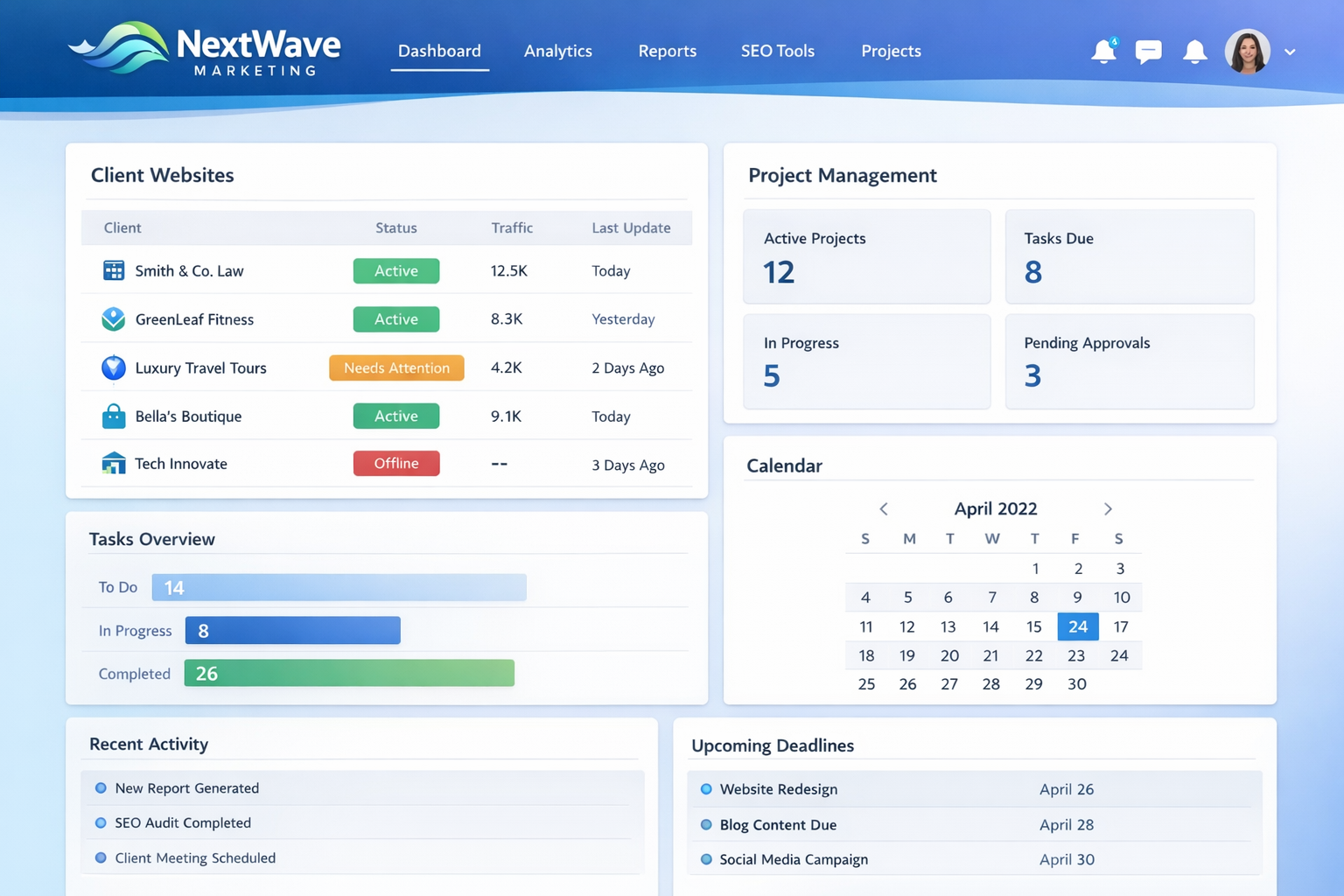
Complete White Label Platform
lindoai offers a fully white label experience from start to finish. As a complete white label website builder, it lets you brand the platform with your agency's identity from the moment you sign up.
The white label features include:
- Custom domain for your builder and client portal.
- Your logo and colors across the entire interface.
- Custom email templates sent from your domain.
- No "Powered by lindoai" anywhere on client-facing pages.
- Published sites with zero third-party branding.
This complete white label approach means your clients never know you are using a white label website builder. They see your brand, your dashboard, and your professional process.
AI Website Builder Integrated
At the heart of lindoai's platform is an AI-powered website builder that generates professional sites from simple prompts. The AI handles layout, content generation, image selection, and SEO optimization.
For agencies looking for the best white label website builder with AI capabilities, this integration is a force multiplier. You can:
- Generate a complete first draft in under 60 seconds.
- Customize every element with a visual editor.
- Generate new content sections with a single click.
- Optimize for SEO automatically.
The AI does not replace your creative input. It accelerates the production process so you can spend more time on strategy and client relationships.
Client Portal With Your Branding
lindoai includes a built-in client portal that your clients access from your branded domain. From this portal, clients can:
- Review website drafts and leave feedback.
- Track project milestones and deadlines.
- Access invoices and make payments.
- Submit maintenance requests.
This integrated portal eliminates the need for separate communication tools. Your clients get a professional, branded experience, and you get a streamlined workflow.
Flat-Rate Pricing for Predictable Margins
One of lindoai's standout features is its flat-rate pricing model. Instead of charging per site or per client, lindoai charges a single monthly fee for unlimited sites.
This pricing model is transformative for agencies. Your platform cost stays the same whether you build 5 sites or 50 sites per month. As you scale, your margins improve dramatically.
Compare this to per-site pricing models, which create a direct conflict of interest. With per-site pricing, every new client increases your costs. With flat-rate pricing, every new client increases your profit.
Evaluation Framework: How to Choose Your White Label Web Design Partner
Choosing the right white label platform is the single most important decision you will make for your agency's web design services. Use this evaluation framework to compare options objectively and find the best fit.
Scorecard for Evaluating White Label Platforms
Create a weighted scorecard with these criteria to evaluate each platform you consider:
| Evaluation Criteria | Weight | Platform A | Platform B | Platform C |
|---|
| White label completeness | 20% | | | |
| AI features | 15% | | | |
| Client management tools | 15% | | | |
| Hosting performance & uptime | 15% | | | |
| Security & compliance | 10% | | | |
| Pricing model | 15% | | | |
| Support quality | 10% | | | |
Rate each platform from 1 to 10 for each criterion, multiply by the weight, and add up the total score. The platform with the highest score is your best fit.
Critical Questions to Ask Each Provider
Before committing to a white label web design partner, get clear answers to these questions:
Can I fully rebrand the platform? Ask whether your clients will see any third-party logos, links, or mentions anywhere in the builder, client portal, or published sites. If the answer is anything less than a firm yes, move on.
What AI capabilities are included? Does the platform offer AI content generation, smart layout suggestions, automated SEO, and image selection? Or is it just a basic template library with a white label sticker?
How does client management work? Is there a dedicated client portal? Can clients leave feedback, approve work, and manage billing through the platform?
What hosting infrastructure backs the platform? Are sites hosted on a global CDN with automatic SSL? What uptime guarantees are offered? How are backups handled?
How is pricing structured? Is it flat-rate or per-site? Are there limits on the number of sites, pages, or bandwidth?
What level of support is available? Is there live chat, phone support, or a dedicated account manager? What are the response time commitments?
Can I customize beyond templates? Does the platform support custom CSS, JavaScript, and third-party integrations for projects that need more than standard templates?
Is migration supported? If you switch from another platform, can you migrate existing sites easily?
Red Flags to Watch For
Some warning signs should make you think twice about a white label partner:
- Hidden brand attribution. Some platforms claim white label support but still include small "Powered by" text in the footer or email notifications.
- Usage caps and overage fees. If the platform limits the number of sites, pages, or visitors and charges steep overage fees, your costs become unpredictable.
- No AI capabilities. In 2026, a white label platform without AI is a dinosaur. Manual template customization does not scale.
- Poor performance scores. Check the platform's sites on Google PageSpeed Insights and Web.dev. Slow load times will hurt your clients' SEO and user experience.
- Weak security posture. Ask about their security certifications, penetration testing schedule, and vulnerability disclosure process. The OWASP guidelines are a good benchmark for evaluating their security maturity.
By using this evaluation framework, you can make an informed decision that aligns with your agency's goals, budget, and quality standards.
How to Start Offering White Label Web Design Services
Ready to launch your white label web design offering? Follow these four steps to get started.
Step 1: Choose Your White Label Platform
Your choice of platform is the foundation of your white label web design business. Take the time to evaluate options carefully.
Create a shortlist of platforms that offer:
- Full white label capabilities with no third-party branding.
- AI-powered design and content tools.
- Built-in client management features.
- Flat-rate or predictable pricing.
- Reliable hosting with good performance.
lindoai ticks all these boxes, but you should evaluate multiple platforms based on your specific needs.
Step 2: Set Pricing and Packages
One of the biggest advantages of white label web design is the pricing flexibility it gives you. Your cost per site is low and predictable, so you can structure pricing to maximize margins while delivering exceptional value.
Consider these pricing strategies:
- Tiered packages: Offer Starter, Professional, and Enterprise packages at different price points.
- Flat project fees: Charge a fixed price per site based on complexity and page count.
- Monthly retainers: Include ongoing maintenance, updates, and hosting in a recurring fee.
With a white label platform costing you a flat monthly fee, your profit margins on each project can range from 60% to 85% depending on how you price.
| Package | Price | Sites Per Month | Your Cost | Profit Per Site |
|---|
| Starter | $2,500 | 5 | ~$50 flat | ~$2,450 |
| Professional | $4,500 | 3 | ~$50 flat | ~$4,450 |
| Enterprise | $7,500 | 2 | ~$50 flat | ~$7,450 |
These numbers assume you are using a flat-rate white label platform. The exact profit depends on your pricing strategy and market position.
Step 3: Onboard Clients
Client onboarding with white label web design follows the same process as traditional web design, with one key difference: the production happens through your white label platform.
Your onboarding process should include:
- Discovery call: Understand the client's business, goals, and preferences.
- Proposal and contract: Define scope, timeline, and pricing.
- Content gathering: Collect brand assets, copy, and images.
- Platform setup: Create the project in your white label dashboard.
Because your white label platform handles the technical production, your onboarding can be faster and simpler than traditional web design onboarding.
Step 4: Deliver and Maintain
Delivery is where white label web design truly shines. Because the platform handles hosting, security, and performance, you can focus on client communication and strategic guidance.
After launching a site, you can offer ongoing maintenance packages that include:
- Content updates and page additions.
- SEO monitoring and optimization.
- Performance tuning and security updates.
- Monthly traffic reports and analytics.
These recurring services create predictable, recurring revenue that stabilizes your cash flow and increases the lifetime value of each client.
White Label Web Design Pricing Models
Understanding the economics of white label web design is essential for running a profitable agency.
Flat Monthly Fee Model
The flat monthly fee model is the most favorable for agencies. You pay a fixed amount to the white label platform, regardless of how many sites you build or manage.
This model:
- Makes your costs predictable and easy to budget.
- Improves your margins as you scale.
- Removes the disincentive to take on more clients.
- Simplifies financial planning and forecasting.
For agencies building multiple sites per month, the flat fee model is the clear winner.
Per-Project Pricing
Some white label platforms charge per project or per site. This model is less favorable for high-volume agencies because costs scale linearly with volume.
Per-project pricing may work for:
- Agencies just starting out with low volume.
- Platforms that include specialized services like custom development.
- One-off projects where the cost is passed directly to the client.
However, for agencies with growth ambitions, per-project pricing creates a ceiling. Every new client increases your costs, reducing your incentive to grow.
How to Maximize Profit Margins
Regardless of your platform's pricing model, you can maximize margins by:
- Choosing flat-rate pricing whenever possible.
- Building templates for common project types to reduce setup time.
- Using AI tools to minimize manual production work.
- Bundling services like hosting, SEO, and maintenance into premium packages.
- Raising prices as your portfolio and reputation grow.
A well-run white label web design agency can achieve profit margins of 70% or higher on each project while delivering exceptional value to clients.
FAQ
Is white label web design legal?
Yes, white label web design is completely legal. It is a standard business practice called private labeling, used across industries from software to consumer goods. As long as you have a legitimate agreement with your white label provider and you are not misrepresenting intellectual property, there are no legal concerns.
Can I customize white label websites?
Absolutely. Modern white label platforms offer extensive customization options. You can change colors, fonts, layouts, content, and functionality. Most platforms also support custom CSS and JavaScript for advanced customization. The level of control rivals what you would get from building a site from scratch.
Do clients know it is white label?
No. If you choose a proper white label platform, the client sees only your brand. The platform's name, logos, and links are completely hidden. The client experience is identical to working with an agency that built everything in-house.
How much can I charge for white label web design?
Pricing varies by market, but most agencies charge between $2,500 and $10,000 for a standard business website built with a white label platform. The exact price depends on the number of pages, complexity of features, and your target market. With platform costs as low as $50 to $300 per month, the profit potential is substantial.
What is the difference between white label and reseller?
White label means the provider is completely invisible to your clients. Your brand is the only brand they see. A reseller arrangement often involves selling another company's services under that company's brand, with the reseller earning a commission or markup. White label builds more brand equity and is generally preferred by agencies that want to establish their own market identity.
Conclusion
White label web design is one of the most powerful business models available to agencies in 2026. It lets you scale your services without the overhead of hiring, deliver projects faster than traditional methods, and maintain strong profit margins while building your brand.
The key is choosing the right platform. You need a solution that offers true white label capabilities, AI-powered tools for efficiency, integrated client management, and pricing that rewards growth rather than penalizing it.
lindoai provides exactly this combination. With a complete white label platform, integrated AI website builder, client portal, and flat-rate pricing, it is built for agencies that want to scale. Start your free plan today and discover how easy white label web design can be.