
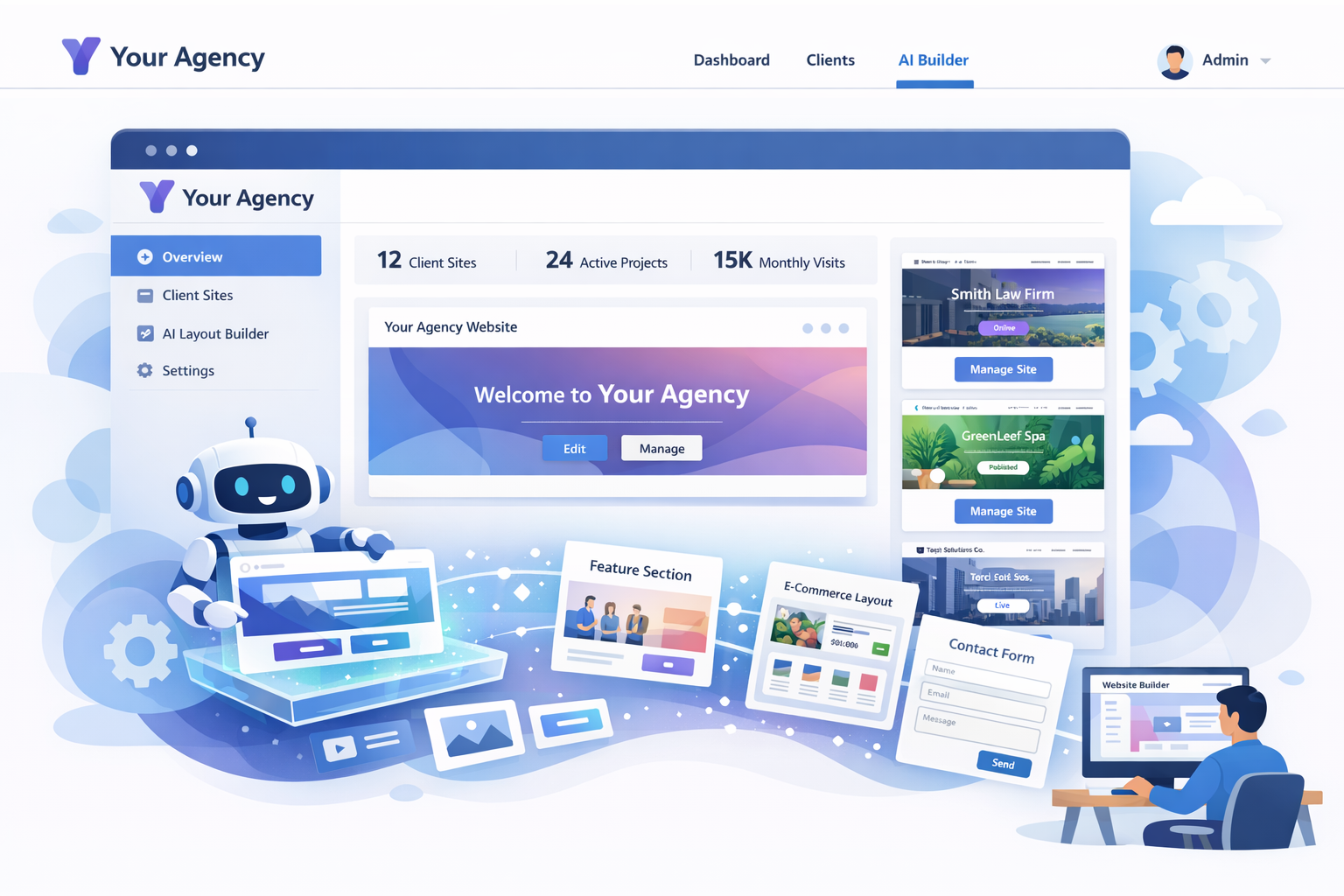
A white label AI website builder lets you create client websites quickly with AI, then rebrand the entire experience so your clients see your agency, not a third-party platform.
If you’re an agency, freelancer, or reseller, the appeal is simple: ship more sites with less repetitive work, keep your brand front and center, and build recurring revenue without scaling headcount linearly.
This guide goes deep. You’ll learn what a white label AI website builder is, how agencies use it to deliver faster, what features matter in real production, how pricing models work, and how to launch your first reseller offer with confidence.
White label plus AI is not a “nice-to-have.” It’s a delivery system. AI accelerates the first draft, and white label protects the client relationship.
What Is a White Label AI Website Builder?
A white label AI website builder is a website platform that combines two capabilities:
- AI-assisted website creation (structure, layout suggestions, draft copy, fast iteration)
- White labeling (your logo, your domain, your client portal, your brand experience)
In plain English: it helps you build websites with AI, and it helps you sell them under your own brand.
You’ll also hear related terms like:
- White label website builder
- Private label website builder
- Reseller website builder
- White label web design platform
The core idea is the same: your client should feel like they’re buying a productized service from you, not renting software from someone else.
How white labeling works (what clients actually see)
A true white label setup usually includes:
- A branded login experience
- A dashboard under your domain (for example, portal.youragency.com)
- Your logo and colors throughout the client portal
- Optional removal of “powered by” branding
That matters because perception drives retention. When the platform looks like your agency’s software, your service feels premium, and clients are less likely to shop around.
How AI changes the agency build process
Traditional web design has a predictable pain point: the blank page.
Your team spends hours setting up:
- Page structure
- Common sections
- Draft copy
- Basic styling
AI collapses that setup time by generating a strong first draft quickly. Then your team focuses on the work that actually differentiates an agency:
- Brand alignment
- Conversion-focused messaging
- SEO structure
- Proof and positioning
Why Agencies Choose a White Label AI Website Builder
Agencies adopt a white label AI website builder for the same reason they adopt any good system: it reduces chaos while increasing output.
The web design market itself is growing, with Mordor Intelligence projecting it will reach $92.06B by 2030, which means demand is there, but competition is increasing too.
Source: Mordor Intelligence Web Design Market
Speed and efficiency gains (without a quality drop)
A good AI builder reduces time-to-first-draft. That one metric drives everything:
- Shorter timelines
- Faster approvals
- Faster invoicing
- More projects per month
This is why agencies often productize AI delivery into offers like “site in 10 days.” The first draft arrives fast, and the rest of the timeline becomes refinement, not invention.
Stronger brand ownership (white label protects the relationship)
If you build on a platform that shows its own branding everywhere, you are effectively educating your client on how to replace you.
White label flips that dynamic:
- Your agency becomes the interface
- Your portal becomes the workflow
- Your process becomes the product
Most agencies think they sell websites. The best agencies sell outcomes, process, and ongoing improvement. White label makes that visible.
Scaling without proportional hiring
Hiring more designers can increase capacity, but it also increases complexity: more handoffs, more QA, more inconsistencies.
AI helps you scale systems first:
- Templates and reusable blocks
- Standardized brief inputs
- Repeatable page structures
Then you hire into a stable machine.
Recurring revenue and retention
White label makes it easier to keep clients on managed plans:
- Hosting and maintenance
- Content updates
- Landing pages
- SEO and reporting
If the client logs into your portal regularly, they are more likely to view your agency as infrastructure rather than a one-off vendor.
Key Features of a White Label AI Website Builder
Not all tools that claim “AI” or “white label” are built for agencies.
Here’s what to look for if you want a platform that works at 10 clients, 25 clients, and 50 clients.
White label depth (not just a logo upload)
A real white label setup includes:
- Custom domain for the portal
- Vendor branding removable or minimal
- Branded client emails and invites (if supported)
- Client-facing UI that does not expose the underlying vendor
Agency test: ask the vendor to create a client login under your domain and click every menu. If you see vendor naming everywhere, assume clients will too.
AI-powered layout and content generation
The AI should help with:
- Site structure and page generation
- Section suggestions per industry
- Draft copy that can be edited easily
- Multiple variations so you can present options
AI that only generates text is helpful, but it is not enough to transform delivery.
Template system and reusable components
This is where agencies win.
You want:
- Templates by niche (local services, coaches, professional services)
- Reusable blocks (testimonials, pricing, FAQs, CTAs)
- Brand presets so new sites start on-brand
Multi-client management and permissions
If the platform cannot manage clients cleanly, your team will drown in admin.
Look for:
- Workspaces per client
- Role-based access control
- Publishing permissions (you control what goes live)
- Version history and rollback
SEO and performance basics
At minimum:
- Title tags and meta descriptions
- Clean URLs
- Heading structure
- Mobile responsiveness
- Fast hosting and SSL
You can sell SEO packages only if the platform supports SEO fundamentals.
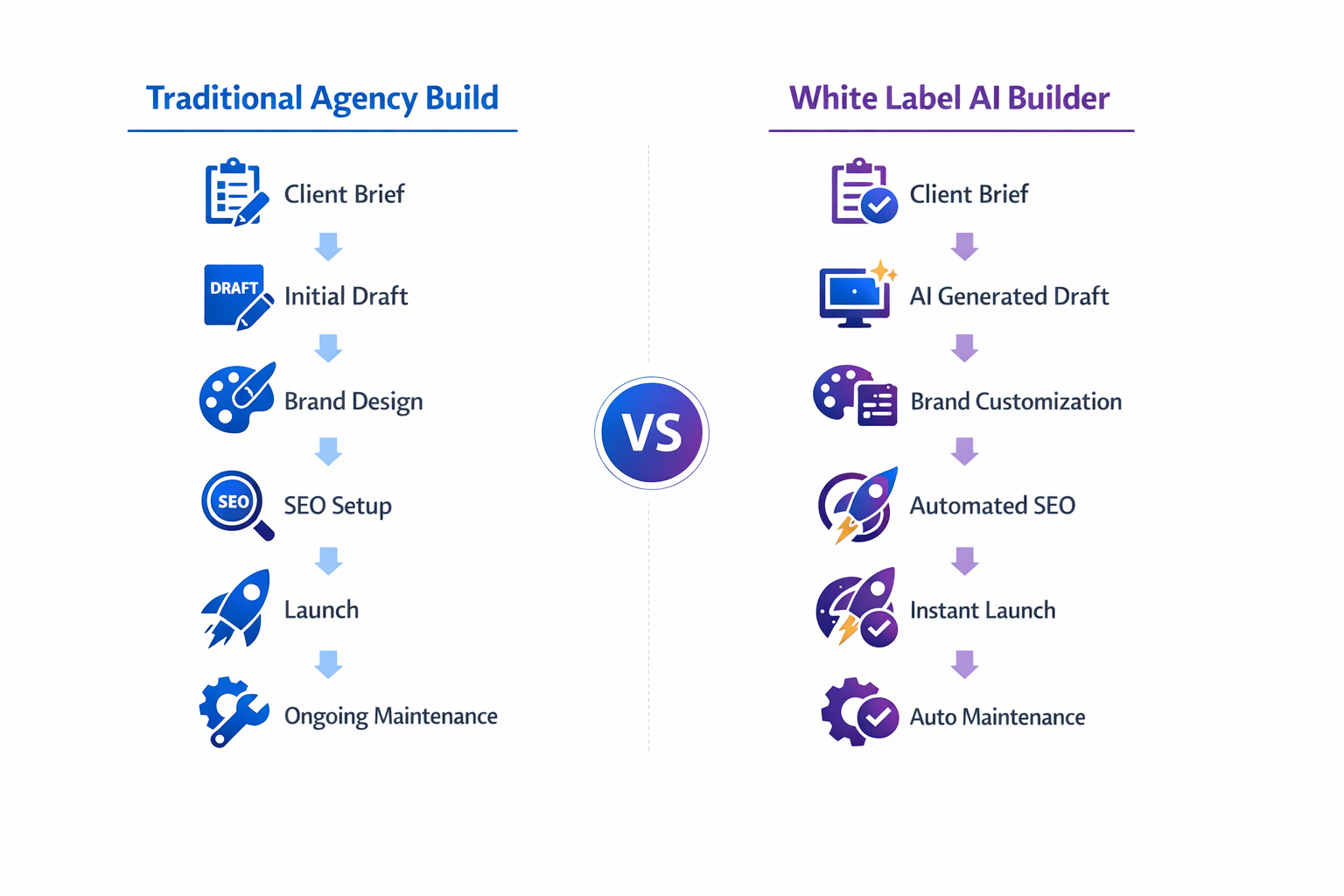
How a White Label AI Website Builder Works (Agency Workflow)
Let’s map this to a workflow you can actually run.
Step 1: Collect structured inputs (brief)
A structured brief produces better output than a long messy email.
Collect:
- Business type and niche
- Service list (top 3 to 5)
- Differentiators
- Location and service area
- Brand tone
- Primary conversion goal
- Proof assets (reviews, testimonials, logos)
Step 2: Generate the first draft
Use the AI to generate:
- Pages and navigation
- Section layout
- Draft copy
- Initial style system
Your target is a draft that is 70 to 80 percent complete.
Step 3: Human refinement (where agencies earn the money)
This is where you turn “generated” into “professional.”
Refine:
- Hero messaging and positioning
- CTA clarity and placement
- Proof and credibility
- SEO structure
- Design polish (spacing, typography, brand alignment)
Step 4: QA, launch, and ongoing management
A scalable agency process includes:
- Mobile review
- Form testing
- SEO metadata check
- Performance check
- Maintenance plan setup
If you want predictable margins, build checklists. AI accelerates drafts, but checklists protect quality.
White Label AI Website Builder vs Traditional Web Design
Traditional web design can produce beautiful work, but it is harder to scale.
Here’s a practical comparison.
| Approach | Best for | Pros | Cons |
|---|---|---|---|
| White label AI website builder | Agencies that want speed and repeatability | Faster production, reusable templates, consistent delivery, branded portal | Requires standardization, not ideal for ultra-custom apps |
| Traditional custom web design | High-end bespoke projects | Maximum flexibility, unique UX | Slower timelines, higher cost, hard to scale profitably |
| WordPress + page builders | Broad range of sites with plugin needs | Large ecosystem | Maintenance burden, performance variability, security overhead |
White Label vs Building Your Own Platform
Some agencies dream about building their own platform. It can make sense, but only under specific conditions.
Cost and time reality
Building your own platform requires:
- Engineering resources
- Ongoing maintenance and security
- Hosting and performance work
- Support and documentation
A white label platform gives you speed to market and predictable costs.
| Option | Upfront cost | Time to launch | Maintenance burden |
|---|---|---|---|
| White label AI website builder | Low to medium | Days to weeks | Low (vendor handles infra) |
| Build your own platform | High | Months to years | High (you own everything) |
When building your own platform makes sense
Consider it only if:
- You have an engineering team
- You plan to sell software as a product
- You have a real differentiator you cannot buy
Otherwise, most agencies win by staying focused on delivery, outcomes, and retention.
Pricing Models for White Label Resellers
Pricing is where white label becomes a business, not a hobby.
Per-site vs per-client vs flat fee
Common platform pricing models:
- Per-site: cost scales with published websites
- Per-client: cost scales with managed client accounts
- Flat subscription: tiers based on usage
What you want is predictable cost at scale.
How agencies set margins (simple framework)
- Calculate platform cost per site
- Add delivery cost (your hours)
- Add support buffer
- Price for outcome
A common structure:
- Launch fee (one-time)
- Monthly care plan
- Growth add-ons (SEO, landing pages, CRO)
This is how agencies turn faster production into recurring revenue.
Real Results: What Agencies Are Achieving
Even without publishing named case studies, agencies see consistent patterns when they adopt a white label AI website builder:
- Faster delivery, which increases capacity
- More consistent quality through templates
- Higher retention through branded portals and monthly plans
Web Professionals Global describes the industry as being in a transformative phase with growing emphasis on AI-assisted workflows.
Source: Web Professionals Global 2025 industry report
A practical way to measure ROI
If you want to measure ROI without complicated spreadsheets, track these four numbers for the next 30 days:
- Average time to first draft
- Total production hours per site
- Revision cycles per project
- Monthly churn on care plans
Even a small improvement multiplies.
Example:
- If you reduce production by 8 hours per site
- And your internal cost is $50/hour
- You add $400 in margin per project
At 10 sites per month, that is $4,000 of margin improvement. That usually pays for the platform and then some.
What changes for clients (why retention improves)
Clients rarely care that you used AI. They care that the process feels organized.
A white label AI website builder helps because:
- The portal gives them one place to log in
- The site improves over time, not just at launch
- Your team can respond faster to changes
That is why agencies that lean into care plans often see retention improve once delivery becomes systematic.
The pattern behind the best-performing agencies
The best agencies treat their platform like a product.
They build:
- A niche template library
- A standard onboarding process
- A QA checklist
- A monthly improvement plan
AI accelerates the engine, but the engine is still your process.
Operational Reality: Multi-Tenant Setup, Permissions, and Client Governance
A lot of white label content focuses on branding, logos, and domains. That matters, but agencies usually lose margin in a different place: operational overhead.
If your platform cannot handle multi-client delivery cleanly, you will drown in:
- Small change requests
- Accidental edits
- Confusing permissions
- “Who published this?” chaos
A serious white label AI website builder needs to behave like a multi-tenant system.
Multi-tenant structure (what to look for)
In a multi-tenant model, each client site is isolated. That means:
- Separate projects or workspaces per client
- Separate users and roles per client
- Clean separation of assets and templates
This reduces the risk of cross-client mistakes, which is a real risk once you scale.
Roles and permissions (the minimum set)
At minimum, agencies should be able to create these roles:
- Agency admin: full access across client accounts
- Agency collaborator: can edit, but cannot publish without approval
- Client reviewer: can comment and approve, but cannot break the site
If the platform only offers “admin” and “editor,” you will end up building your own permission system with Slack rules and prayers.
Publishing governance
Publishing should be intentional.
A mature workflow looks like:
- Draft changes
- Client review
- Agency approval
- Publish
This protects your brand and reduces emergency rollbacks.
Audit history and rollback
If you sell maintenance, you need insurance.
Look for:
- Version history
- The ability to rollback quickly
- Clear change logs
These are not “enterprise features.” They are margin protection.
Agencies do not lose money because they are slow. They lose money because they have to fix avoidable mistakes.
Pricing and Packaging: How Agencies Turn AI Speed Into Profit
Here is the reality: if you use AI to deliver faster but keep selling “custom websites,” you will not capture the value.
White label and AI work best when you package outcomes.
Model 1: Fast-launch offer
A common offer for small businesses:
- First draft in 24 to 48 hours
- Launch in 7 to 10 business days
- One main revision cycle plus a small polish cycle
This works because it is easy to understand and it reduces client anxiety.
Model 2: Build plus care plan
This is the highest leverage model for agencies.
- Launch fee covers build and initial setup
- Monthly plan covers hosting, security, updates
- Add-ons cover growth (SEO, landing pages, conversion work)
Guardrail tip: define what “updates” means. Text changes and image swaps are different from new page builds.
Model 3: Niche subscription
If you specialize in a niche, you can sell a subscription that includes:
- A niche template set
- Ongoing updates
- Seasonal landing pages
- Reporting
AI helps you keep delivery fast while maintaining consistency.
Example margin math (simple but useful)
Use this model to validate pricing:
- Production hours per site with AI
- Your internal blended hourly cost
- Platform cost per site
- Support buffer per month
Then price the offer based on value.
If AI saves you 10 to 15 hours per site, do not automatically lower prices. Keep prices stable and increase profit, or keep profit stable and add more value.
Migration, Ownership, and Client Offboarding
Migration is the question clients ask when they have been burned before.
If you want to sell confidently, you need clear answers.
Who owns the site and content?
Clients should own their content, but you should define:
- Who owns the design and templates
- What happens to custom assets
- What the client receives if they leave
Export and portability
Some platforms allow easy export. Others do not.
If your platform is not export-friendly, build an offboarding plan:
- Final content delivery as files
- Redirect plan
- SEO metadata transfer checklist
SEO-safe migration process
If you migrate existing clients, protect:
- URL structure and redirects
- Meta titles and descriptions
- Image alt text
- Analytics tracking
A controlled pilot migration of 1 to 3 clients is the safest approach.
Real Results: What Agencies Are Achieving (Patterns)
Even without naming clients, agencies tend to see the same improvements after adopting a white label AI website builder.
Pattern 1: Shorter time to first draft
The first draft is the bottleneck. Once it is fast, projects move.
Pattern 2: More consistent delivery
Templates and reusable blocks reduce variability, which reduces QA time.
Pattern 3: Higher retention
A branded portal plus ongoing plans creates stickiness.
If you want an industry signal: Web Professionals Global describes the industry as being in a transformative phase with growing emphasis on AI-assisted workflows.
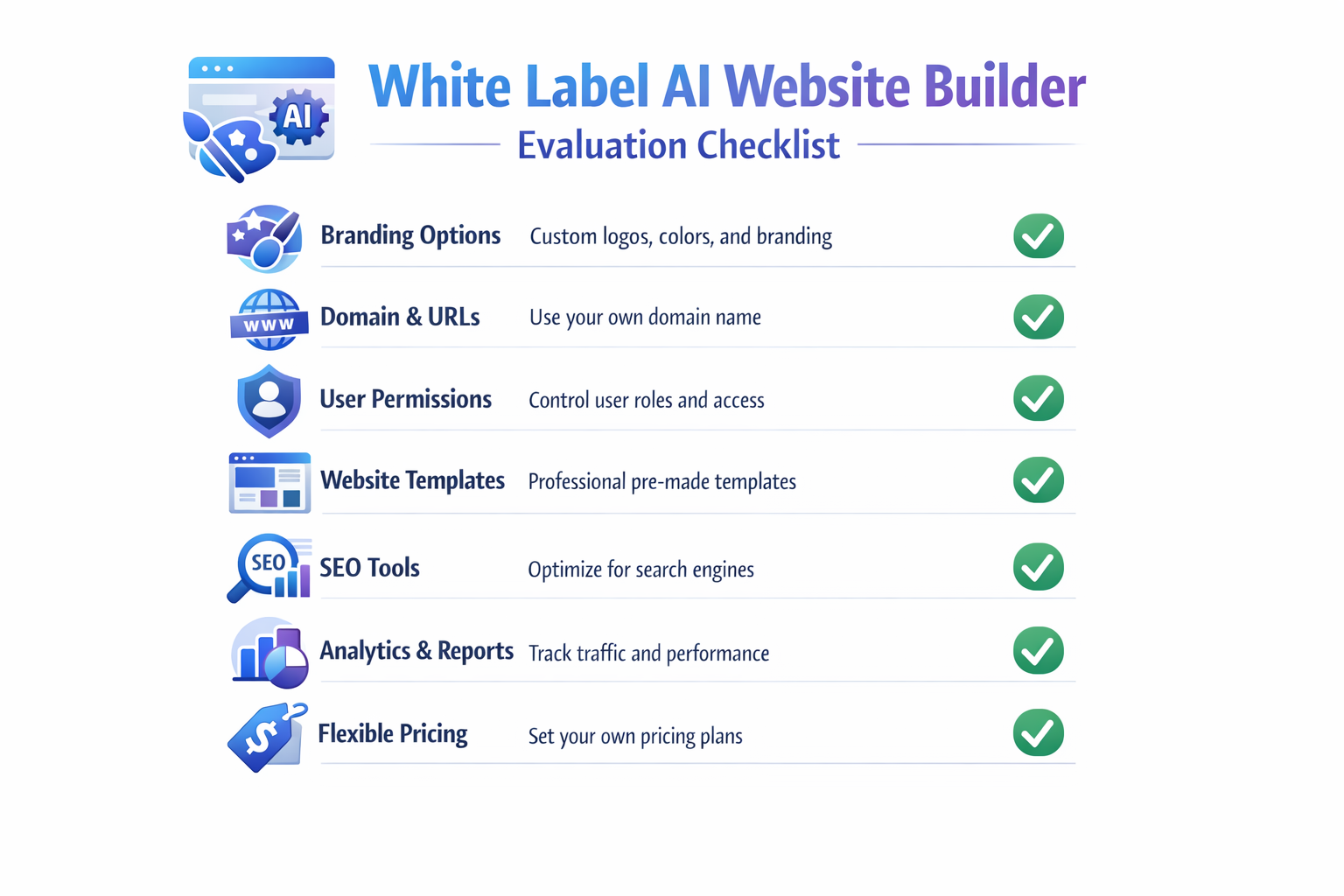
How to Choose a White Label AI Website Builder (Evaluation Checklist)
Use this checklist during demos. It will save you months of pain.
Branding and portal
- Custom domain for the portal
- Vendor branding removable
- Brand presets and reusable templates
AI and production speed
- Draft site generation from a structured brief
- Section generation and variations
- Editable output (no locked content)
Agency operations
- Multi-client management
- Roles and permissions
- Approval workflow
- Rollback/version history
SEO and performance
- Titles, metas, headings, clean URLs
- Mobile responsiveness
- Reliable hosting and SSL
Pricing and scale
- Clear pricing at 10, 25, 50 sites
- Support SLA
- Export/migration path
Getting Started: How to Resell Websites Under Your Brand
Here’s a step-by-step launch plan.
1) Pick a niche or a narrow offer
Start narrow so delivery is repeatable:
- Local service businesses
- Coaches and consultants
- Clinics and practices
2) Set up your white label branding
Brand the portal and set a custom domain if supported.
3) Build templates and reusable blocks
Create:
- A homepage structure
- A services layout
- A testimonials block
- A pricing or CTA block
4) Sell a packaged offer
Sell speed, clarity, and outcomes.
Then add the recurring plan.
5) Build a launch checklist (so speed does not break quality)
Your first few sites will feel easy. The mistakes show up when you have 10 clients and everyone wants “one small change.”
Use a checklist for every launch:
- Meta title and description set on key pages
- One H1 per page, headings structured
- Forms tested and routed to the right inbox
- Mobile checked on real devices
- Images optimized and alt text added
- Analytics installed
6) Sell the maintenance plan before you launch
The best time to sell recurring is when the client is excited.
Offer a simple menu:
- Care plan (hosting, security, small edits)
- Growth plan (SEO pages, landing pages, reporting)
This is how a white label AI website builder becomes a recurring revenue engine.
7) Document your process
Write down:
- Your brief template
- Your standard page structure
- Your QA checklist
- Your revision rules
Documentation makes delivery consistent, and consistent delivery is what scales.
White Label AI Website Builder vs White Label Website Builder (Do You Need the AI Part?)
Some agencies already use a white label website builder and wonder if the “AI” part is actually necessary.
Here is the honest answer: AI is most valuable when your agency delivers high volumes of similar sites, or when your clients consistently struggle to provide content.
When AI is a game changer
AI saves the most time when you need to produce:
- A full site structure quickly
- Multiple versions of hero messaging
- Draft service descriptions and FAQs
- Page variations for different offers or locations
If your agency is often blocked waiting on client copy, AI reduces that bottleneck.
When AI is less important
AI matters less when:
- Every project is custom UX and custom development
- The client provides high-quality copy and brand assets up front
- Your agency sells strategy and design thinking more than speed
In those cases, you may still want white label, but AI will not be the primary lever.
The best hybrid approach
Many agencies adopt a hybrid workflow:
- Use AI to generate a first draft
- Use humans to refine messaging, design system, and SEO
- Use templates to enforce consistency
That is how you get speed without shipping generic work.
The 60-Minute Demo Test (What to Do Live)
If you want to evaluate platforms quickly, run this exact test during a demo.
- Create a new site from a structured brief
- Generate the draft with AI
- Change global styles and save a brand preset
- Edit SEO metadata on the homepage
- Add a form and test submission
- Invite a client user and verify permissions
- Publish and confirm the live URL
If any step is painful, that pain will repeat across every client you onboard.
Common Mistakes Agencies Make (and How to Avoid Them)
Mistake 1: Shipping AI drafts without polish
Fix: require a human polish pass with a checklist.
Mistake 2: Selling “unlimited edits” on a monthly plan
Fix: define what edits are included, and create an upgrade path.
Mistake 3: Ignoring SEO and analytics
Fix: build SEO and tracking into your standard launch checklist.
Mistake 4: Picking a platform based on the demo homepage
Fix: test multi-client ops, permissions, and templates, not just the homepage builder.
White Label AI Website Builder Buyer Checklist (Copy/Paste)
Use this checklist to evaluate any white label AI website builder in a consistent way.
White label requirements
- Custom domain for portal
- Vendor branding removable
- Branded emails or at least consistent sender branding
Agency operations
- Multi-client workspaces
- Roles and permissions
- Approval workflow before publish
- Version history and rollback
AI capabilities
- Draft site generation from brief
- Section generation and variation
- Editable copy and layout
Website fundamentals
- SEO controls (titles, metas, headings, URLs)
- Mobile responsiveness
- Reliable hosting and SSL
Business model
- Pricing that preserves margin at 10, 25, 50 sites
- Support SLA
- Export and migration plan
If a platform scores low on permissions or multi-client ops, it will cost you time and churn later.
Where lindo.ai fits
If you want to build and resell sites under your own brand, lindo.ai supports agency workflows and can help you deliver faster.
FAQ
Is a white label AI website builder worth it for small agencies?
Yes, especially if you want to increase output without hiring immediately. Small agencies benefit from templates, repeatable workflows, and faster first drafts.
Can I use my own domain and branding?
In most cases, yes. Always confirm custom domain support, branding depth, and whether the vendor branding can be removed from the client portal.
How does AI help build websites faster?
AI accelerates the highest-friction steps: initial structure, section generation, and draft copy. Instead of starting from a blank page, you start from a draft and refine.
Can clients tell it is white labeled?
If the platform supports true white labeling, clients should see your branding and your domain. Always test the full client login experience.
What about migration and ownership?
Ask early: - Can you export sites? - What happens if you stop paying? - Who owns the content? This protects your agency and your clients.
Build and resell websites under your brand
A white label AI website builder can help you deliver faster, standardize quality, and create recurring revenue.
If you want to explore an agency-ready option, start here: AI website builder