
In practical terms, a white label website builderlets an agency offer website software without developing the editor, hosting, or infrastructure itself. Clients see the agency’s brand while the underlying provider runs the technology. The agency controls its services, pricing, client relationship, and ongoing website management.
Best for
- Agencies and freelancers managing several client websites
- Teams that want a branded portal and recurring service model
- Resellers standardizing delivery for a niche or local market
Not ideal for
- A business that needs only one simple website and no client portal
- Teams requiring full source-code ownership or a proprietary editor
- Regulated projects before security and compliance needs are verified
White label, reseller, partner, or private label?
These terms describe different parts of the business relationship. Check what clients actually see instead of relying on the vendor’s label.
| Model | What it means | Whose brand clients see |
|---|---|---|
| White label | You rebrand the provider’s platform and client experience. | Your agency |
| Reseller | You sell the provider’s product or a service built on it. | Depends on the program |
| Partner or affiliate | You refer customers and may earn commission. | The provider |
| Private label | A more exclusive or customized branded implementation. | Usually your business |
If you are evaluating a platform now, use the checklist below and compare the full client login, emails, billing, permissions, export options, and support—not just the logo settings. You can also inspect Lindo’s white label website builder platform as a concrete example.
What Is a White Label Website Builder?
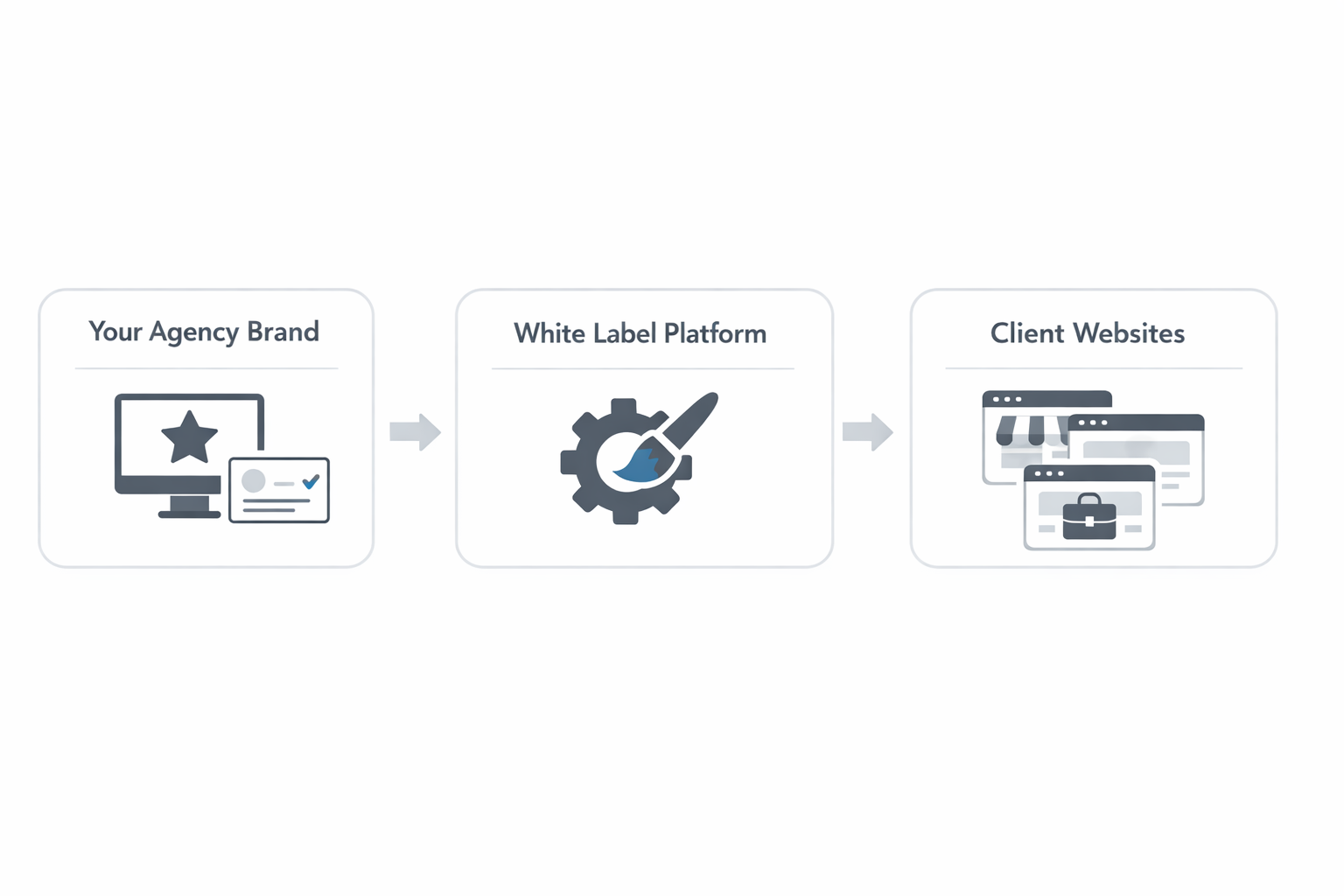
A white label website builder is a website creation platform you can rebrand as your own, then use to build, manage, and resell websites to clients under your company name.
Instead of sending clients to “Platform X” and letting that brand get the credit, you present a fully branded experience that feels like your agency built proprietary software:
- Your logo and brand colors
- Your custom domain (for the portal or dashboard)
- Your client portal experience
- Your packages, pricing, and onboarding
You will also see related terms like white label web design platform, reseller website builder, branded website builder for agencies, and white label site builder. They all point to the same core idea: you sell websites and ongoing services, while the platform stays invisible.
How white labeling works (in plain English)
Here’s the simplest way to picture it:
- You choose a platform that supports white labeling.
- You apply your branding (logo, colors, domain, and sometimes custom emails).
- You build or generate client websites on top of the platform.
- Your client logs into a dashboard that looks like your software.
From the client’s perspective, your agency is not only the service provider. You look like the technology provider too.
The strategic difference is control: you own the client relationship and can offer ongoing value in one branded experience. That can support retention when the service remains useful and the client can get help easily.

Who uses white label builders?
White label platforms are popular with:
- Web design agencies that want to scale production and retain clients
- Freelancers who want to productize a “website in X days” offer
- Marketing agencies that want to add websites as a high-margin service
- SaaS resellers packaging websites for a niche (coaches, trades, local services)
If your business depends on delivering multiple sites per month, a white label site builder is often the cleanest way to reduce operational chaos.
White label vs “partner program” (do not confuse these)
Some vendors offer partner programs that include referral links, commissions, or limited branding. That is not the same as a true white label website builder.
A true white label platform usually includes:
- A branded dashboard under your own domain
- The ability to remove vendor branding from the client-facing experience
- A scalable structure for managing multiple client sites
If the vendor brand is still front and center, you are effectively doing lead generation for someone else.
What you can white label (and what you usually can’t)
This is where agencies get burned. Two platforms can both claim “white label,” but one gives you a true branded experience and the other gives you a logo upload and a “powered by” footer.
In most cases, a white label website builder lets you customize:
- Portal branding: your logo, colors, and sometimes typography across the dashboard
- Custom domain: clients log into a URL on your domain (for example, portal.youragency.com)
- Client-facing messaging: invites, onboarding emails, and notifications (sometimes fully customizable)
- Default brand presets: a starting style system so every new site begins “on brand”
What many tools do not fully support (and you should test):
- Full email white labeling (from domain, sender name, reply-to consistency)
- Removal of every vendor reference (some keep subtle vendor marks in settings or URLs)
- Custom billing experience (you may still need Stripe, invoicing tools, or a reseller plan)
Actionable tip: ask the vendor to create a demo client login under a custom domain, then click through every menu. If you see vendor naming inside the product, assume your clients will eventually see it too.
Common white label business models
Agencies and resellers typically run one of these models:
- Build + handoff: you build the site on your platform and hand it to the client. This is the least “sticky” model.
- Build + manage: you keep the site in your platform and charge monthly for updates, hosting, and ongoing improvements.
- Reseller at scale: you sell the platform experience plus services to a specific niche (for example, “websites for gyms”), often with standardized templates and onboarding.
If you want recurring revenue, the build + manage model is often the most practical starting point. Retention still depends on the quality of the ongoing service, not the platform alone.
Why Agencies Are Switching to White Label Platforms
The useful question is not whether white labeling is popular. It is whether a platform removes enough production, client-management, and support work to improve your agency’s delivery model.
Here are the operational reasons agencies evaluate white label platforms.
Speed up delivery without sacrificing quality
Most agencies lose margin in the same place: production time.
You can build beautiful sites, but if you have to rebuild from scratch every time, your capacity is capped. A strong white label website builder gives you:
- Reusable templates and sections
- Brand presets
- Fast first drafts
- A consistent publishing workflow
When you combine that with AI assisted creation (layout suggestions, content drafts, section generation), you compress the blank page phase dramatically.
Actionable tip: track your “time to first draft” on the last 5 projects. If it’s more than 2 to 3 days, you are leaving margin on the table.
Recurring revenue and client retention
White label changes your business model.
Instead of one off builds, you can sell monthly plans such as:
- Hosting and maintenance
- Content updates
- Landing pages for campaigns
- SEO retainers
- Conversion optimization
A branded platform can also make the ongoing relationship easier to understand: clients know where to request updates, review performance, and manage their service. That convenience can support retention, but it does not replace good service.
If clients log into your branded dashboard every month, you are no longer “the agency they hired once.” You are infrastructure.
Lower overhead vs building from scratch
Building your own platform sounds attractive until you do the math.
Custom development means:
- Engineering costs
- Ongoing bug fixes
- Security updates
- Hosting and performance tuning
- Feature requests from clients that never end
A white label website builder lets you deliver the software experience without becoming a software company.
Better client experience (less email chaos)
Most client frustration comes from ambiguity: “Where do I leave feedback?” “What is the status?” “Which version is live?”
A good branded website builder for agencies often includes a client portal, roles, and workflow checkpoints. That reduces back and forth and makes projects feel more professional.
The “package problem” (and why white label fixes it)
Most agencies feel pressure to sell custom work because it sounds premium. The problem is that custom work is hard to standardize. That means:
- Project timelines slip
- Revisions explode
- Profit per project becomes unpredictable
White label platforms push you toward packaged delivery. You build your own internal “production system” with templates, blocks, and repeatable steps.
Example: local service websites often share a repeatable structure: Home, Services, About, Reviews, and Contact. Templates and brand presets can reduce first-draft time once your team has standardized that workflow.
Client trust and perceived professionalism
Here’s the subtle benefit agencies underestimate: a branded portal changes how clients perceive you.
When clients can log in, see progress, review changes, and feel like they’re working with a structured system, they are less likely to treat you like a freelancer they can micromanage.
That impacts:
- How fast they approve work
- How comfortable they feel paying monthly
- How likely they are to refer you
The portal is not just admin convenience. It’s positioning.
Key Features to Look For in a White Label Builder
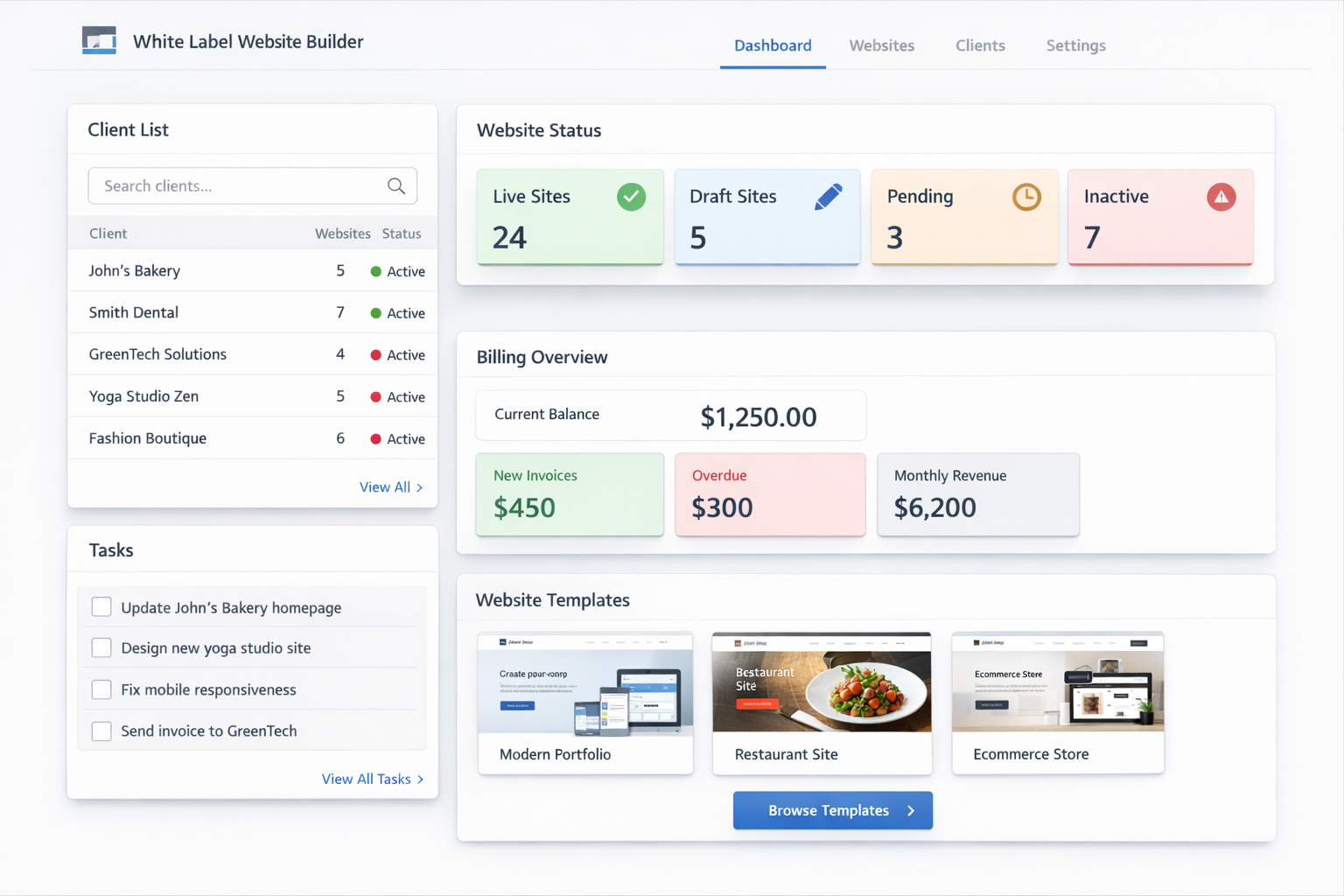
Not all platforms are built for real agency life. Many tools claim to be “white label” but still expose the vendor, limit branding, or fail in day-to-day operations.
Here are the features that actually matter.
Custom branding and domain
This is the core promise.
At minimum, you want:
- Custom logo and colors
- Custom domain for your agency portal
- Minimal or removable “powered by” branding
Checklist: ask for a demo of the full client login experience. If the vendor brand appears in the URL, the dashboard, or system emails, that is a red flag.
AI powered design tools
AI is not magic, but it is leverage.
Useful AI capabilities include:
- Generating a first draft site structure from a business description
- Suggesting section layouts (hero, services, testimonials, FAQs)
- Drafting copy you can edit and refine
- Creating multiple variations quickly for client review
The goal is simple: fewer hours per site, without lowering quality.
Client management dashboard
A reseller website builder must support client operations.
Look for:
- Multiple clients and projects, separated cleanly
- Role based access (client vs admin vs teammate)
- Approval workflows so clients can review before publishing
- A clear way to duplicate templates across clients
If you cannot manage clients efficiently, you will hit a scaling wall fast.
SEO and performance
A website that looks good but does not rank or load fast is a retention problem.
Your platform should support:
- Easy title tags and meta descriptions
- Clean URL structure
- Proper heading hierarchy
- Mobile performance basics
- Fast hosting and reliable uptime
Because clients do not blame “the platform.” They blame you.

Templates, reusable blocks, and brand presets
The real scaling power is standardization.
Look for:
- Industry templates
- Reusable blocks (testimonials, pricing, FAQs)
- Brand presets so every new site starts on brand
This is what makes higher site volume possible without rebuilding the same components for every client.
Security, compliance, and reliability
If you serve professional businesses, this matters more than most agencies admit.
Minimum expectations:
- SSL by default
- Backups
- Role based access
- Clear publishing permissions
If you work with regulated niches (healthcare, finance), add compliance requirements to your evaluation.
Integrations that matter (CRM, forms, analytics, booking)
Even if your platform is “all in one,” agencies still rely on a few core integrations.
Make sure the platform supports, directly or indirectly:
- Forms and lead capture: native forms or easy embedding
- Analytics: straightforward Google Analytics / GA4 support and conversion tracking
- CRM handoff: simple workflows to push leads to HubSpot, Pipedrive, or another CRM
- Scheduling: easy integration with Calendly or similar tools
Actionable tip: build a test landing page, submit a form, and track the lead end to end. If you cannot do that cleanly, client marketing packages become harder to deliver.
Hosting, uptime, and support (your hidden cost center)
The cheapest platform is not always the best platform. If you spend hours debugging hosting issues, your “tool cost” becomes labor cost.
Ask directly:
- What is the uptime expectation?
- Who handles SSL, backups, and incident response?
- What is the support SLA (hours, response time)?
If you sell websites at scale, your support time is your real margin killer. Choose a platform that reduces support tickets, not one that creates them.
“White label” in the contract: what to confirm
Before you sign anything, confirm what the vendor means by white label. Ask for these answers in writing:
- Can you remove all vendor branding from the client dashboard?
- Can you use a custom domain for the portal?
- Are there limits on the number of client accounts or sites?
- What happens if you stop paying, can you export sites?
This is not paranoia. It’s risk management. Your agency reputation is tied to the platform, even if the client never hears its name.
What to test in a 60-minute platform trial
If you only have one hour to evaluate a platform, do this:
- Create a site from scratch or from a template.
- Customize branding (logo, colors, fonts) and save a preset.
- Add a contact form and test a submission.
- Edit SEO meta title and description.
- Preview on mobile.
- Publish to a live URL.
- Log in as a client role and try to leave feedback.
If any of those steps is painful, that pain will scale with every client you add.
White Label vs Building Your Own Platform
This is the decision many agencies wrestle with, especially once they hit consistent revenue.
Cost comparison table
Here’s a practical comparison.
| Option | Upfront cost | Ongoing cost | Time to launch | Best for |
|---|---|---|---|---|
| White label website builder | Low to medium | Predictable subscription | Days to weeks | Agencies that want speed and margin |
| Build your own platform | High | High and variable | Months to years | Teams with engineering and long-term product plans |
Most agencies do not need a proprietary platform. They need a repeatable delivery system.
Time to market
If your goal is to start reselling websites this quarter, building your own platform is rarely realistic.
White label lets you:
- Launch a branded offer quickly
- Test niches and pricing
- Iterate on packages
You learn faster, and you start collecting recurring revenue sooner.
Maintenance and updates
With a white label web design platform, the vendor handles:
- Security updates
- Infrastructure
- Performance
- New features
You focus on selling, delivering, and retaining.
Decision checklist: which path fits your agency?
If you’re stuck between “we should build our own” and “we should white label,” use this checklist. Answer honestly.
Choose a white label platform if:
- You want to launch or pivot in weeks, not quarters
- Your team is primarily designers, marketers, or account managers
- You want predictable platform costs and fewer infrastructure fires
- Your edge is delivery, niche expertise, and client outcomes
Building your own platform may make sense if:
- You have an in-house engineering team and a product roadmap
- You plan to sell software at scale (not just services)
- You can afford a long feedback loop and ongoing R&D
- You have a unique technical differentiator you cannot buy
Reality check: if your agency is not already running a disciplined product process (roadmap, QA, release cycles, support), “building a platform” often turns into a distraction that slows growth.
The hybrid approach many agencies use
Some agencies choose a hybrid approach:
- Use a white label site builder for routine, repeatable projects
- Reserve custom development for high-value exceptions (complex ecommerce, custom apps, unique integrations)
This keeps delivery fast for most clients while preserving your ability to do bespoke work when it pays.
Implementation Playbook: Your First 30 Days
If you want to make this real, here is a 30-day implementation plan you can follow. This is designed to get you from “thinking about it” to “selling it.”
Days 1-3: Platform selection sprint
- Build one mock client site end to end
- Test the client login experience under your branding
- Verify SEO basics (titles, metas, URLs)
- Confirm how templates and duplication work
Days 4-10: Create your core templates
Build templates for your most common niche:
- Home
- Services
- About
- Contact
- Reviews / Testimonials
- FAQ
Create reusable blocks for:
- Pricing
- CTAs
- Social proof
- Service grids
Days 11-15: Package and pricing
Write one clear offer page for your own website:
- What you build
- How fast you deliver
- What it costs
- What happens after launch (monthly plan)
Days 16-30: Start selling
- Outreach to 30 niche businesses
- Partner outreach to 5 marketing agencies
- Publish 1 niche case study or sample site
- Close 1-3 pilot clients and refine your process
The goal of the first 30 days is not perfection. It’s proof: proof you can sell it, deliver it, and retain it.
How to Launch Your White Label Web Design Business
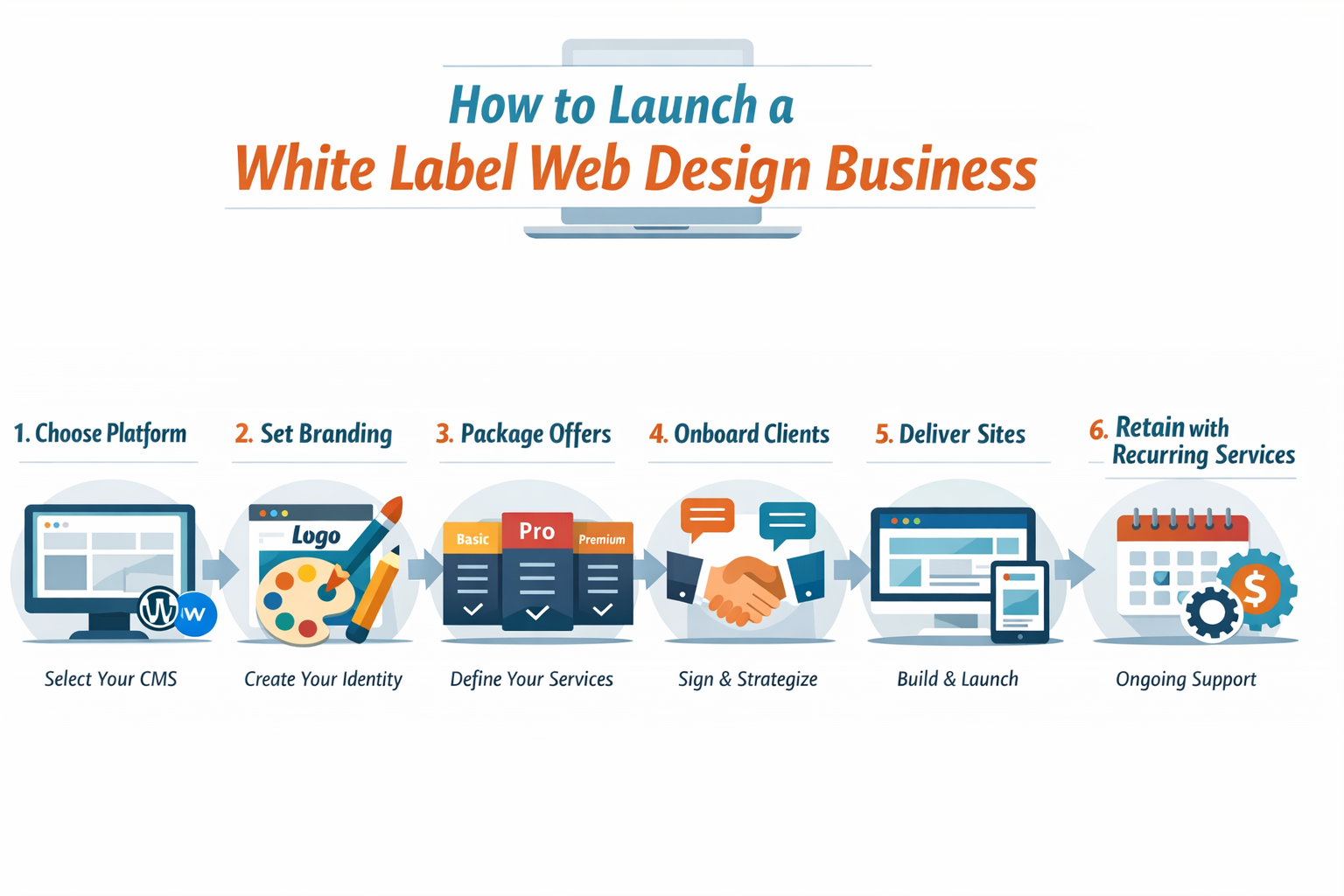
Most agencies fail at this because they keep selling “custom websites.” The white label model works best when you productize delivery.
Here is a step by step plan.
Step 1: Choose your platform
Define your non negotiables:
- True white labeling (branding and domain)
- Client management
- Templates and reuse
- SEO basics
- Pricing that leaves room for margin
Then shortlist 2 to 3 platforms and test them by building a mock client site.
If you want a platform designed for agencies from day one, start here: white label website builder
Step 2: Set up your brand
Your goal is to make the platform feel like your product.
Do this before onboarding clients:
- Add your logo and colors
- Configure your domain
- Create a branded onboarding checklist
Step 3: Package your services
Productized services sell faster than custom quotes.
A simple three tier model:
- Starter: 3 to 5 pages, basic SEO, launch in 7 to 10 days
- Growth: everything in Starter, plus blog, analytics, advanced SEO setup
- Scale: everything in Growth, plus landing pages and ongoing updates
Step 4: Land your first clients
What works early:
- Niche outreach (local services, coaches, clinics)
- Partnerships with marketing agencies that do not build websites
- A “website refresh” entry offer
- Case studies and before after examples
The key is to sell an outcome, not a website.
Pricing Models for White Label Resellers
Pricing is where agencies either scale or stall.
Per site vs per client vs flat fee
Common models:
- Per site: you pay for each live website
- Per client: you pay based on number of clients managed
- Flat fee: monthly subscription with usage tiers
For most agencies, predictability matters.
How to set your margins
A simple framework:
- Calculate platform cost per client site.
- Add your delivery cost (time, contractors, revisions).
- Add a buffer for support.
- Price for value.
Example:
- If your blended cost per site is $250/month
- And you sell a plan for $499/month
- You can support the account and still have margin
The point is not the exact number. The point is controlling costs and standardizing delivery.
A practical pricing framework you can copy
If you want pricing that works, you need two things: predictable platform costs and a packaged offer that clients understand.
Here’s a simple framework many agencies use:
- Build fee (one-time): covers setup, initial design, and launch.
- Management fee (monthly): covers hosting, security, and routine updates.
- Growth add-ons (monthly or quarterly): SEO, landing pages, CRO, or content.
Example structure:
- Launch: $1,500-$5,000 depending on niche and complexity
- Care plan: $199-$799/month depending on what’s included
- Growth plan: $500-$2,500/month (SEO + landing pages + reporting)
The numbers are not universal. The logic is. You separate the initial build from the long-term relationship.
How to avoid pricing traps
Common traps include:
- Pricing based on hours instead of outcomes
- Offering “unlimited edits” without guardrails
- Underpricing support time (clients will use it)
Guardrail tip: define what “updates” mean in your monthly plan (for example, text edits and image swaps, not full page redesigns). Then add an upgrade path for bigger changes.
How to Measure the Return from a White Label Platform
A white label platform does not guarantee faster delivery, better margins, or higher retention. Measure whether it changes those outcomes in your own workflow.
The potential benefits to test are:
- Faster delivery, which increases capacity
- Higher retention from monthly plans
- Better margins from standardized packages
Compare these measures before and after a controlled pilot instead of relying on a vendor’s productivity claims.
What “ROI” looks like in practice
When agencies talk about ROI from white label platforms, it usually shows up in three places:
- Capacity: you can deliver more sites per month with the same team.
- Margin: fewer hours per project means profit rises even if pricing stays stable.
- Retention: clients stay longer when you manage the site inside your system.
A practical way to measure it is to track:
- Time to first draft
- Total production hours per site
- Revision cycles per project
- Monthly churn rate on care plans
Illustrative calculation: if a measured workflow change saves 10 production hours and your fully loaded internal cost is $50 per hour, the modeled savings are $500 per project. Replace both assumptions with your actual time and cost; this is not a Lindo customer benchmark.
Delivery patterns worth testing
Start with a narrow, repeatable use case and measure it:
- Local services: standardized pages, strong CTAs, simple lead capture
- Professional services: authority content, testimonials, conversion focused layouts
- Niche landing pages: rapid testing for ads and campaigns
The common thread is a repeatable structure. That is exactly what a white label web design platform enables.
Where lindo.ai fits
If you want to build and resell websites under your own brand, lindo.ai is built for that model.
Explore:
White Label Website Builder Evaluation Checklist (Copy/Paste)
If you want a quick way to compare platforms, use this checklist during demos. Copy it into a doc and score each item 0-2.
Branding and white label depth
- Custom domain for the client portal
- Vendor branding removable (no forced “powered by”)
- White-labeled emails and invites (or at least consistent sender branding)
- Branded templates and presets you can reuse
Agency operations
- Multi-client management (clear separation)
- Roles and permissions (admin, teammate, client)
- Approval workflow before publishing
- Easy duplication of sites, pages, and blocks
Website quality
- Mobile responsiveness is strong by default
- SEO controls (titles, metas, headings, URLs)
- Performance basics (fast load times, stable hosting)
- Simple integrations (analytics, forms, CRM handoff)
Business model support
- Pricing model that preserves your margin at 10, 25, 50 sites
- Ability to package your own services on top
- Clear support process and SLA
- Export/migration options if you ever need to move
If a platform scores low on client ops or white label depth, it will cost you time and churn later.
FAQ
How much does a white label website builder cost?
It depends on the pricing model (per site, per client, flat fee) and how many sites you manage. The real question is whether you can maintain healthy margins after support and revisions. A good test is to model your costs at 10 sites, 25 sites, and 50 sites and see if your pricing still works.
Do I need technical skills to use one?
Not necessarily. Many platforms are designed for non technical teams, especially if they include templates and AI assisted creation. That said, technical knowledge helps with advanced SEO, integrations, and custom requirements.
Can my clients tell it is white labeled?
If the platform supports true white labeling, clients should see your branding, your domain, and your portal. However, some tools still show “powered by” marks or vendor UI elements. Always test the full client login experience.
What is the difference between white label and reseller?
They are closely related: white label is rebranding the platform as your own, and reseller is the business model of selling websites and services using a platform. Most agencies want both.
How do I migrate existing clients?
Start with a controlled pilot: migrate 1 to 3 low risk clients first, rebuild the most common pages using templates, verify redirects, SEO metadata, and analytics, then move the rest in batches. The key is protecting SEO, maintaining uptime, and communicating clearly.

Ready to scale your agency with a white label platform?
A white label website builder can turn your agency into a scalable delivery machine: faster builds, cleaner operations, and recurring revenue.
See Lindo’s white label solution