
Best AI SEO agents for automating website optimization
Your next SEO tool should help finish useful work. Here is how Liftaven, Search Atlas, Frase, AirOps and Surfer compare when the job is improving a real client website—not filling a folder with AI drafts.
The shortlist, without a fake winner
If your agency already has pages attracting impressions but struggles to decide what to change, start by evaluating Liftaven. If your backlog is deployment-heavy, compare Search Atlas. If the bottleneck is research and editorial production, look at Frase or AirOps. If a writer owns the process and needs focused optimization support, include Surfer.
| Tool | Workflow to evaluate | Check before buying |
|---|---|---|
| Liftaven | Connected reports → reviewed website changes | Website/editor eligibility; sampled audits |
| Search Atlas / OTTO | On-site optimization and deployment | Installation, approval mode and rollback |
| Frase | Research, content production and monitoring | Site, article and monitored-page allowances |
| AirOps | Repeatable, multi-step content workflows | Workflow setup, review ownership and usage |
| Surfer | Editor-led content optimization | Content recommendations versus deployment |
This is a shortlist for website agencies and small content teams, not an exhaustive market ranking. We selected different approaches to the same problem so you can compare the work that reaches a client’s website. A tool with fewer features can be the better purchase if it reliably removes your actual bottleneck.
What is an AI SEO agent—and what is just automation?
For this guide, an AI SEO agent is software that can use tools and website context to work through several steps toward an SEO task. It might retrieve search data, inspect a page, identify a plausible issue and prepare a specific revision. Autonomy describes which of those steps it can take without another instruction. It does not mean the system is right, or that it has permission to publish.
A content editor can suggest missing topics without investigating a traffic change. A scheduled crawler can find broken links without deciding which repair matters commercially. A workflow builder can coordinate several tools without knowing your client’s priorities. All three can be useful SEO automation tools; calling everything an “agent” hides the practical differences.
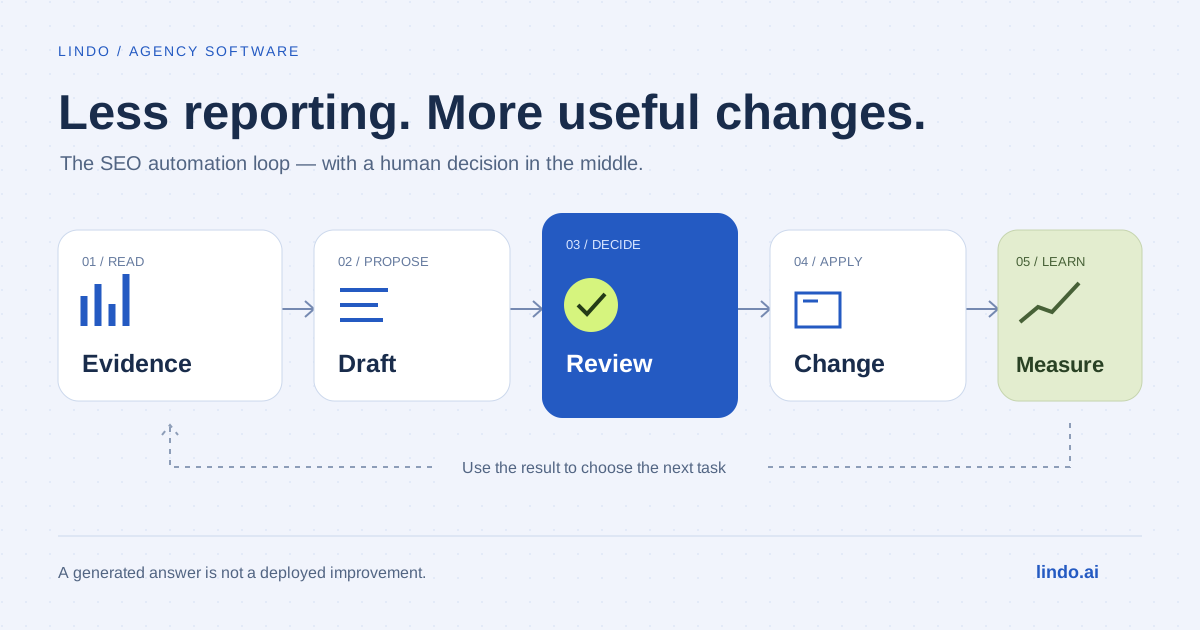
Ask a vendor to show one complete task on a representative page: the evidence it read, the decision it made, the exact proposed change, who approves it, where it is applied and how the result is checked. If the demonstration ends at a paragraph of advice, budget for the execution work that remains. If it publishes immediately, ask what prevents a wrong or stale change.
Liftaven: a practical shortlist for improving existing websites
Liftaven brings website context, Google Search Console and Google Analytics into an SEO workspace with research, documents and proposed website changes. Its public product description lists GitHub, Webflow, WordPress.com and Lindo connections. The useful buying question is whether that connection can support the particular improvement you need—not simply whether your platform’s logo appears on the page.
Consider a small agency maintaining a handful of service websites. The team does not necessarily need another hundred article ideas. It needs to understand why a commercially important page appears for the wrong searches, whether the content answers the intended query and what a safe next revision would look like. That is the workflow we would pilot with Liftaven.
Our source review found separate reporting tools, current-page reads, saved documents and a proposal step. The implementation distinguishes preparing a change from applying one: a proposal records the before and after content for review. It also checks whether the target has changed before application. These are useful design boundaries, although reading the implementation is not a substitute for testing your live connection.
What to ask it to do
Use a bounded request: “Find one existing service page worth improving. Explain the page and query evidence, read its current content, and prepare one relevant change for review.” Give it the business goal and target market. Do not ask it to rewrite every page or maximize a score. A defensible recommendation may be to preserve a page, investigate tracking or collect more evidence instead.
For a site built in Lindo, keep website construction and ongoing SEO analysis distinct. Lindo builds and manages the website; Liftaven can be evaluated for the connected improvement workflow. A reporting connection is not blanket permission to edit. Review the actual editable fields, target page and proposed values before approving anything.
Where its boundaries matter
Liftaven documents opt-in reviews every three days, covering the homepage and up to seven linked pages. That is a sample, not a complete crawl of a large site. It describes article output as drafts and GitHub changes as pull requests requiring review. A team with thousands of URLs still needs an appropriate crawling and prioritization process. A review cadence is not a promised time to rank.
WordPress.com eligibility is also different from universal compatibility with self-hosted WordPress. With Webflow, checking that metadata was staged is different from checking that it was published. With GitHub, an opened pull request is different from a merged and deployed change. Include these handoffs in your pilot so your client receives a finished improvement rather than another pending task.
Budget: The public site lists monthly plans at $29 for one website and 100 credits, $49 for three websites and 200 credits, and $79 for ten websites and 400 credits. Confirm current allowances and billing before choosing a plan. More connected websites do not remove the need for someone to review the work. Liftaven product and plan details ↗
Our take: Put Liftaven on your shortlist when you want evidence and proposed website edits in one workflow. Do not treat it as a replacement for a full technical audit, editorial expertise or a tested publishing process. Its fit should be demonstrated with one useful approved change on the stack you actually maintain.
Search Atlas / OTTO: evaluate the deployment layer
Search Atlas describes OTTO as an execution-focused system covering technical and on-page optimization, with deployment options and an approval mode. Its documentation discusses changes to titles, structured data, headings and links, alongside controls for reviewing and rolling back optimizations. That breadth makes it relevant when an agency’s recurring problem is getting approved SEO work implemented across websites.
The most valuable demonstration is not a dashboard full of fixed issues. Ask to inspect a change on your exact hosting setup, confirm how it reaches the served page and understand what remains if you disable the connection. Check approval settings before enabling automation. Vendor language about instant indexing is not evidence that a search engine will index every submitted URL.
Pilot task: Choose one non-critical page with a verified metadata problem. Record the original, review the proposed fix, inspect the live result and demonstrate rollback. Ask for current pricing against your actual site count and deployment requirements. Do not compare an entry-plan headline with a fully configured agency rollout.
Frase: a shortlist for a content team with a backlog
Frase combines research, drafting, optimization and publishing workflows. Its Content Guard offering monitors published content for decline and prepares revisions; its AI Visibility feature is a separate measurement capability. Those distinctions matter: knowing a page is slipping, drafting a replacement and observing an AI mention are not the same event.
We would evaluate it when a team already has an editorial owner but needs a more repeatable path from topic research to a reviewed article. Supply an actual brief, source material and examples of the client’s voice. Reject a polished draft if it introduces unsupported claims or merely restates competing pages. Research assistance should leave more time for original information, not remove it from the process.
Budget and scope: The reviewed pricing page lists Starter at $49 month to month, or $39 per month billed yearly, with one site, one seat and monthly content/audit limits. Professional and Scale expand capacity; white-label features are listed under Enterprise. Check monitored-page allowances, seats and publishing permissions as well as article counts.
Pilot task: Refresh one existing guide using original customer questions and product evidence. Inspect what changed, have the subject-matter owner review it and test the CMS handoff. Keep automatic publishing disabled until you have agreed which content types can safely bypass individual approval.
AirOps: for teams ready to design the process
AirOps Workflows connect inputs, research, AI steps, review and publishing in an explicit sequence. Its documentation distinguishes those workflows from natural-language Playbooks and describes Grids for running work across rows. This is a different buying proposition from asking a ready-made assistant a single SEO question: you are also choosing a way to define and operate the process.
That can suit an agency with a repeatable brief, a content inventory and a named editor. For example, an existing-page refresh could collect source material, identify outdated sections, prepare revisions and route them for review. The opportunity is consistency across repeated work; the risk is running an imperfect process across many pages before anyone spots the mistake.
Pilot task: Run the same workflow on three deliberately different pages: one that needs a factual correction, one that needs restructuring and one that should remain unchanged. Record setup time, intervention time and rejected output. Check the current plan and usage model against realistic runs, including retries. A flexible system is not automatically a low-maintenance one.
Surfer: include it when the editor is still in charge
Surfer belongs in this comparison as an adjacent optimization platform, not as proof that every SEO tool is an autonomous agent. Its Content Editor is relevant when a writer is actively improving a page and wants guidance about coverage. This may be enough if your publishing process already works and your bottleneck is the quality of briefs or revisions.
A content recommendation is an input to judgment. Adding a suggested phrase can make a page less clear if it does not match the reader’s task. A higher tool score is not a ranking, a qualified lead or evidence that the page now contains a better answer. Preserve useful examples, product-specific details and the terminology your actual audience uses.
Pilot task: Have an editor revise one guide with the tool, then review the result against the original brief without looking at the score. Ask whether the answer became more accurate, easier to use and better supported. Evaluate the current package separately for any monitoring, automation or publishing capabilities you require; do not infer them from the editor alone.
An agency page gets impressions but few inquiries. What should the agent do?
Imagine a local service website whose commercial page received 6,000 impressions and 42 clicks during a 28-day period. That is a 0.7% click-through rate. Its report also shows an average position of 18. Neither figure alone proves the title is bad. The page could be appearing below the first results, matching the wrong query mix or serving a seasonal audience.
Before rewriting it, separate the searches about buying the service from informational questions. Then compare the relevant group with a comparable previous period, using the same country and device filters. Read the page itself. Does it actually offer the service those people want? Is the location clear? Is the contact action usable? An agent should help resolve these questions, not jump straight to a more dramatic headline.
| Observation | Useful next step | Do not conclude |
|---|---|---|
| Impressions rise; clicks stay flat | Inspect new queries, pages and positions | The recent content edit caused the change |
| Relevant queries reach a vague page | Draft a clearer answer and service description | A longer page will necessarily perform better |
| A useful revision is approved | Check the live page and record the change date | An approved draft has already been deployed |
| Clicks improve after the revision | Review query mix and qualified inquiries | All improvement was caused by the agent |
Suppose the evidence supports a clearer title and one missing section explaining service coverage. Preserve the useful FAQ and the existing URL. Prepare the exact change, have the business confirm the claim, then publish through the approved route. Record a review date without promising a result by that date. The deliverable is a justified improvement and a measurement plan, not a guaranteed increase in traffic.
Run a two-week workflow pilot, not a two-week ranking contest
Two weeks can reveal whether a tool fits your process. It usually cannot establish the long-term SEO impact of a handful of edits. Separate the operational decision—can we use this safely and economically?—from the search-performance question, which needs enough comparable data and may remain uncertain.
Start with three pages: one commercial page, one established guide and one page that appears healthy. The healthy page is a useful control for the tool’s judgment. A system that always recommends a rewrite may be optimizing for activity rather than necessity. Ask it to explain what it would preserve and why.
Keep an evidence ledger: record the affected URL, query group, dates, current content, proposed change, reason, reviewer and publishing status. Include the missing evidence. An unavailable report is not a zero. A sampled audit is not a site-wide clean bill of health. If two data sources count different things, keep them separate rather than inventing a combined traffic total.
Price the completed work: include subscription cost, setup, review time and rework. An illustrative $49 subscription plus two hours of review at an internal $60 hourly cost is $169 before other expenses. If that produces four accepted changes, the cost is $42.25 per accepted change. Those are example inputs, not measured Liftaven or competitor economics. Replace them with your own numbers and compare equivalent work.
Set a stop condition: pause if the tool cannot identify its evidence, proposes unsupported claims, overwrites useful information or needs more correction than the original task. A failed pilot is useful information. Do not solve weak output by approving larger batches.
For agencies, connect this process to a clearly scoped maintenance offer. Specify which pages you review, what changes need client sign-off and how results are reported. The website management software guide covers the wider operational choice; this pilot evaluates the SEO improvement part.
What about GEO, AEO and visibility in AI answers?
Use these labels to describe the discovery channels you want to understand, not as permission to manufacture hundreds of near-identical answers. A useful agency page should answer a real question, state the conditions behind its recommendation and provide evidence a reader can inspect. A clear comparison table can help; a table full of invented superiority claims cannot.
Google’s guidance for AI features says its usual SEO practices remain relevant and that no special optimization is required for inclusion in AI Overviews or AI Mode. That is guidance about Google, not a promise about every answer engine. Do not sell a special schema or file as guaranteed admission to AI recommendations.
For your pilot, keep three separate records: observed citations or mentions for a defined prompt set, identifiable AI referral visits, and qualified outcomes from those visits. A citation does not necessarily produce a click; a click does not necessarily produce a lead. Compare repeated observations with their dates and context, and treat attribution gaps honestly.
The durable content task is still concrete: explain the service or product accurately, answer follow-up questions, demonstrate the process with original material and make the next step useful. An SEO agent can help with research and maintenance. It cannot manufacture expertise your business has not supplied.
Your AI SEO agent pilot worksheet
Use this for your own pilot. Notes stay in this page session and are not sent to us. Download before leaving; reloading clears the worksheet.
Questions before choosing an AI SEO agent
What is the best AI SEO agent for a small agency?
Start with the agency’s bottleneck. Shortlist Liftaven for connected-data analysis and reviewable changes to supported websites, Search Atlas for broader on-site automation, Frase for a content operation, and AirOps for custom repeatable workflows. Surfer is also worth comparing when writers need optimization assistance. These are fit-based recommendations, not measured performance rankings.
Can an AI SEO agent improve an existing website?
Yes, tools in this category can research existing pages, prepare revisions and, with compatible connections and permissions, help apply changes. The exact editable fields and publishing steps vary. Test one reversible change on your own stack before authorizing broader work.
Does connecting Search Console let an agent edit my site?
No. Reporting access and website-editing access are separate. Search Console data can inform a recommendation, but applying it requires an appropriate website or repository connection and the relevant authorization.
Will an SEO agent get my website cited by ChatGPT or Google AI?
No tool can guarantee a citation. Useful, accessible, well-supported content is a better objective than a promised AI score. Track observed mentions, referral traffic and qualified conversions separately; they measure different things.
Should I replace my SEO specialist with an agent?
Use automation to reduce repeatable research and execution work. Keep a person accountable for business priorities, factual accuracy, sensitive claims, publishing decisions and interpreting results. A finished draft is not a verified strategy.
Sources and review method
Reviewed October 2, 2026. We compared workflow scope, approval boundaries, implementation paths and agency fit using the sources below. Liftaven’s supplied implementation was also inspected; unshipped code is not evidence that a live feature works. We did not run paid-account benchmarks for these five tools, award numerical ratings or verify vendor performance testimonials. Plans and capabilities can change.
Try the evidence-to-change workflow.
If connected reports and reviewed website edits match your bottleneck, evaluate Liftaven with one real page. Keep the worksheet, verify the connection and decide from the work you can actually use.