The short answer
Connect a verified problem to a specific deliverable and a test. List what stays, what changes, who supplies each input, and what is excluded. Separate the project fee from ongoing costs, and make timing conditional on named approvals.
- A good fit
- A service-business redesign with a known owner, a defined customer task, and enough discovery to identify the current site’s dependencies.
- Pause if
- You have not checked the existing site or the buyer needs an application, complex commerce, or an integration you have not validated. Scope discovery before quoting the build.
1. Do enough discovery to know what must not break
A redesign is not only a visual replacement. Inventory the existing URLs, service descriptions, contact routes, forms, downloads, tracking, integrations, and account owners. Ask which pages customers or partners already use. A page with modest traffic can still be an important referral destination.
Record the current problem as an observation and the hoped-for business effect as a hypothesis. ‘The service page does not state the approved service area’ is testable. ‘A new site will double leads’ is not a delivery commitment you can infer from that observation. If access or dependencies are unknown, quote a discovery phase or state the unresolved assumption.
2. Put the decision on the first page
Open with the client’s situation, the primary customer action, the proposed first release, the fee basis, and the conditions needed to begin. Keep this summary consistent with the detailed scope. An optional booking integration should not appear as included in the opening pitch.
The example below is fictional and contains no real client results or market-price benchmark. Replace every assumption after discovery. For a new website rather than a redesign, replace the preservation inventory with domain, content, and operating requirements; do not invent a migration that is not needed.
Purpose: help referred homeowners understand garden-design services and submit a suitable project enquiry.
First release: Home, Garden Design, Projects, Contact.
Preserve: approved service facts, domain ownership, and useful existing URLs where practical.
Change: service-area explanation, project captions, enquiry instructions.
Not included: booking software, payments, ongoing articles, multilingual content.
Schedule: agreed after approved content and required account access are available.
Fee: insert the agreed project amount, currency, and treatment of ongoing costs.
Decision requested: approve scope and responsibilities, resolve open dependencies, then agree commercial terms.
3. Scope pages and journeys, not ‘a modern website’
List the content and behavior of each deliverable. ‘Four pages’ alone does not explain whether you are writing copy, sourcing images, configuring a form, or migrating 40 project records. A page inventory and a visitor journey make those differences visible.
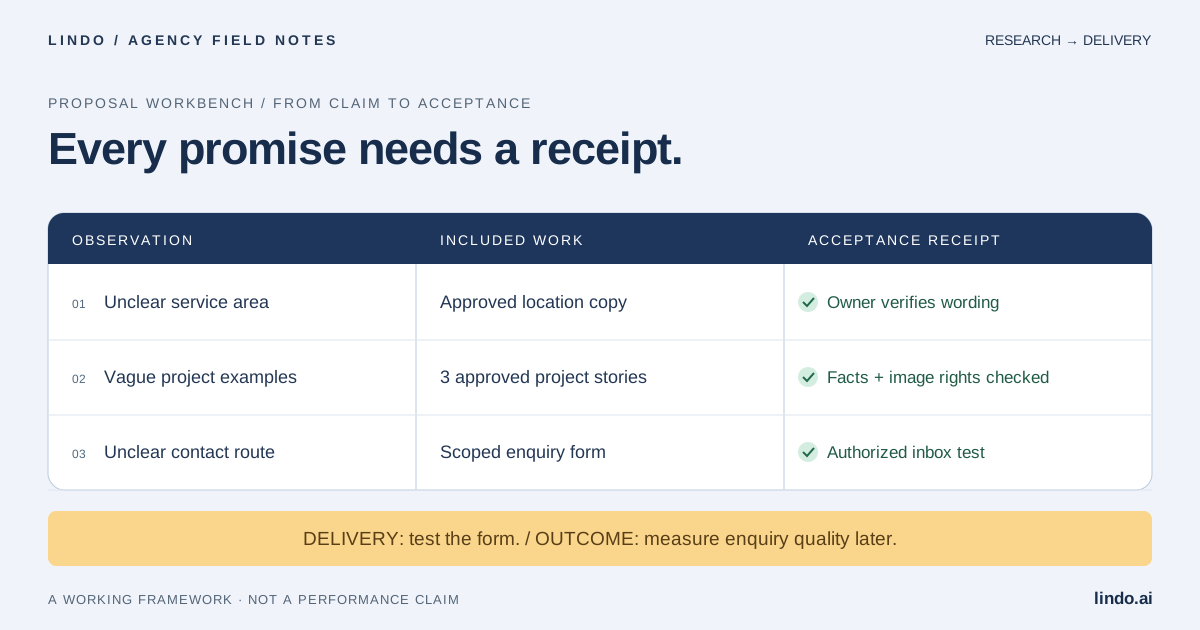
For each item, name the client input and the acceptance test. Keep the content quantity bounded: for example, three approved project summaries, not ‘portfolio migration’ with an unknown record count. Any quantities below belong to this fictional example, not a recommended universal package.
Primary documentation: W3C: accessible forms
| Deliverable | Client input | Acceptance evidence |
|---|---|---|
| Home: offer and service-area summary | Approved positioning and contact details | Owner confirms wording and CTA destination |
| Garden Design: service, process, enquiry CTA | Approved scope and exclusions | Visitor can identify project fit and next step |
| Projects: three project summaries | Licensed photos and factual captions | All three records match approved source material |
| Contact: agreed enquiry fields and delivery | Recipient and privacy wording | Authorized test reaches the recipient; errors are clear |
| URL preservation and agreed redirects | Existing URL inventory and access | Kept URLs load; changed URLs reach relevant destinations |
4. Make migration and SEO preservation explicit
Separate a design refresh from a platform or URL migration. Confirm which URLs remain unchanged and map intentional moves to relevant destinations. Include metadata, canonical URLs, indexability, sitemap updates, internal links, and authorized analytics verification in the scope where applicable. Define who implements redirects and who checks them after deployment.
Preserving these signals reduces avoidable disruption; it does not guarantee stable rankings. Google’s site-move guidance recommends URL mapping and monitoring, and notes that processing a move takes time. Keep domain cutover, email records, and rollback ownership visible. Do not cancel the old platform or change billing merely because the new design is approved.
Primary documentation: Google Search Central: site moves with URL changes
5. Separate project scope, recurring costs, and options
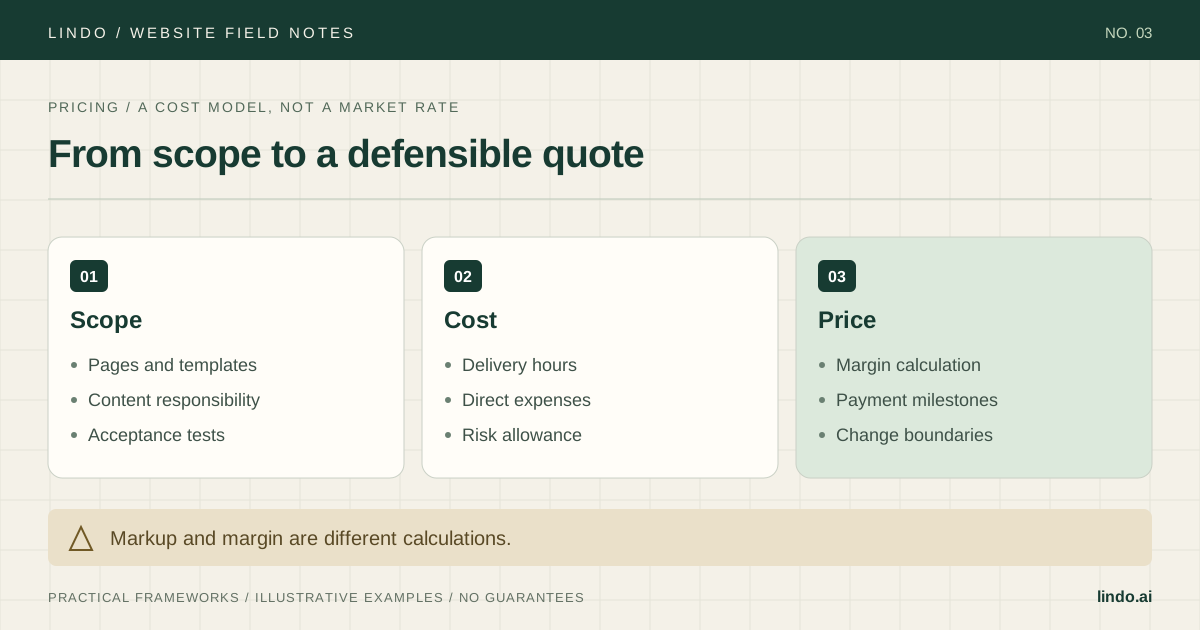
State the project amount and currency you have agreed, then list hosting, domain renewal, paid services, and optional care work separately with the responsible account owner. Do not silently include platform subscriptions inside a one-time figure or represent a client-supplied fee as an automated market estimate.
Use a dependency-based schedule: content approval, first draft, consolidated review, acceptance, then launch. Name the approver and what happens if inputs arrive late. Describe the included review rounds by what can change; distinguish corrections within scope from added pages, integrations, or a new direction.
Payment terms, tax treatment, intellectual-property terms, privacy responsibilities, and termination provisions need an appropriate agreement and review for the parties involved. This guide and the worksheet organize delivery scope; they are not a ready-made legal contract.
Project fee / currency:
Included pages, records, and review rounds:
Ongoing services / estimated cost source / payer:
Optional work / separate approval needed:
Content deadline / named approver:
Draft milestone begins after:
Review window and consolidated feedback owner:
Launch prerequisites:
Change request: description → impact → written approval before work
Commercial agreement and unresolved terms:
6. Agree launch acceptance before the final review
Ask the client to approve concrete evidence: accurate business facts, readable mobile layouts, usable navigation, labeled form inputs, understandable validation errors, and authorized delivery to the correct recipient. Agree the representative devices and browsers you will check. ‘Works everywhere’ is not a bounded test plan.
Record the production URL, tester, date, expected behavior, result, and any accepted exception. A preview form test is not proof that the production inbox works after the domain changes. Give the client an operating note covering edits, access, renewals, support, and the next review.
Track business outcomes separately after launch. Define a qualified enquiry with the owner and record any available baseline, period, traffic mix, and follow-up process. Do not label a new visual design a conversion win without comparable evidence.
| Test | Evidence | Owner |
|---|---|---|
| Contact submission and validation | Authorized test received; required-field errors checked | Agency tester + client recipient |
| Mobile service-to-contact journey | Device/browser and observed result | Agency tester |
| URLs and search access | URL map results, canonical/indexability checks | Technical owner |
| Routine edit and account access | Client performs an approved content update | Client editor |
| Unresolved exception | Impact, approver, responsible person, next date | Named decision owner |
7. Create the draft, then remove every unsupported promise
The free proposal worksheet linked below assembles your own inputs into an editable draft in the browser. It does not research the client, calculate a market price, create legal terms, or send a proposal. Copy or download the text, replace placeholders, and review it with the client before agreeing the work.
Read the proposal as the person who will deliver it. Can you identify every included page and content quantity? Does each integration have a validated owner and test? Are placeholders still presented as facts? Does a business-outcome hope accidentally read like a guarantee? Resolve those questions before asking for approval.
Take it into the project
Website redesign proposal scope and acceptance worksheet
Copy this into your project brief, assign an owner to each item, and attach evidence before marking it complete. No email required.
- The problem is verified and the intended customer action is stated.
- Pages, content quantities, and visitor journeys are bounded.
- Existing URLs and dependencies have owners.
- Fees, ongoing costs, exclusions, and optional work are separated.
- Schedule depends on named inputs and approvals.
- Each deliverable has an acceptance test.
- Production handoff and unresolved exceptions are recorded.
- Commercial terms are reviewed separately; no ranking or revenue guarantees are implied.
A fictional four-page example, scope-to-test matrix, commercial fields, and handoff checklist to adapt after discovery.
Common questions
What should a website redesign proposal include?
Include the verified problem, intended customer action, page-level scope, migration requirements, responsibilities, fees and ongoing costs, schedule dependencies, exclusions, acceptance tests, and the decision requested. Keep legal and commercial terms separately reviewed.
How is a redesign proposal different from a new website proposal?
A redesign must account for an existing asset: URLs, content, search visibility, integrations, tracking, access, and current customer journeys. State what will be preserved, changed, or retired.
Should SEO be included in the redesign price?
State the exact SEO work and its fee basis. URL mapping and indexability checks are different from ongoing content or link campaigns. Do not let a generic SEO label imply rankings or unspecified recurring work.
Is the free proposal generator an AI writer or a contract?
Neither. It assembles your project inputs into an editable scope draft in the browser. It does not verify facts, supply legal terms, estimate market prices, or send anything to the client.